Cudos or Kudos: Correct Spelling, Meaning, and Easy Ways to Remember It
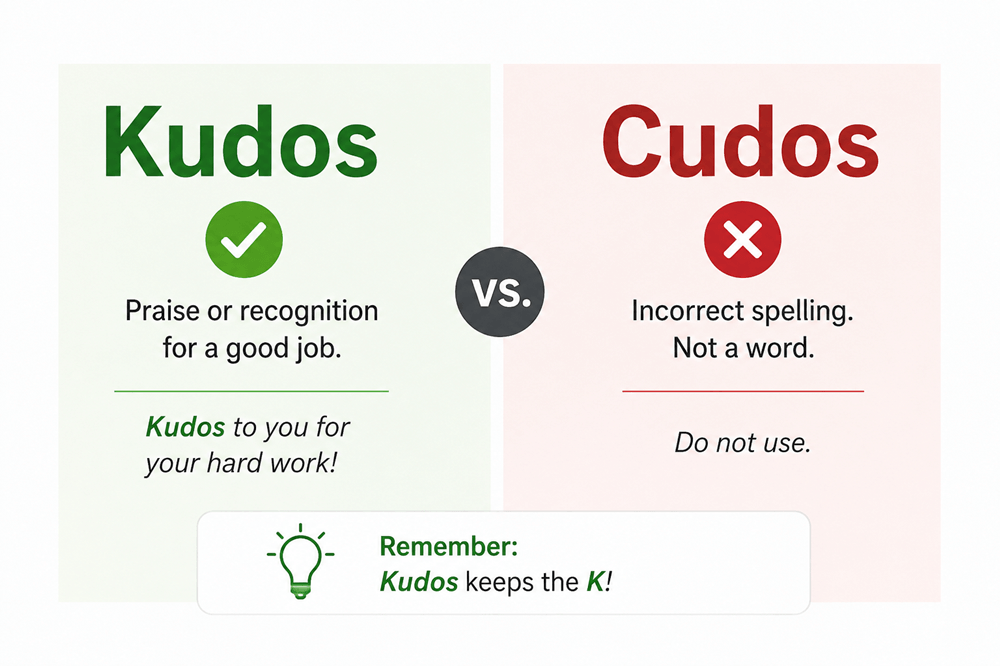
If you are choosing between cudos or kudos, the correct spelling is kudos. The word cudos is a common misspelling, but it is not accepted in standard English. You use kudos when giving praise, credit, or recognition for something done well.
Cudos or Kudos: Which One Is Correct?
The correct spelling is kudos.
Cudos is incorrect. It may look believable because many English words use the letter c for a hard “k” sound, as in cat, credit, coffee, and classic. Since kudos begins with the same hard sound, it is easy to assume that the word should begin with c. But in this case, English keeps the k.
You should write:
Correct: Kudos to you for finishing the project early.
Incorrect: Cudos to you for finishing the project early.
Once you know the correct form, the mistake becomes easier to spot. The word should always begin with ku-, not cu-.
What Does Kudos Mean?
Kudos means praise, honor, credit, admiration, or recognition. When you give someone kudos, you are acknowledging that they did something impressive, helpful, brave, thoughtful, creative, or successful.
For example:
Kudos to everyone who helped organize the event.
This means everyone who helped deserves praise or appreciation.
You might also say:
She deserves kudos for speaking honestly during a difficult moment.
Here, kudos means she deserves respect and recognition for what she did.
The word is often used in friendly, professional, academic, and casual writing. It sounds positive without being too emotional. That makes it useful in emails, comments, articles, speeches, workplace messages, school writing, and everyday conversation.
Why Cudos Looks Like It Could Be Right
The misspelling cudos usually happens because of sound. The first sound in kudos is the same sound you hear at the beginning of cool, credit, care, and cute. Since all of those words begin with c, your brain may reach for the more familiar spelling pattern.
There is also another reason cudos looks tempting: the word is not spelled the way many short English praise words are spelled. Words like credit, compliment, and congratulations all begin with c. Because kudos belongs to the same general idea of praise, people sometimes expect it to follow the same spelling style.
But kudos has its own spelling. You do not need to change it to match similar words. The correct word is always kudos.
How to Remember the Spelling of Kudos
The simplest memory trick is this:
Kudos starts with K because it is a kind word.
That small phrase connects the letter k with the positive meaning of the word. When you are giving someone praise, you are usually saying something kind. So you can remember:
Kind words deserve kudos.
Both kind and kudos begin with k. That gives your memory a clear anchor.
Another useful trick is to picture the word as two parts:
ku + dos = kudos
The beginning is not cu. It is ku. If you train your eye to notice that first pair of letters, the spelling becomes easier to remember.
You can also connect kudos with the phrase:
Kudos keeps the K.
This is short, direct, and easy to repeat when you are typing. If you are about to write cudos, pause and remind yourself that kudos keeps the K.
Is Kudos Singular or Plural?
Kudos can be confusing because it looks plural. Many English words ending in -s are plural, such as dogs, books, chairs, and ideas. Because kudos ends in s, some people assume it means multiple “kudo” items.
In modern everyday English, kudos is usually treated as a singular mass noun. That means it works more like praise, respect, or credit. You do not usually count it one by one.
You would normally say:
She deserves kudos for her hard work.
Not:
She deserves many kudos for her hard work.
People sometimes say a kudo informally, but kudos is the standard form you will usually need. In polished writing, it is safer to use kudos as the complete word.
Common Phrases With Kudos
You will often see kudos in a few common sentence patterns. Learning these phrases can help you remember both the spelling and the meaning.
Kudos to you means “you deserve praise.”
Example: Kudos to you for staying calm under pressure.
Kudos to everyone is used when praising a group.
Example: Kudos to everyone who helped make the event successful.
Give kudos means to give praise or recognition.
Example: You should give kudos to the team for solving the problem quickly.
Deserve kudos means to be worthy of praise.
Example: He deserves kudos for admitting the mistake and fixing it.
Earn kudos means to gain praise through action.
Example: The designer earned kudos for creating a clean, user-friendly layout.
In every phrase, the spelling stays the same: kudos.
Cudos vs Kudos in Example Sentences
Seeing the correct and incorrect spellings side by side can make the difference easier to remember.
Correct: Kudos to the volunteers who stayed late.
Incorrect: Cudos to the volunteers who stayed late.
Correct: You deserve kudos for handling that conversation so well.
Incorrect: You deserve cudos for handling that conversation so well.
Correct: The teacher gave kudos to the students for their effort.
Incorrect: The teacher gave cudos to the students for their effort.
Correct: Kudos for being honest when it was difficult.
Incorrect: Cudos for being honest when it was difficult.
Correct: The whole team earned kudos after the successful launch.
Incorrect: The whole team earned cudos after the successful launch.
The correction is simple: replace cudos with kudos.
How to Use Kudos Naturally
Kudos is positive, but it can sound slightly polished or formal depending on the sentence. It is common in workplaces, classrooms, online comments, newsletters, and public praise. It works well when you want to recognize someone without sounding overly dramatic.
For example, in a professional email, you could write:
Kudos to the team for completing the report ahead of schedule.
That sounds appreciative and professional.
In casual conversation, you could say:
Kudos for keeping your promise.
That sounds friendly and direct.
In a social media caption, you might write:
Kudos to everyone who showed up and supported the cause.
That sounds warm and public without being too formal.
The word is especially useful when you want to praise effort, not just results. You can give kudos for patience, honesty, courage, persistence, creativity, leadership, teamwork, or kindness.
What to Use Instead of Kudos
If kudos does not fit the tone of your sentence, you can use a simpler alternative. Good replacements include praise, credit, recognition, respect, appreciation, congratulations, or compliments.
For example:
Kudos to her for helping.
You could also write:
Credit to her for helping.
Or:
She deserves recognition for helping.
These alternatives are useful, but they do not change the spelling rule. When you choose the word kudos, it must be spelled with a k.
The Final Answer on Cudos or Kudos
The correct spelling is kudos. The spelling cudos is a mistake, even though it may seem logical because the word begins with a hard “k” sound.
To remember it, use the phrase kudos keeps the K. You can also connect it with kind words, because both kind and kudos begin with k. When you are giving praise, credit, or recognition, the word you want is always kudos.
So the next time you write a sentence like kudos to you, do not start it with c. Give the word its correct letter, and let kudos keep its k.