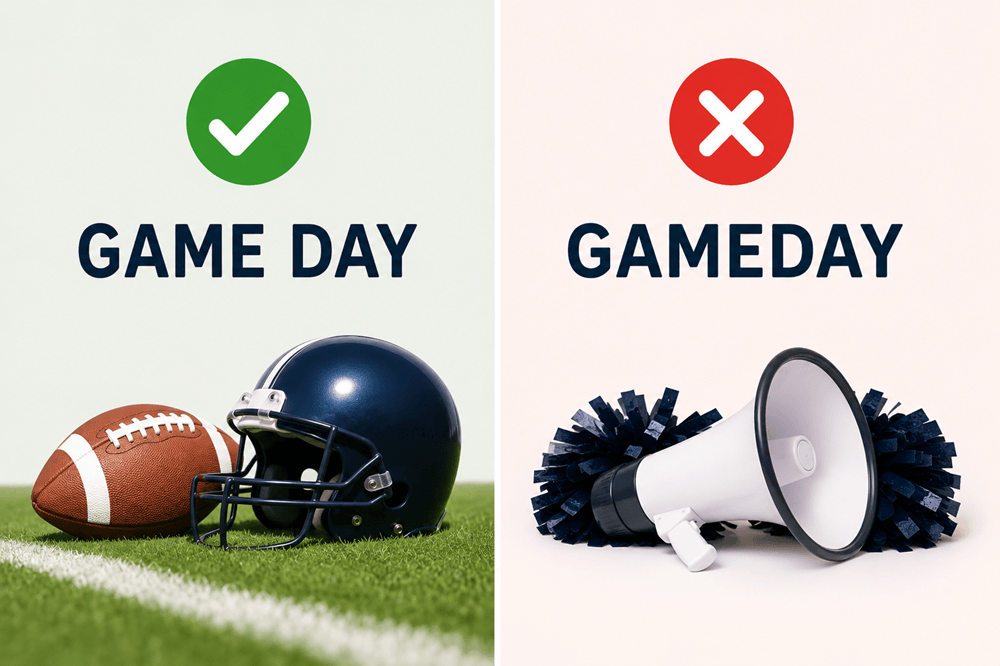
Is Gameday One Word? Game Day vs. Gameday Explained
Game day is traditionally written as two words when referring to the day on which a sports game or competition takes place.
Correct:
- Tomorrow is game day.
- The players arrived early on game day.
- We prepared snacks for game day.
The one-word spelling gameday is also common in sports marketing, social media, brand names, and informal writing. However, game day remains the safer spelling in standard English. Major dictionaries such as Oxford and Collins list the expression as two words.
Quick Answer
Use game day as two words in standard writing:
- game day schedule
- game day preparation
- game day excitement
- on game day
Use gameday when it is part of an official title, brand name, hashtag, or publication style that deliberately joins the words.
A simple memory rule is:
A game takes place on a day, so game day is normally two words.
What Does Game Day Mean?
Game day is the day on which a scheduled sports game or competition takes place.
It may refer to:
- the day of a football game
- the day of a basketball game
- the day of a school competition
- the day of a tournament
- the day of an important sporting event
Examples:
- The stadium becomes crowded on game day.
- Players follow a special routine on game day.
- Everyone wore the team’s colors for game day.
- The coach announced the starting lineup before game day.
- Traffic is usually heavier around the stadium on game day.
The phrase often includes all the activities surrounding the game, not just the competition itself.
Is Gameday a Word?
Gameday is used as a word, particularly in informal sports culture.
You may see it in:
- social media posts
- hashtags
- team slogans
- television program titles
- sports advertisements
- merchandise
- website names
Examples:
- It’s gameday!
- Get your gameday gear ready.
- Follow our gameday coverage.
The meaning is clear, and some informal dictionaries record the closed form. However, traditional dictionary entries and edited prose generally favor game day as two words.
For schoolwork, professional articles, and formal writing, game day is the safest choice.
Game Day vs. Gameday
The difference is mainly one of style.
| Form | Status | Best Use |
|---|---|---|
| Game day | Standard two-word form | Formal and general writing |
| Gameday | Common informal variant | Branding, sports marketing, and social media |
| Game-day | Hyphenated modifier | Before a noun in some edited styles |
Compare:
- The team is ready for game day.
- Check out our gameday collection.
- The coach reviewed the game-day schedule.
All three may be understandable, but they do not always suit the same type of writing.
Game Day as a Noun
Use game day as two words when it functions as a noun phrase.
Examples:
- Game day is finally here.
- We have been preparing for game day all week.
- The weather may affect game day.
- Everyone feels nervous before game day.
- What are your plans for game day?
You can often place a preposition before it:
- on game day
- before game day
- after game day
- during game day
The two-word form is natural in all these expressions.
Game Day Before Another Noun
The phrase often appears before another noun:
- game day schedule
- game day routine
- game day meal
- game day experience
- game day tickets
- game day clothing
Many publications leave game day open in these phrases:
- The players followed their game day routine.
- We checked the game day schedule.
- She prepared a special game day meal.
Some edited styles use a hyphen to show that the two words work together as a modifier:
- game-day routine
- game-day schedule
- game-day preparations
Both styles can appear. The important point is to follow one consistent style.
For most general website writing, the open form is simple and readable:
game day schedule
Is Game-Day Hyphenated?
Game-day may be hyphenated when it appears directly before a noun as a compound adjective.
Examples:
- game-day preparations
- game-day traditions
- game-day transportation
- game-day excitement
The hyphen shows that game and day work together to describe the following noun.
However, the hyphen disappears when the phrase stands alone:
- Our game-day preparations began early.
- We began preparing early for game day.
Some modern publishers omit the hyphen even before a noun. Therefore, check the style used by your school, company, or publication.
Is It “Game Day” or “Game Night”?
Both phrases are correct, but they describe different times.
Game day refers to the day of a competition:
- The team travels on game day.
Game night may refer to:
- a sporting event held at night
- an evening when friends or family play games
Examples:
- Friday is game night at the stadium.
- We host a family game night every month.
Both expressions are normally written as two words.
Is It “It’s Game Day” or “It’s Gameday”?
The standard form is:
It’s game day.
This means that the day of the game has arrived.
Example:
- Put on your jersey—it’s game day!
The version It’s gameday! is common in enthusiastic social media captions, promotional slogans, and merchandise. It is understandable but more informal.
For an article or school assignment, choose:
It’s game day.
Is It Game Day Ready or Gameday Ready?
The clearest standard phrase is:
game-day ready
Example:
- The players are game-day ready.
The hyphens connect the words when the entire phrase acts as an adjective.
You might also write:
- The players are ready for game day.
This version sounds natural and avoids complicated hyphenation.
The closed form gameday ready is common in advertising but is less traditional.
Is It Game Day Outfit or Gameday Outfit?
The standard form is:
game day outfit
Example:
- She planned her game day outfit in advance.
A retailer or sports brand may use:
gameday outfit
This closed form can make a slogan or product category appear shorter and more distinctive.
For ordinary writing, use game day outfit.
Is It Game Day Food or Gameday Food?
Use:
game day food
Examples:
- We prepared several game day foods.
- Nachos are popular game day food.
- The article contains easy game day recipes.
The form gameday food may appear in marketing copy, but two words are safer in standard prose.
Is It Game Day Experience or Gameday Experience?
The standard form is:
game day experience
Examples:
- Music is an important part of the game day experience.
- The stadium improved its game day experience.
- Fans praised the complete game day experience.
A company may use gameday experience as part of branded language, but that does not change the general spelling rule.
Is Game Day Capitalized?
Usually, no.
Write game day in lowercase when it is a general phrase:
- Tomorrow is game day.
- The game day schedule has changed.
- We arrived early on game day.
Capitalize it at the beginning of a sentence:
- Game day begins with a team breakfast.
It may also be capitalized when it is part of an official title, event name, program, or brand:
- Community Game Day
- Championship Game Day
Do not capitalize it simply because the game is important.
What Is the Plural of Game Day?
The plural is:
game days
Examples:
- The restaurant is busiest on game days.
- Players follow different routines on home and away game days.
- Traffic increases during major game days.
If a brand deliberately uses gameday, its plural may be gamedays, but the standard open form is more natural in general writing.
Why Do People Write Gameday?
English compound words often move from open to closed forms over time.
For example:
- web site became website
- base ball became baseball
- basket ball became basketball
Because game day is used so frequently in sports, some writers naturally combine it into gameday.
Sports organizations and advertisers may also prefer the one-word form because it:
- looks compact
- works well in logos
- fits easily into hashtags
- feels energetic
- can serve as a brand name
This does not necessarily make the one-word spelling wrong in every context. It simply makes it less traditional than game day.
Common Mistakes
Joining the words in formal writing
Less standard:
- Tomorrow is gameday.
Preferred:
- Tomorrow is game day.
Adding an unnecessary apostrophe
Incorrect:
- Tomorrow is game day’s.
Correct:
- Tomorrow is game day.
Use the apostrophe only for possession:
- The game day’s biggest surprise was the weather.
That construction is grammatically possible, although a clearer rewrite may be better:
- The biggest surprise of game day was the weather.
Inconsistent spelling
Inconsistent:
- Our game day schedule includes complete gameday coverage.
Consistent:
- Our game day schedule includes complete game day coverage.
Capitalizing the general phrase
Incorrect:
- We are ready for Game Day.
Correct:
- We are ready for game day.
Capitalize it only when it is part of an official name or title.
How to Remember the Spelling
Think of similar time phrases:
- school day
- work day
- election day
- practice day
- game day
These expressions usually remain separate because one word describes the type of day.
A useful memory sentence is:
The game happens on a day, so game day has a space.
You can also remember:
Use game day in sentences and gameday only when a brand or title chooses it.
Final Answer
Game day is normally written as two words in standard English.
Examples:
- Tomorrow is game day.
- The players arrived early on game day.
- We reviewed the game day schedule.
Gameday is a common informal spelling used in sports marketing, social media, hashtags, program titles, and brand names.
For formal and general writing, choose:
game day
Remember:
A game takes place on a day, so game day is usually two words.