
What Is This Word? How to Identify an Unfamiliar Word
The question “What is this word?” usually means that someone has seen or heard a word they do not recognize and wants to know its spelling, pronunciation, meaning, or use.
The best way to identify an unfamiliar word depends on where you found it.
You may need to:
- examine the surrounding sentence
- sound the word out
- check its spelling
- look for prefixes and suffixes
- use a dictionary
- search from an image or description
A word is usually easier to identify when you have context.
Quick Answer
To identify an unfamiliar word:
- Copy the word exactly if it is written.
- Read the sentence around it.
- Look for familiar word parts.
- Try pronouncing it in smaller sections.
- Check a reliable dictionary.
- Confirm that the definition fits the original context.
If you only heard the word, write down how it sounded and note the sentence in which it was used.
What Does “What Is This Word?” Mean?
The question can ask for several different kinds of information.
It may mean:
- How is this word pronounced?
- What does this word mean?
- How is this word spelled?
- Is this a real word?
- What word is shown in this picture?
- What word did someone say?
- Which word belongs in this sentence?
For example, if someone points to colonel and asks, “What is this word?” they may be asking how to pronounce it.
If someone hears a word that sounds like their, they may be asking whether it is spelled:
- their
- there
- they’re
Understanding the type of problem helps you find the right answer.
How to Identify a Written Word
If you can see the word clearly, copy it exactly.
Pay attention to:
- capital letters
- apostrophes
- hyphens
- repeated letters
- similar-looking letters
- spaces between words
For example:
- everyday
- every day
These forms look similar but have different grammatical uses.
Likewise:
- its
- it’s
An apostrophe changes the meaning.
Copying the original spelling carefully prevents you from searching for the wrong word.
Use the Sentence for Context
A word’s surrounding sentence often provides its strongest clue.
Consider this sentence:
- The desert climate was extremely arid.
Even if you do not know arid, the words desert climate suggest that it probably means dry.
Now consider:
- She gave a brief explanation.
The noun explanation helps show that brief means short.
Ask these questions:
- Is the word describing a person, place, thing, or action?
- Does the sentence sound positive or negative?
- Is the word connected to time, size, emotion, or movement?
- What meaning would make the sentence logical?
Context may not give you a complete definition, but it can narrow the possibilities.
Look for Prefixes and Suffixes
Many unfamiliar words contain recognizable parts.
A prefix appears at the beginning of a word.
Examples:
- un- means not
- re- means again
- pre- means before
- mis- means wrongly
A suffix appears at the end.
Examples:
- -less means without
- -ful means full of
- -er may mean a person who
- -ness means a state or quality
Consider the word carelessness:
- care
- -less
- -ness
It means the state or quality of being without enough care.
Breaking a word into parts can reveal its general meaning before you open a dictionary.
Find the Root Word
The root carries the main meaning.
Examples:
- helpful → help
- unreadable → read
- movement → move
- disagreement → agree
If you recognize the root, the unfamiliar form becomes easier to understand.
For example:
reusable
- re- = again
- use = root
- -able = capable of
The word means capable of being used again.
This method is especially useful for longer academic and technical words.
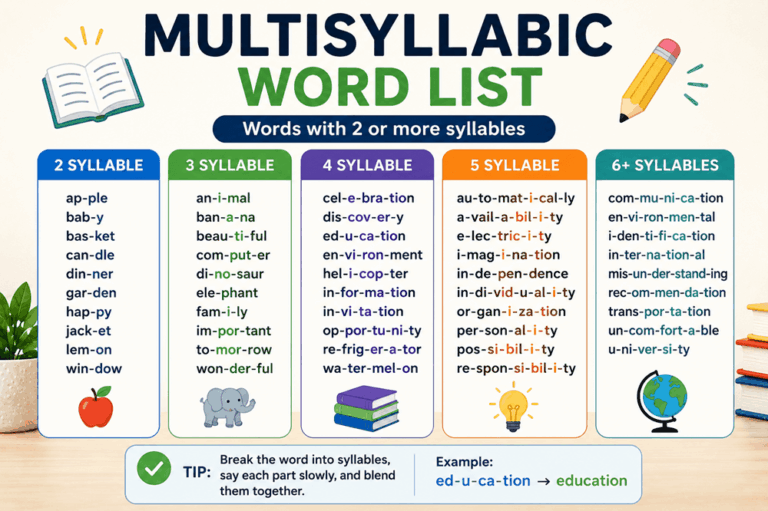
How to Sound Out an Unfamiliar Word
Divide the word into smaller sections.
For example:
unbelievable
Break it into:
un + be + liev + a + ble
Then say each part slowly before combining them.
You can also look for familiar letter groups:
- tion often sounds like “shun”
- ph often sounds like “f”
- kn often begins with a silent k
- wr often begins with a silent w
Examples:
- phone
- knee
- write
- action
However, English pronunciation is not always predictable. Words such as colonel, choir, and yacht cannot be pronounced reliably from spelling alone.
A dictionary with audio pronunciation is the safest tool.
What if You Only Heard the Word?
If you heard the word but did not see it, write down the sounds as closely as possible.
Also record:
- the complete sentence
- who said it
- the topic being discussed
- where you heard it
- any possible meaning
For example, a word that sounds like site could be:
- site
- sight
- cite
The sentence reveals the correct choice:
- Visit the construction site.
- The mountains were a beautiful sight.
- Please cite your sources.
Sound alone may not be enough because English contains many homophones.
What Are Homophones?
Homophones are words that sound alike but have different spellings and meanings.
Examples include:
- their, there, and they’re
- hear and here
- right and write
- flour and flower
- one and won
- weather and whether
If you are asking “What is this word?” after hearing it, context is essential.
For example:
- I need to write a letter.
- Turn right at the corner.
Both words sound alike, but the sentence determines the spelling.
What if the Word Is in an Image?
If the word appears in a photograph, sign, handwritten note, screenshot, or book page, examine the letters carefully.
Common visual confusions include:
- rn looking like m
- cl looking like d
- O looking like 0
- l looking like I
- handwritten u looking like n
Try to identify:
- the first letter
- the final letter
- the total number of letters
- any repeated letters
- nearby words
If the image is blurry, use the sentence or subject matter to estimate the missing letters.
For example, a restaurant sign probably contains food-related words, while a school worksheet may contain vocabulary or grammar terms.
Check a Dictionary
Once you have a likely spelling, use a current dictionary.
A useful dictionary entry may include:
- pronunciation
- part of speech
- definition
- example sentences
- word origin
- plural form
- related words
Do not stop at the first definition if the word has several meanings.
For example, bank can mean:
- a financial institution
- the side of a river
- to tilt an aircraft
- a stored supply
Choose the definition that fits the original sentence.
Confirm the Part of Speech
Knowing whether the word is a noun, verb, adjective, or adverb can help identify it.
Noun
Names a person, place, thing, or idea:
- teacher
- city
- freedom
Verb
Shows an action or state:
- run
- think
- become
Adjective
Describes a noun:
- bright
- careful
- unusual
Adverb
Describes a verb, adjective, or another adverb:
- quickly
- extremely
- carefully
Consider:
- She gave a concise answer.
Because concise describes answer, it is an adjective.
That grammatical clue helps confirm the correct definition.
Watch for Misspellings
Sometimes the unfamiliar “word” is actually a spelling error.
Examples:
- alot → a lot
- seperate → separate
- definately → definitely
- recieve → receive
- aswell → as well
If a dictionary does not recognize the spelling, try:
- removing an extra letter
- adding a missing letter
- checking whether it should be two words
- testing a similar-sounding form
Search suggestions can help, but always confirm the final spelling with a dictionary.
Is It a Word or a Name?
Capitalization may show that the term is a name rather than an ordinary word.
Examples:
- Jordan
- Amazon
- London
- Shakespeare
A capitalized term may be:
- a person
- a company
- a city
- a product
- a book title
- an organization
However, some words can be both names and ordinary words.
Examples:
- Rose
- Hope
- Apple
Context determines which meaning is intended.
Is It Slang?
An unfamiliar term may be slang rather than a standard dictionary word.
Slang often appears in:
- text messages
- social media
- songs
- gaming
- online comments
- conversations among particular age groups
Examples include:
- sus
- rizz
- cap
- bet
- lowkey
Slang meanings can change quickly, so the date and context matter.
A term may also have different meanings in different online communities. Avoid assuming that the first definition you find is always correct.
Common Mistakes When Identifying a Word
Guessing from sound alone
Several spellings may have the same pronunciation.
Use the sentence for confirmation.
Ignoring punctuation
Apostrophes and hyphens can change meaning.
Compare:
- well known
- well-known
- we’ll
- well
Choosing the first dictionary meaning
Many words have several definitions.
Choose the one that fits the sentence.
Trusting an autocorrect suggestion immediately
Autocorrect may replace an unusual but correct word with a more common one.
Ignoring regional spelling
Some words have accepted American and British forms:
- color and colour
- traveled and travelled
- yogurt and yoghurt
Both may be correct.
A Simple Identification Method
Use this five-step process:
1. Record it
Copy the word or write how it sounded.
2. Collect context
Save the sentence or describe the situation.
3. Break it apart
Look for prefixes, roots, suffixes, and familiar letter patterns.
4. Search carefully
Check a dictionary or reliable language reference.
5. Test the meaning
Place the definition back into the original sentence.
If the sentence still makes sense, you probably found the correct word.
How to Ask for Help Clearly
Instead of asking only:
- What is this word?
Provide as much information as possible.
For a written word:
- “What does reticent mean in this sentence?”
For a spoken word:
- “I heard a word that sounded like ‘per say.’ What is the correct spelling?”
For an image:
- “What word is written on this sign?”
For pronunciation:
- “How do you pronounce epitome?”
A more specific question usually produces a faster and more accurate answer.
Final Answer
The question “What is this word?” can ask about a word’s spelling, meaning, pronunciation, or identity.
To find the answer:
- copy or record the word carefully
- examine the sentence around it
- look for roots, prefixes, and suffixes
- check possible homophones
- use a reliable dictionary
- confirm that the meaning fits the context
The most important clue is usually the sentence in which the word appears.
Remember:
A word is easiest to identify when you have both its form and its context.