Payed or Paid: Correct Spelling, Meaning, Difference, and Examples for Clear Writing
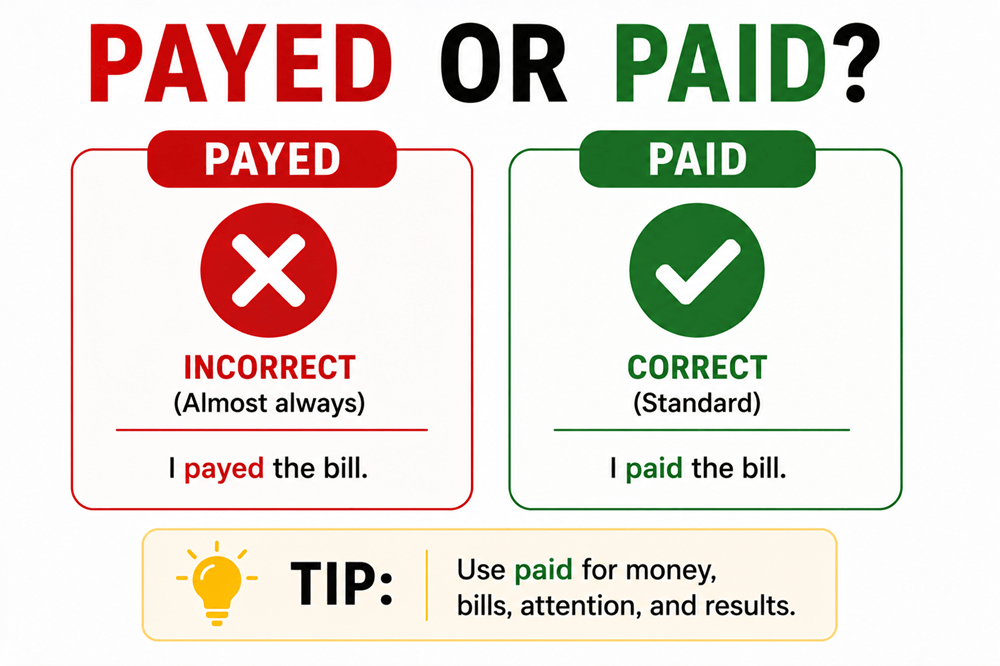
Paid is the correct past tense of pay in almost every everyday situation. Use paid when you mean someone gave money, received money, settled a bill, paid attention, or experienced a result. Payed is a real word, but it is extremely rare and mostly used in nautical contexts. For normal writing, the correct choice is paid.
Quick Answer
Use paid as the standard past tense and past participle of pay.
- Correct: She paid the bill yesterday.
- Correct: They paid for dinner.
- Correct: He has paid his rent already.
- Correct: You should have paid more attention.
Payed is not the correct spelling when you are talking about money, bills, salaries, attention, respect, consequences, or rewards.
- Incorrect: She payed the bill yesterday.
- Incorrect: They payed for dinner.
- Incorrect: He has payed his rent already.
- Incorrect: You should have payed more attention.
The simple rule is this: pay becomes paid, not payed, in ordinary English.
Payed or Paid: What Is the Difference?
The difference between payed and paid is usage. Paid is the normal past tense of pay. It is the word you should use when money is exchanged, a bill is settled, someone earns wages, attention is given, or a result happens because of an earlier action.
Payed exists, but it is rare. It is mostly used in nautical language, where it can mean letting out rope, cable, or chain. Unless you are writing about ships, ropes, sailing, or very specific technical uses, payed is almost certainly not the word you need.
| Word | Status | Best Use | Example |
|---|---|---|---|
| Paid | Standard past tense of pay | Money, attention, wages, bills, results | She paid the invoice. |
| Payed | Rare specialized form | Nautical or technical use | The sailor payed out the rope. |
If you are writing for school, work, a website, a text message, an email, or a business document, use paid.
What Does Paid Mean?
Paid is the standard past tense and past participle of pay. It usually means that money was given in exchange for something, a debt was settled, or someone received money for work.
Examples:
- You paid for the groceries.
- She paid the electric bill.
- The company paid its employees on Friday.
- He paid the mechanic after the repair.
In each sentence, paid refers to money. Someone gave money, received money, or completed a payment.
Paid also appears in many common non-money phrases. You can pay attention, pay respect, pay a price, or pay the consequences. In the past tense, those phrases use paid.
- She paid attention during the lesson.
- They paid their respects at the memorial.
- He paid the price for his mistake.
- The team paid dearly for its poor planning.
Even though these examples are not all about literal money, the correct past-tense spelling is still paid.
What Does Payed Mean?
Payed is a rare form of pay, but it does not usually mean giving money. In modern English, payed is mostly used in nautical or technical contexts. It can mean to let out rope, cable, or chain gradually.
Examples:
- The sailor payed out the rope carefully.
- The crew payed out the cable from the deck.
- The chain was payed out slowly as the boat moved.
These sentences are specialized. Most people will rarely need this spelling. If you are not talking about rope, cable, chain, or a similar nautical action, payed is probably wrong.
That is why payed causes confusion. It looks like a normal -ed past tense, just like played, stayed, or delayed. But pay is irregular in its ordinary meaning. It becomes paid.
Why Paid Is the Correct Everyday Spelling
Paid is correct because pay is an irregular verb. Many verbs form the past tense by adding -ed. For example, play becomes played, stay becomes stayed, and clean becomes cleaned. But not every verb follows that pattern.
Pay follows an irregular pattern:
- Present: pay
- Past tense: paid
- Past participle: paid
That means you write:
- You pay today.
- You paid yesterday.
- You have paid already.
You do not write payed when the meaning involves money or ordinary payment. The accepted form is paid.
When to Use Paid
Use paid whenever you are talking about money, payment, wages, bills, debt, cost, attention, respect, or consequences.
Use paid for money:
- She paid the cashier in cash.
- He paid for the tickets online.
- The customer paid with a credit card.
- They paid the rent before the deadline.
Use paid for work and wages:
- The workers were paid every two weeks.
- She was paid fairly for the project.
- He got paid after finishing the job.
Use paid in common expressions:
- She paid attention to every detail.
- They paid tribute to the former coach.
- He paid the price for ignoring the warning.
- The plan paid off in the end.
In all of these examples, paid is the correct spelling.
When to Use Payed
Use payed only in rare technical or nautical contexts. The most common phrase is payed out, meaning released or let out gradually, especially rope, cable, or chain.
Examples:
- The crew payed out the rope as the boat drifted away.
- The cable was payed out slowly to avoid tangling.
- The sailor payed out more line during the operation.
Unless you are writing this kind of sentence, you probably do not need payed. For normal English, paid is almost always correct.
Paid Attention or Payed Attention?
The correct phrase is paid attention.
Correct:
- You paid attention in class.
- She paid close attention to the instructions.
- He should have paid more attention while driving.
Incorrect:
- You payed attention in class.
- She payed close attention to the instructions.
- He should have payed more attention while driving.
Pay attention is a common expression. Its past tense is paid attention, not payed attention.
Paid Off or Payed Off?
The correct phrase is usually paid off.
Correct:
- Her hard work paid off.
- They paid off the loan early.
- The risk paid off in the end.
Incorrect:
- Her hard work payed off.
- They payed off the loan early.
- The risk payed off in the end.
Paid off can mean a debt was fully settled, or it can mean effort produced a good result. In both meanings, use paid.
Paid for or Payed For?
The correct phrase is paid for.
Correct:
- She paid for lunch.
- He paid for the mistake later.
- The tickets were already paid for.
Incorrect:
- She payed for lunch.
- He payed for the mistake later.
- The tickets were already payed for.
Whether the meaning is literal money or a figurative consequence, paid for is the standard spelling.
Paid Leave, Paid Job, and Paid Vacation
Use paid when describing something that involves payment, wages, or compensation.
- paid leave
- paid vacation
- paid job
- paid position
- paid internship
- paid advertisement
Examples:
- She accepted a paid internship.
- The company offers paid vacation.
- This article includes a paid advertisement.
- He finally found a paid position in his field.
In these phrases, paid describes something connected to money or compensation. Payed would be incorrect.
Common Mistakes With Payed and Paid
The most common mistake is writing payed because it seems to follow the normal -ed rule. Since pay sounds similar to play, it is easy to assume the past tense should look similar too.
Compare these forms:
- play → played
- stay → stayed
- delay → delayed
- pay → paid
The first three are regular. Pay is irregular.
Incorrect:
- I payed the bill.
- She payed the driver.
- They payed attention.
- The job payed well.
Correct:
- I paid the bill.
- She paid the driver.
- They paid attention.
- The job paid well.
In ordinary writing, paid is the word readers expect.
Examples of Paid in Sentences
Here are more examples of paid used correctly:
- The customer paid before leaving the store.
- She paid the subscription fee last week.
- He paid his friend back after payday.
- The invoice has already been paid.
- The students paid attention during the lesson.
- The company paid workers for overtime.
- Her patience paid off after months of practice.
- They paid their respects to the family.
Each sentence uses paid because it refers to money, attention, respect, or a result.
Examples of Payed in Sentences
Here are rare examples of payed used correctly:
- The sailor payed out the rope as the boat moved away.
- The crew payed out the cable slowly.
- The line was payed out from the stern.
These examples are specialized. They are not about paying money. They are about letting out rope, line, cable, or chain. This is why payed is almost never the correct choice in everyday writing.
How to Remember Payed or Paid
A simple way to remember the correct spelling is this:
- Paid is for payment.
- Payed is rare and usually nautical.
You can also remember this sentence:
You paid with money.
The word paid is short and common, just like the word pay. If your sentence has anything to do with money, bills, jobs, attention, respect, or consequences, use paid.
Another helpful reminder is:
- Pay today.
- Paid yesterday.
- Have paid already.
That pattern will keep you correct in almost every situation.
Final Answer
Paid is the correct past tense and past participle of pay in everyday English. Use paid when talking about money, bills, wages, attention, respect, consequences, rewards, or anything that has been settled or compensated. Payed is a rare word used mainly in nautical contexts, such as paying out rope or cable.
The easiest rule is simple: for normal writing, use paid. Unless you are talking about letting out rope, line, cable, or chain, payed is almost certainly not the word you need.