Journies or Journeys: Correct Plural Spelling and Easy Ways to Remember It
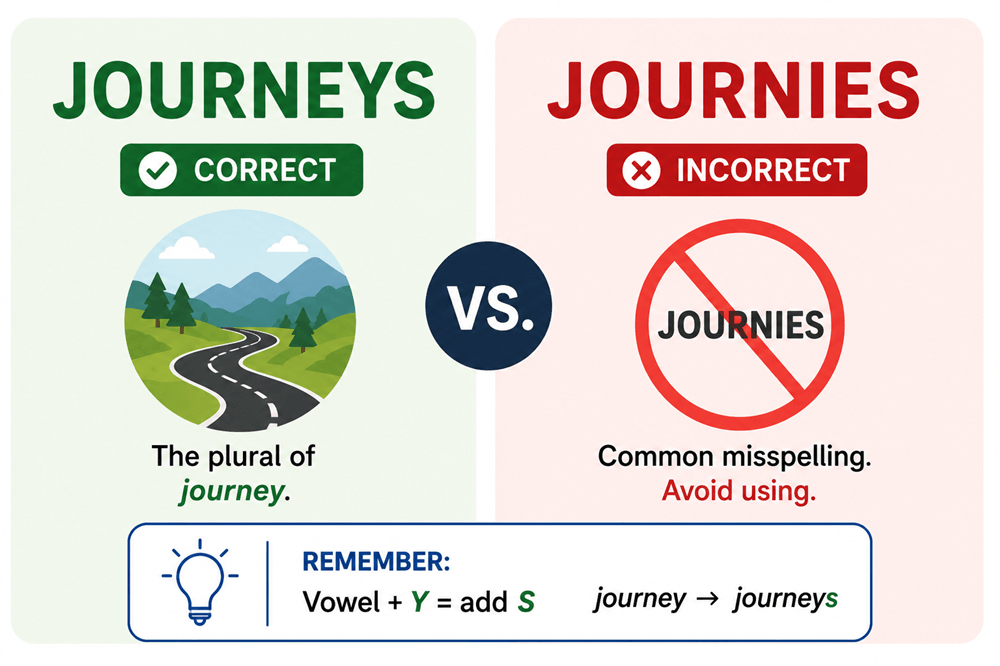
If you are choosing between journies or journeys, the correct spelling is journeys. The word journies is a common misspelling, but it is not standard English. You use journeys when talking about more than one journey, whether you mean actual trips, emotional growth, personal change, or long life experiences.
Journies or Journeys: Which Spelling Is Correct?
The correct plural spelling is journeys.
Journies is incorrect. It may look believable because many words ending in y change to ies in the plural. For example, baby becomes babies, city becomes cities, and story becomes stories. Because of that pattern, you might expect journey to become journies.
But journey follows a different rule. Since the y comes after a vowel, you keep the y and simply add s.
You should write:
Correct: Their journeys took them across three continents.
Incorrect: Their journies took them across three continents.
The same rule applies whether you are writing about travel journeys, spiritual journeys, healing journeys, creative journeys, fitness journeys, or career journeys. The plural is always journeys.
What Does Journeys Mean?
Journeys is the plural form of journey. A journey is a trip, process, experience, or path from one place or state to another. Sometimes the word is literal, meaning actual travel. Other times, it is figurative, meaning personal development, change, or progress.
For example:
Their journeys through the mountains were difficult but unforgettable.
In this sentence, journeys refers to actual trips through the mountains.
You might also write:
Everyone’s healing journey looks different.
If you make that plural, you would write:
Everyone’s healing journeys look different.
Here, journeys does not mean physical travel. It means emotional or personal progress. The spelling still stays the same.
The word can be used for many kinds of movement: a trip from one country to another, a student’s learning process, a parent’s experience raising children, a person’s recovery after loss, or a creative person’s path toward confidence. In every case, when you mean more than one, the plural is journeys.
Why Journies Looks Like It Could Be Right
The misspelling journies happens because English has a very common plural rule: when a word ends in a consonant plus y, you change the y to ies.
That rule gives you words like:
baby → babies
city → cities
party → parties
story → stories
country → countries
Once you learn that pattern, your mind may try to apply it to every word ending in y. That is where journies comes from. It looks like it should follow the same rule as stories or countries.
But the spelling rule changes when the letter before y is a vowel. In journey, the letter before y is e. Since e is a vowel, you do not change y to ies. You simply add s.
That is why the correct plural is:
journey → journeys
The Simple Spelling Rule for Journeys
The rule is easy once you slow down and look at the letter before y.
If a word ends in consonant + y, change y to ies.
Examples:
story → stories
party → parties
baby → babies
If a word ends in vowel + y, keep the y and add s.
Examples:
journey → journeys
key → keys
day → days
toy → toys
valley → valleys
This is the exact reason journeys keeps the y. The ending is not consonant + y. It is vowel + y. The e protects the y from changing.
You can think of it this way:
journey + s = journeys
You do not need to remove anything. You do not need to change the ending. Just add s.
A Simple Way to Remember Journeys
The easiest memory trick is:
A journey keeps its Y.
This works because the main mistake is changing the y into ies. If you remember that journey keeps its y, you will naturally write journeys.
You can also remember this phrase:
Journeys are like days: just add S.
That is helpful because day and journey both end in a vowel before y. You would never write daies. You write days. In the same way, you do not write journies. You write journeys.
Another good comparison is:
key → keys
day → days
journey → journeys
These words all keep the y. When the letter before y is a vowel, the plural stays simple.
Common Examples With Journeys
Seeing journeys in natural sentences can help the correct spelling feel more familiar.
Their journeys began in different places but led to the same conclusion.
This means more than one person had a path or experience that ended in a similar way.
Travelers often remember the journeys more clearly than the destinations.
Here, journeys refers to trips or travel experiences.
Personal journeys are rarely as simple as they look from the outside.
This uses journeys in a figurative way, meaning personal paths through life.
The book follows the emotional journeys of three different characters.
In this sentence, journeys refers to inner growth, struggle, and change.
Long journeys require patience, planning, and a willingness to adapt.
This could mean physical travel or a long process. Either way, the spelling stays journeys.
Journies vs Journeys in Side-by-Side Examples
Side-by-side examples make the difference easy to see:
Correct: Their journeys shaped who they became.
Incorrect: Their journies shaped who they became.
Correct: The novel explores the journeys of two sisters.
Incorrect: The novel explores the journies of two sisters.
Correct: Many journeys begin with uncertainty.
Incorrect: Many journies begin with uncertainty.
Correct: These journeys taught them courage and patience.
Incorrect: These journies taught them courage and patience.
Correct: The documentary follows several journeys across the desert.
Incorrect: The documentary follows several journies across the desert.
In every example, journeys is the correct spelling. The form journies should be avoided in standard writing.
Journey as a Verb
Journey can also be used as a verb, though it is more common as a noun. As a verb, it means to travel or move through an experience.
For example:
They journeyed across the country in an old van.
You may journey through seasons of doubt before finding clarity.
When you use the verb form, the spelling changes depending on tense. The past tense is journeyed, not journied. The present participle is journeying, not journing or journieing.
That gives you a helpful spelling family:
journey
journeys
journeyed
journeying
Notice that the y stays in all of these common forms. That is another clue that journies does not fit the word’s normal pattern.
How to Check Yourself Before Writing Journeys
Before you write the plural, look at the end of the singular word:
journey
Now look at the letter before y. It is e. Since e is a vowel, you keep the y and add s.
You can use this quick check:
Is the letter before Y a vowel?
Yes: add S.
journey → journeys
This same check works for many other words:
holiday → holidays
valley → valleys
monkey → monkeys
chimney → chimneys
These examples are useful because they show the same pattern. You do not write holidaies, vallies, monkies, or chimnies in standard English. You keep the y and add s.
The Final Answer on Journies or Journeys
The correct plural spelling is journeys. The spelling journies is a mistake, even though it may look similar to real plurals like stories, cities, and parties.
To remember the difference, look at the letter before y. In journey, the letter before y is the vowel e, so you keep the y and add s. Think of days, keys, and valleys. They all follow the same pattern.
So when you are writing about trips, life paths, emotional growth, learning experiences, or long personal changes, choose journeys. A journey keeps its y, and the plural is always journeys.