Jist or Gist: Which Spelling Is Correct?
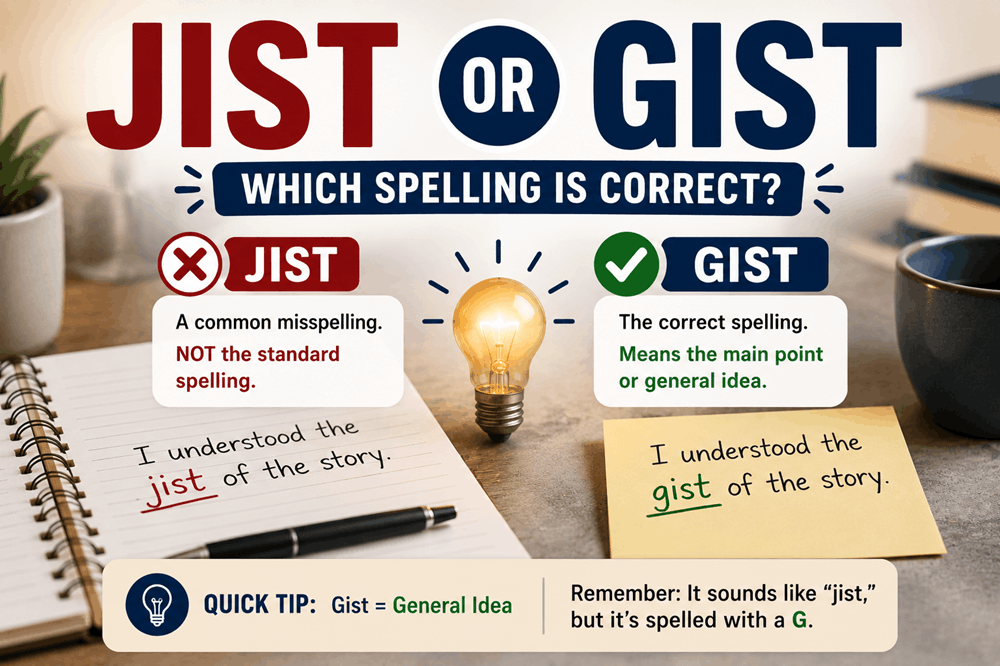
Gist is the correct spelling when you mean the main point, basic idea, or short summary of something. Jist is a common misspelling of gist in standard English.
If you are writing for school, work, email, or a public article, use gist.
Jist or Gist: Simple Examples
- Correct: I understood the gist of the story.
- Incorrect: I understood the jist of the story.
- Correct: Can you give me the gist of the meeting?
- Incorrect: Can you give me the jist of the meeting?
The word sounds like it starts with a “j” sound, but it is spelled with a g: gist.
What Does Gist Mean?
Gist is a noun. It means the main point or general meaning of something, without every detail.
- The report was long, but I got the gist.
- She explained the gist of the plan in two sentences.
- I missed a few words, but I understood the gist of what he said.
- The article gives the gist of the new rule.
You can think of gist as the short version of the main idea.
Is Jist a Word?
Jist is not the standard spelling when you mean “main point” or “general idea.” In most writing, it will look like a spelling mistake.
Use gist instead.
Why Jist and Gist Are Confusing
Gist is confusing because the g makes a soft sound, like the j in jam. Since the word sounds like “jist,” many people spell it that way by mistake.
Common Phrases With Gist
- get the gist: I did not hear every word, but I got the gist.
- the gist of it: The gist of it is that we need more time.
- give me the gist: Can you give me the gist before the meeting?
- understand the gist: She understood the gist of the lesson.
Common Mistake
The common mistake is spelling the word the way it sounds. Because gist sounds like “jist,” the wrong spelling can feel natural.
For polished writing, use gist.
Memory Tip for Jist or Gist
Think of gist as the general idea.
Gist and general both start with g. That can help you remember the correct spelling.
Final Reminder
Use gist when you mean the main point, basic idea, or short summary. Avoid jist in standard writing because it is usually a misspelling of gist.