Invision or Envision: Correct Spelling, Meaning, Usage, Examples, and Memory Tips Explained
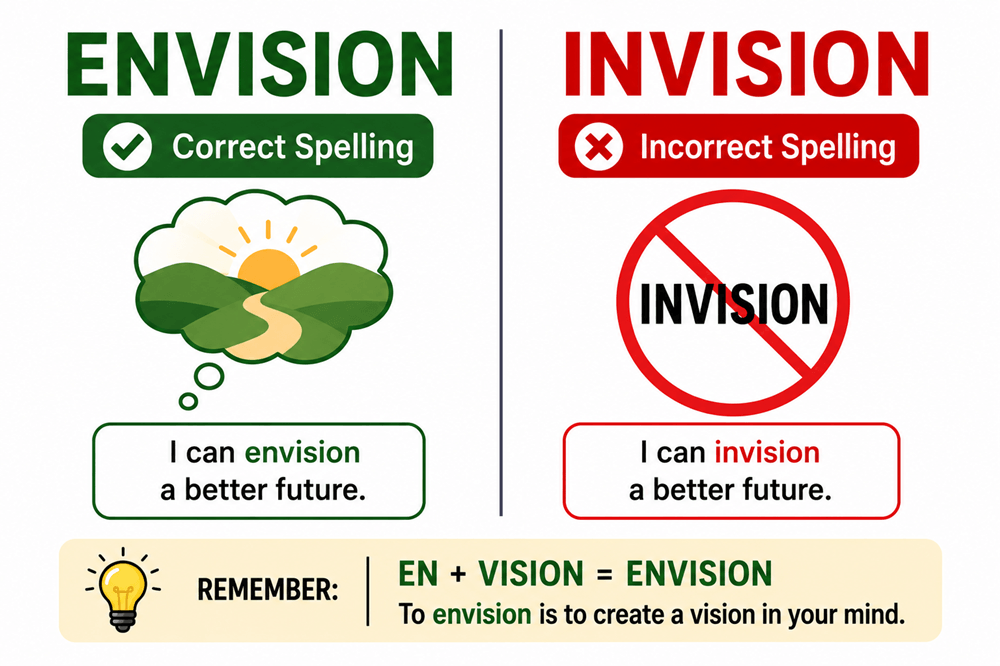
Envision is the correct standard word. Invision is usually a misspelling. Use envision when you mean to imagine, picture, foresee, or mentally create an idea of something before it happens. The key spelling clue is simple: envision begins with “en,” not “in.”
Quick Answer
Use envision, not invision, when you mean to imagine or picture something in your mind.
- Correct: I can envision a better future.
- Correct: She envisioned herself running her own business.
- Correct: The designer envisioned a calm, modern room.
Invision is not the standard spelling for this meaning.
- Incorrect: I can invision a better future.
- Incorrect: She invisioned herself running her own business.
The simple rule is: envision means to imagine or picture; invision is usually a spelling mistake.
Invision or Envision: What Is the Difference?
The difference between invision and envision is spelling and correctness. Envision is the real verb you use when talking about imagining something. Invision may appear as a name or brand in some contexts, but it is not the standard English verb meaning “to picture in your mind.”
| Word | Status | Example |
|---|---|---|
| Envision | Correct verb | They envision a cleaner city. |
| Invision | Usually incorrect as a verb | They invision a cleaner city. |
If you are writing for school, work, articles, emails, business plans, personal goals, or creative writing, choose envision.
What Does Envision Mean?
Envision means to imagine something clearly, form a mental picture of it, or think about what something could become. It often points to the future, a plan, a dream, a goal, or a possible result.
Examples:
- She envisioned a peaceful life by the ocean.
- The architect envisioned a building full of natural light.
- Can you envision yourself living in another country?
- The team envisioned a product that would save people time.
- He could not envision a future without music.
In each sentence, envision means to see something mentally before it exists or before it happens. It is not physical seeing. It is imagining, planning, picturing, or mentally designing.
What Does Invision Mean?
Invision is usually a misspelling of envision. People write it because the word sounds like it could start with in. Since in is a common English prefix, the mistake feels natural.
Examples:
- Incorrect: I invision a world where people are kinder.
- Correct: I envision a world where people are kinder.
- Incorrect: She invisioned a new career path.
- Correct: She envisioned a new career path.
There is one important note: InVision can appear as a proper name, such as a company, product, or brand name. In that case, the spelling is part of the name. But when you mean the ordinary verb “to imagine,” the correct spelling is envision.
Spelling Structure: Why Envision Starts With En
Envision is built from two parts:
- en + vision = envision
The word vision means sight, image, dream, or mental picture. The prefix en- can mean to make, put into, or cause to be. So envision means to create a vision in the mind.
This spelling structure is the best way to remember the word:
- en = make or form
- vision = mental picture
- envision = form a mental picture
The spelling is not in + vision. You are not putting something physically “in vision.” You are forming a vision mentally, so the word begins with en.
Why People Misspell Envision as Invision
People often misspell envision as invision because in is more familiar than en. Words like inside, input, include, and invite make in feel natural at the start of a word.
The sound also causes confusion. In quick speech, the first syllable of envision may sound close to in. But the spelling is still en.
Look at the correct middle and beginning:
- Correct: envision
- Incorrect: invision
The word you need for imagining is always envision.
When to Use Envision
Use envision when talking about imagining a future result, goal, design, plan, or possibility.
- They envision a safer neighborhood.
- She envisioned the garden before planting it.
- The founder envisioned a company that treated workers well.
- Can you envision the finished project?
- He envisioned himself becoming a teacher.
Envision is especially common with dreams, plans, design, leadership, strategy, and personal growth. It often sounds more thoughtful or intentional than simply saying imagine.
Envision vs Imagine
Envision and imagine are similar, but they are not always identical. Imagine is broader. You can imagine anything, even something silly, impossible, or random. Envision often suggests a clearer mental picture, goal, plan, or future possibility.
| Word | Use | Example |
|---|---|---|
| Imagine | General mental picture | Imagine a purple elephant. |
| Envision | Clear future idea or plan | She envisioned a better school system. |
If the sentence is casual or playful, imagine may be enough. If the sentence is about a future goal, plan, or serious mental picture, envision often fits better.
Common Mistakes
The most common mistake is starting the word with in.
Incorrect:
- We invision a brighter future.
- He invisioned a different ending.
- The artist invisions a bold new style.
Correct:
- We envision a brighter future.
- He envisioned a different ending.
- The artist envisions a bold new style.
Another mistake is using envision when a simpler word would sound more natural. In casual writing, imagine, picture, or see may work better.
- Simple: I can picture the room in blue.
- More formal: I can envision the room in blue.
How to Remember Envision
Use these memory tips:
- Envision starts with en, not in.
- Envision contains vision, because it means to form a mental picture.
- Think: en + vision = envision.
- If you mean “imagine,” choose envision.
A simple memory sentence is: To envision is to create a vision.
You can also remember it this way: Envision begins like “enter a vision.” You are entering a mental picture of what something could become.
Final Answer
Envision is the correct spelling when you mean to imagine, picture, foresee, or mentally create an idea of something. Example: She envisioned a successful future.
Invision is usually a misspelling and should be avoided unless it is part of a proper name. To remember the correct spelling, break the word into en + vision. If you are creating a vision in your mind, you envision it.