Allie or Ally: Correct Meaning, Spelling, Usage, and Memory Tips Explained Clearly
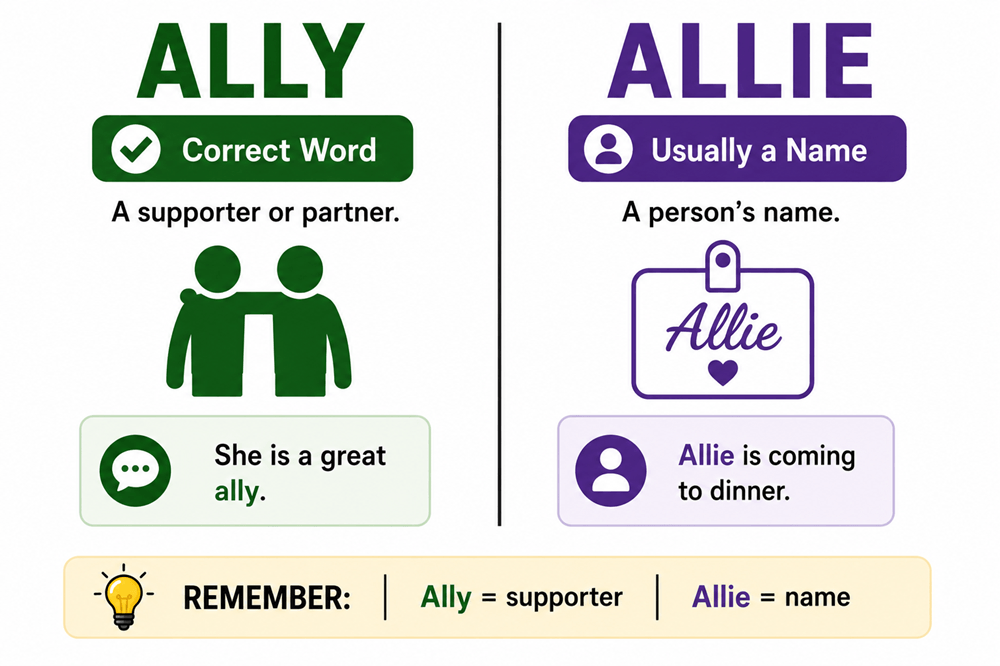
Ally is the correct word when you mean a supporter, helper, partner, or someone on your side. Allie is usually a person’s name or nickname, not the standard word for someone who supports you. If you are talking about friendship, teamwork, support, politics, war, or advocacy, use ally.
Quick Answer
Use ally when you mean a person, group, or country that supports another person, group, or country.
- She was a loyal ally during a difficult time.
- The two countries became allies.
- He is an ally of the environmental movement.
Use Allie only as a name.
- Allie is coming to dinner tonight.
- I met Allie at school.
- Allie sent me a message yesterday.
The simple rule is: ally means supporter; Allie is a name.
Allie or Ally: What Is the Difference?
The difference between Allie and ally is meaning and spelling. Ally is the common English word. It can be a noun or a verb. As a noun, it means someone who helps or supports you. As a verb, it means to join with someone for support or a shared purpose.
Allie, with ie at the end, is usually a proper name. It is often short for names like Allison, Alexandra, Alicia, or Alina. Because it is a name, it is normally capitalized.
| Word | Meaning | Example |
|---|---|---|
| Ally | A supporter or partner | She is my ally. |
| Allie | A person’s name | Allie is my friend. |
If you are not naming a person called Allie, you almost certainly need ally.
What Does Ally Mean?
Ally means someone who supports, helps, defends, or works with another person or group. An ally is on your side. The word can be used in personal, social, political, military, workplace, and advocacy contexts.
Examples:
- She became an ally when everyone else stayed silent.
- The teacher was an ally for struggling students.
- The small nation needed a powerful ally.
- Good communication can make a manager an ally, not an obstacle.
- He tried to be a better ally to his coworkers.
Ally often suggests trust and support. It does not always mean close friendship. A person can be your ally because they share your goal, defend your rights, support your work, or stand with you in a difficult situation.
What Does Allie Mean?
Allie is usually a name. It should be treated like other names, such as Annie, Ellie, Katie, or Millie.
Examples:
- Allie gave a great presentation.
- Did you invite Allie to the party?
- Allie and her sister live nearby.
Because Allie is a proper noun, it is usually capitalized. You should not use Allie when you mean a supporter or partner unless the person’s actual name is Allie.
Incorrect:
- She was a strong Allie in the campaign.
Correct:
- She was a strong ally in the campaign.
Spelling Structure: Why Ally Ends in Y
The word ally ends in y. This is the standard spelling when the word means supporter or partner.
- all + y = ally
A helpful way to remember it is to connect ally with the phrase all in. An ally is someone who is all in with support. The word also contains all, which can remind you that an ally stands fully with you.
Look at the spelling:
- Correct: ally
- Wrong for supporter: allie
The y ending is the key. If the word means a supporter, choose ally.
Spelling Structure: Why Allie Looks Like a Name
Allie ends in ie, which is common in names and nicknames.
- Allie
- Ellie
- Annie
- Millie
- Charlie
This spelling pattern helps you remember the difference. The ie ending often gives a word a name-like appearance. That is why Allie works naturally as a person’s name, but not as the standard spelling for a supporter.
Think of it this way:
- Ally = role
- Allie = name
When to Use Ally
Use ally when describing someone who supports another person, group, country, or cause.
- She is an ally to new employees.
- The organization needs more allies in the community.
- They became allies during the conflict.
- A good ally listens before speaking.
- The senator gained several political allies.
You can also use ally as a verb. When people ally with each other, they join together for support or a shared purpose.
- The two groups allied against the proposal.
- Small businesses allied with local leaders.
- The countries allied during the war.
As a noun, the plural is allies.
- She has many allies at work.
- The country relied on its allies.
When to Use Allie
Use Allie when it is someone’s name.
- Allie called after lunch.
- I gave the book to Allie.
- Allie works in marketing.
Do not use Allie as a general word for supporter. Names and common nouns work differently. If the sentence uses the word with a, an, my, our, or their, you probably need ally.
- an ally
- my ally
- our allies
- their political ally
Common Mistakes
The most common mistake is writing allie when the sentence needs ally.
Incorrect:
- He was my closest allie.
- The group needed more allies, but one strong allie helped.
- She wanted to be an allie to the community.
Correct:
- He was my closest ally.
- The group needed more allies, but one strong ally helped.
- She wanted to be an ally to the community.
Another mistake is forgetting that ally changes spelling in the plural. The plural is not allys. It is allies.
- One ally
- Two allies
How to Remember the Difference
Use these memory tips:
- Ally means supporter and ends in y.
- Allie is a name and ends in ie.
- Ally contains all, like someone who is all in with support.
- Allie looks like Ellie, Annie, and Millie, so remember it as a name.
A simple memory sentence is: An ally is all in; Allie is a name.
Final Answer
Ally is the correct word when you mean a supporter, helper, partner, or someone on your side. Example: She was a trusted ally.
Allie is usually a name. Example: Allie is visiting tomorrow.
To remember the difference, look at the ending. Ally ends in y and means supporter. Allie ends in ie and works like a person’s name.