Loosing or Losing: Correct Meaning, Spelling Difference, Usage, and Easy Examples Explained
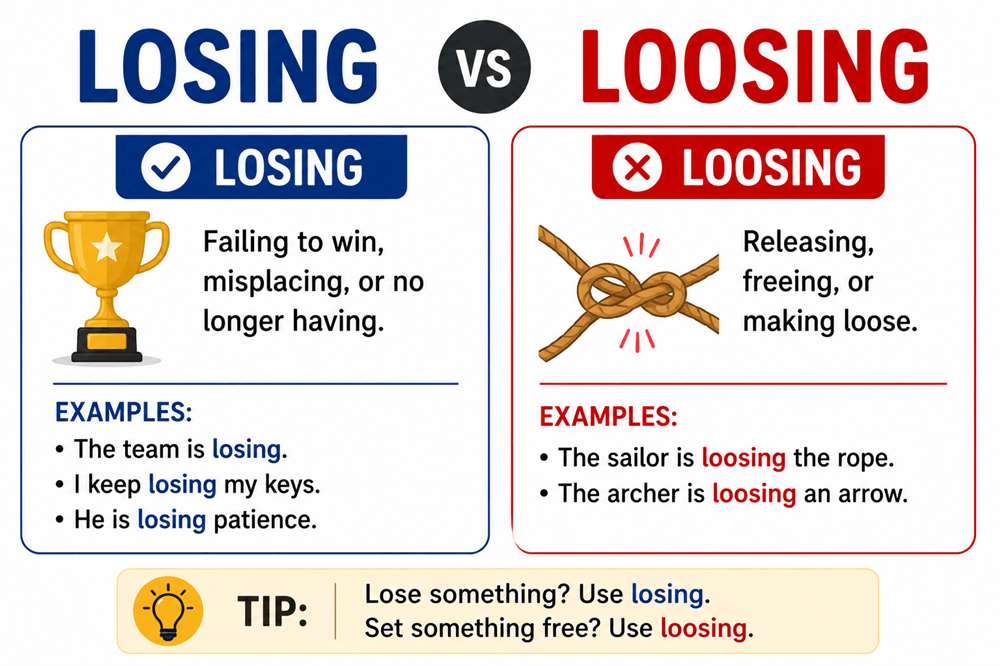
Losing and loosing are both real words, but they do not mean the same thing. In most everyday sentences, the correct word is losing. Use losing when someone fails to win, misplaces something, or no longer has something. Loosing is much rarer and means releasing, freeing, or making something loose.
Quick Answer
Use losing when you mean failing to win, misplacing, or no longer keeping something.
- Correct: The team is losing the game.
- Correct: She keeps losing her keys.
- Correct: He is losing patience.
Use loosing only when you mean releasing, freeing, or making something loose.
- The sailor was loosing the ropes.
- The archer was loosing an arrow.
The simple rule is: losing means not winning or no longer having something. Loosing means releasing or loosening something.
Loosing or Losing: What Is the Difference?
The difference between loosing and losing comes from two different verbs: loose and lose.
Losing comes from the verb lose. It means to fail to win, misplace something, waste an opportunity, or no longer have something.
Loosing comes from the verb loose. As a verb, loose means to release, set free, or make less tight. This use is real, but it is uncommon in modern everyday English.
| Word | Comes From | Meaning | Example |
|---|---|---|---|
| Losing | Lose | Failing to win, misplacing, or no longer having | She is losing her phone again. |
| Loosing | Loose | Releasing, freeing, or making loose | He is loosing the knot. |
Because loosing is so rare, many sentences that use it are actually spelling mistakes. If you are talking about defeat, loss, missing items, weight, money, time, control, patience, interest, or confidence, the word you need is almost always losing.
What Does Losing Mean?
Losing is the present participle of lose. It describes the action of failing to keep, failing to win, or no longer having something.
Examples:
- The team is losing by ten points.
- I am tired of losing my charger.
- She is losing interest in the project.
- He is losing confidence after several mistakes.
- The company is losing money.
Losing can describe physical things, emotions, competitions, opportunities, habits, relationships, or control. It is a very common word in everyday English.
What Does Loosing Mean?
Loosing is the present participle of the verb loose. As a verb, loose means to release, set free, let go, or make something less tight.
Examples:
- The hunter was loosing the hounds.
- The archer was loosing arrows into the target.
- The worker was loosing the ropes from the dock.
- The storm was loosing debris across the road.
This use can sound formal, old-fashioned, poetic, or technical. In everyday conversation, people usually say releasing, freeing, letting go of, or loosening instead.
That is why loosing is rarely the best word unless you specifically mean releasing something.
Why Losing Is Often Confused With Loosing
Losing and loosing are easy to confuse because they look similar. The only visible difference is one extra o. However, that extra letter changes the word completely.
The confusion also comes from the words lose and loose. They are spelled almost alike, but they are pronounced differently and mean different things.
- Lose rhymes with choose.
- Loose rhymes with goose.
When you add -ing, the same difference remains:
- lose becomes losing
- loose becomes loosing
If your sentence is about something being gone, missed, defeated, or no longer possessed, use losing with one o after the l.
Examples of Losing in Sentences
Here are natural examples of losing used correctly:
- She is losing her voice after cheering all night.
- The team kept losing close games.
- I am losing track of time.
- He is losing sleep over the decision.
- The store is losing customers.
- They are losing hope after weeks of waiting.
- The child was afraid of losing his favorite toy.
- She is losing weight slowly and safely.
In each sentence, losing means something is being lost, reduced, missed, or no longer kept.
Examples of Loosing in Sentences
Here are examples of loosing used correctly, though this word is much less common:
- The sailor was loosing the rope from the post.
- The archer was loosing one arrow after another.
- The handler was loosing the dogs into the field.
- The old gate was loosing its chain in the wind.
These sentences involve releasing, freeing, or letting something go. That is the narrow meaning of loosing.
Most modern writers would often choose a simpler word instead:
- The sailor was loosening the rope.
- The archer was releasing an arrow.
- The handler was letting the dogs loose.
Losing vs Loosening
Another word to know is loosening. This word is more common than loosing when you mean making something less tight.
Loosening means making something looser.
- She is loosening the knot.
- He is loosening his tie.
- The screws are loosening over time.
Loosing means releasing or setting free.
- The archer is loosing an arrow.
In everyday writing, if you mean making something less tight, loosening usually sounds more natural than loosing.
Losing in Common Phrases
Losing appears in many common English phrases. These phrases should use losing, not loosing.
- losing weight
- losing money
- losing time
- losing interest
- losing patience
- losing control
- losing hope
- losing sleep
- losing your mind
- losing the game
Examples:
- He is losing patience with the delays.
- The business is losing money every month.
- She is losing interest in the conversation.
- I am losing track of the details.
In these phrases, loosing would be wrong because nothing is being released or set free.
Common Mistakes to Avoid
The most common mistake is writing loosing when the sentence needs losing.
Incorrect:
- The team is loosing again.
- I keep loosing my keys.
- She is loosing confidence.
- He is loosing weight.
Correct:
- The team is losing again.
- I keep losing my keys.
- She is losing confidence.
- He is losing weight.
Another mistake is assuming loosing is always wrong. It is not always wrong, but it is rare. It only works when the meaning is releasing, freeing, or letting loose.
How to Remember Loosing or Losing
Here is an easy way to remember the difference:
Losing has one “o” because something is gone.
Loosing has two “o”s because something is being made loose or set loose.
- Losing = no longer having, failing to win, misplacing
- Loosing = releasing, freeing, letting loose
You can also remember this sentence:
If you lose something, you are losing it.
If your sentence is about defeat, missing something, or no longer having something, choose losing.
Final Answer
Losing and loosing are both words, but losing is the one most writers need. Use losing when someone fails to win, misplaces something, or no longer has something. Use loosing only when you mean releasing, freeing, or setting something loose. In everyday writing, loosing is often a mistake for losing.