Buses or Busses: Correct Plural Spelling, Meaning, Usage, and Examples Explained Clearly
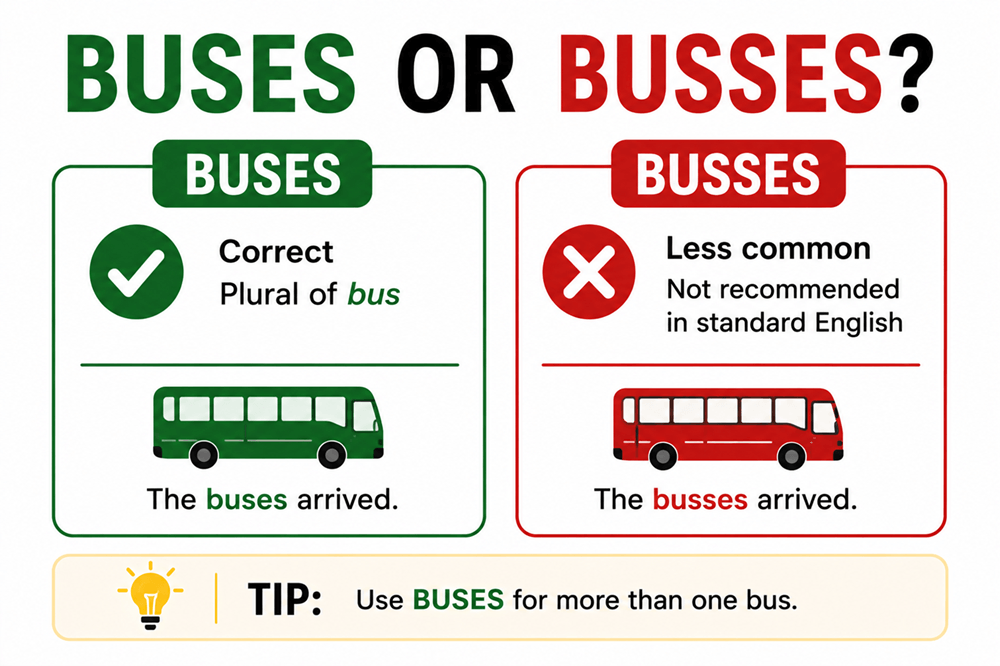
Buses is the standard plural form of bus. Use buses when you are talking about more than one bus, such as school buses, city buses, tour buses, or shuttle buses. Busses is sometimes listed as a variant plural, but it is much less common and can look old-fashioned or incorrect to many readers. The easiest rule is this: one bus, two buses.
Quick Answer
Use buses as the normal plural of bus.
- Correct: The buses arrived late this morning.
- Correct: Several school buses were parked outside.
- Correct: The city added more buses to the route.
Busses is not the preferred plural spelling in modern everyday English.
- Less common: The busses arrived late this morning.
- Preferred: The buses arrived late this morning.
The simple rule is this: if you mean more than one bus, write buses.
Buses or Busses: What Is the Difference?
The difference between buses and busses is mainly spelling and common usage. Buses is the standard plural noun used in modern English. It is the spelling you should use in school writing, articles, transportation notices, signs, captions, reports, and everyday sentences.
Busses can appear as a variant plural, but it is far less common. Many readers may assume it is a spelling mistake because the expected spelling is buses. If you want your writing to look clean and current, buses is the safer choice.
| Word | Main Use | Example |
|---|---|---|
| Bus | Singular noun | The bus stopped at the corner. |
| Buses | Standard plural noun | The buses stopped at the corner. |
| Busses | Less common variant plural; also related to the verb buss | The busses stopped at the corner. |
For most writing, especially a grammar article, buses should be treated as the correct default plural.
What Does Bus Mean?
Bus is a noun that refers to a large road vehicle used to carry passengers. A bus may transport students, commuters, tourists, airport travelers, hotel guests, sports teams, or people moving around a city.
Examples:
- The bus arrived at seven o’clock.
- She takes the bus to work every morning.
- The school bus stopped in front of the house.
- A tour bus waited outside the museum.
In these sentences, bus is singular. It refers to one vehicle. When you are talking about two or more, the standard plural is buses.
What Does Buses Mean?
Buses means more than one bus. It is the standard plural spelling of bus. You use it when describing multiple passenger vehicles.
Examples:
- The buses were full during rush hour.
- Three buses left the station at the same time.
- The company bought new buses for its routes.
- School buses lined up outside the building.
Buses is used in many common phrases:
- city buses
- school buses
- tour buses
- shuttle buses
- electric buses
- public buses
- charter buses
In all of these phrases, buses is the spelling most readers expect.
Is Busses Wrong?
Busses is not always impossible, but it is not the best plural spelling for modern standard English. Some dictionaries may recognize busses as a variant plural of bus, but it is much less common than buses. In everyday writing, busses can look odd, outdated, or mistaken.
Compare these examples:
- Less common: The busses were delayed by traffic.
- Preferred: The buses were delayed by traffic.
- Less common: Several busses waited near the stadium.
- Preferred: Several buses waited near the stadium.
If your goal is clear, polished writing, use buses. It is the spelling that works best for modern readers.
Why Is the Plural Buses?
The plural of bus is buses because many nouns ending in an s sound add -es in the plural. That extra syllable makes the word easier to pronounce.
Examples:
- bus → buses
- class → classes
- glass → glasses
- kiss → kisses
- dress → dresses
The word bus follows this pattern, but it does not need the doubled s in standard modern spelling. That is why the preferred plural is buses, not busses.
When to Use Buses
Use buses whenever you mean more than one bus. This is the correct choice for nearly all ordinary writing.
Examples:
- The buses run every fifteen minutes.
- Many buses stop near the train station.
- The school district ordered new buses.
- The airport provides shuttle buses for passengers.
- The city is replacing older buses with electric buses.
Use buses in formal writing, casual writing, school assignments, public notices, transportation schedules, travel articles, and business communication. It is clear, standard, and familiar.
When to Use Busses
You will rarely need busses as the plural of bus. It may appear as a less common variant, but it is not the recommended spelling for most writing.
However, busses can also come from the verb buss. The verb buss means to kiss, usually in an old-fashioned or literary way. In that sense, busses can mean “kisses.”
Examples:
- She busses the child on the forehead.
- The old poem mentions hugs and busses.
This use is rare today. Most people do not use buss in everyday conversation. Still, it explains why busses can be a real word in a different context.
If you are talking about transportation vehicles, use buses.
School Buses or School Busses?
The correct phrase is school buses.
Correct:
- The school buses arrived at 3:15.
- Parents waited near the school buses.
- The district inspected all school buses before the semester began.
Less common:
- The school busses arrived at 3:15.
Because school buses appears in education, transportation, and safety writing, the standard spelling is especially important. Use buses.
City Buses or City Busses?
The correct phrase is city buses.
Correct:
- City buses are crowded during rush hour.
- The city buses now accept mobile payments.
- Several city buses were rerouted because of construction.
Less common:
- City busses are crowded during rush hour.
For public transportation writing, buses is the clean, standard form.
Bus’s, Buses, or Buses’?
Bus’s, buses, and buses’ are different forms. The apostrophe changes the meaning.
| Form | Meaning | Example |
|---|---|---|
| Bus | One vehicle | The bus is late. |
| Bus’s | Something belonging to one bus | The bus’s door opened. |
| Buses | More than one bus | The buses are late. |
| Buses’ | Something belonging to more than one bus | The buses’ routes changed. |
Use buses without an apostrophe when you simply mean more than one bus.
- Correct: The buses are parked outside.
- Incorrect: The bus’s are parked outside.
Apostrophes show possession. They do not make normal plurals.
Common Mistakes With Buses and Busses
The most common mistake is adding an extra s and writing busses when the sentence needs the standard plural buses.
Less common:
- The busses left the station early.
- The tour busses waited outside the hotel.
- Electric busses are becoming more common.
- The school busses were inspected last week.
Preferred:
- The buses left the station early.
- The tour buses waited outside the hotel.
- Electric buses are becoming more common.
- The school buses were inspected last week.
Another mistake is using an apostrophe to form the plural.
Incorrect:
- The bus’s are running late.
Correct:
- The buses are running late.
If you mean multiple vehicles, write buses.
Examples of Buses in Sentences
Here are examples of buses used correctly:
- The buses were delayed by heavy traffic.
- Several buses stopped near the stadium.
- The school buses lined up outside the gym.
- The city added more buses to the downtown route.
- Tour buses filled the parking lot near the museum.
- The airport shuttle buses run all day.
- Electric buses are quieter than older diesel buses.
- The buses arrived just before the rain started.
In each sentence, buses means more than one bus and uses the standard spelling.
Examples of Busses in Sentences
Here are examples showing busses as a less common plural variant:
- Less common: The busses were parked by the curb.
- Preferred: The buses were parked by the curb.
- Less common: Two busses waited outside the school.
- Preferred: Two buses waited outside the school.
Here is busses used from the rare verb buss, meaning to kiss:
- The grandmother busses the baby on the cheek.
This use is uncommon and old-fashioned. In almost every modern sentence about vehicles, choose buses.
How to Remember Buses or Busses
A simple way to remember the correct spelling is this:
- Bus = one vehicle
- Buses = more than one vehicle
You can also remember this phrase:
One bus, many buses.
That short sentence is usually all you need. If you are writing about transportation, passengers, routes, schools, tours, airports, or city travel, buses is the spelling to use.
Another helpful reminder is that buses looks like other common plurals ending in -es:
- bus → buses
- class → classes
- dress → dresses
The standard spelling keeps the word simple: buses, not busses.
Final Answer
Buses is the standard plural form of bus. Use it when talking about more than one bus, such as school buses, city buses, tour buses, shuttle buses, or electric buses. Busses may appear as a rare variant, but it is much less common and can look incorrect in modern writing.
The easiest rule is simple: one bus, many buses. For clear, polished, and standard English, choose buses.