Is Worser a Word? Correct Usage and Better Alternatives
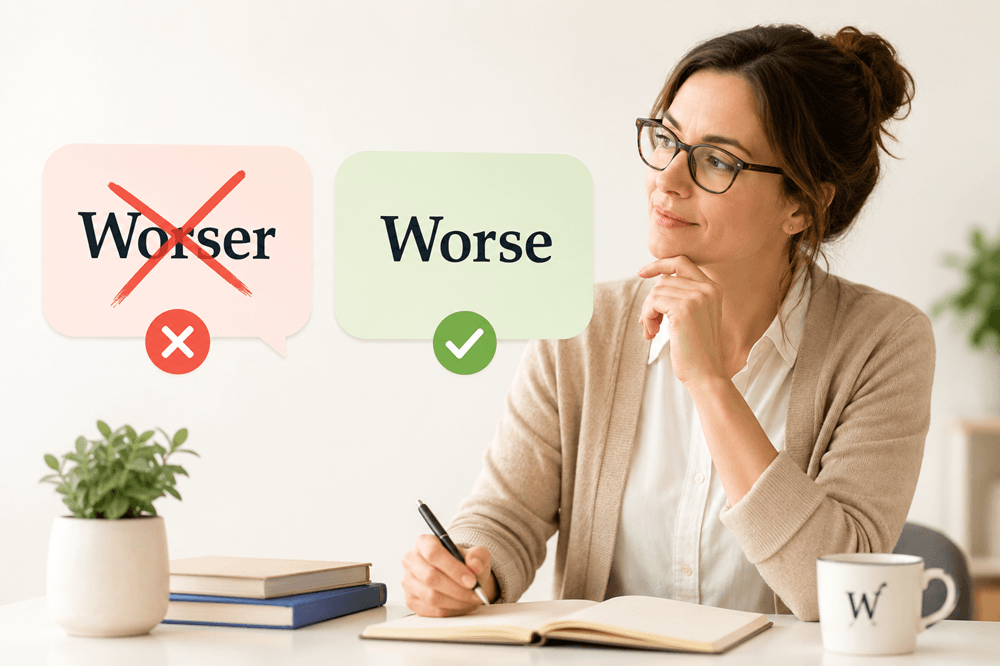
Worser is a word, but it is not standard modern English. In normal writing, the correct word is worse.
Use worse when comparing something bad to something more bad, unpleasant, serious, painful, or difficult.
Examples:
Correct: This headache is worse than yesterday.
Incorrect: This headache is worser than yesterday.
Correct: The second movie was worse than the first one.
Incorrect: The second movie was worser than the first one.
The simple rule is this: worse already means more bad. You do not need to add -er to it.
Is Worser Correct?
Worser is not correct in standard English. You may see it in old writing, dialect, jokes, song lyrics, informal speech, or intentionally childish language, but it should not be used in school essays, business emails, professional writing, resumes, articles, or formal messages.
The standard word is worse.
Worse is the comparative form of bad. That means it is used when one thing is more bad than another thing.
Examples:
This weather is worse than last week’s weather.
Her cough sounds worse today.
The problem became worse after the update.
That answer is worse than the first one.
In each sentence, worse already does the job. Adding -er creates a form that sounds unnecessary and nonstandard.
Why Do People Say Worser?
People say worser because it feels like it should follow a normal pattern.
Many short adjectives form comparisons by adding -er:
fast → faster
slow → slower
small → smaller
cold → colder
So it may seem logical to say:
bad → badder
worse → worser
But English does not always follow the regular pattern. Bad is irregular. Its forms are:
bad
worse
worst
That is why we say worse, not worser, when comparing two things.
Think of it like good:
good
better
best
You would not usually write gooder in standard English. In the same way, you should not write worser in standard English.
Worse vs Worser
The difference between worse and worser is simple.
Worse is the standard word.
Worser is nonstandard.
Use worse in nearly all modern writing.
Examples:
Correct: The traffic is worse today.
Incorrect: The traffic is worser today.
Correct: His attitude got worse after the argument.
Incorrect: His attitude got worser after the argument.
Correct: This solution is worse than the original problem.
Incorrect: This solution is worser than the original problem.
If you are trying to sound clear, polished, or professional, choose worse.
Is Worser Ever Okay?
Worser can appear in some special situations, but those situations are limited.
You might see worser in:
old-fashioned writing
regional dialect
casual jokes
children’s speech
fictional dialogue
lyrics or poetry
intentional grammar mistakes
For example, a writer might use worser in dialogue to show how a character speaks:
“He made everything worser,” the child said.
In that sentence, worser may be used on purpose to create a certain voice. But that does not make it a good choice for normal writing.
If you are not using it deliberately for style, humor, or character voice, use worse.
What Does Worse Mean?
Worse means more bad, more unpleasant, more serious, more difficult, or lower in quality.
Use worse when comparing two situations, people, choices, feelings, conditions, or results.
Examples:
My cold is worse today.
This road is worse than the highway.
The new rule made the situation worse.
His second excuse was worse than the first.
The pain got worse during the night.
The word worse can describe many kinds of negative comparison. It can refer to health, behavior, quality, weather, performance, emotions, writing, service, or almost anything that has declined.
Worse vs Worst
Worse and worst are also easy to confuse.
Worse compares two things.
Worst means the most bad out of all choices.
Use worse when comparing one thing to another.
Use worst when describing the lowest, most serious, or most negative option.
Examples:
Correct: This test was worse than the last one.
Correct: That was the worst test of the year.
Correct: My headache is worse today.
Correct: This is the worst headache I have ever had.
Correct: The first mistake was bad, but the second was worse.
Correct: That was the worst mistake in the whole project.
A quick way to remember it:
Worse = more bad
Worst = most bad
Common Mistakes With Worser
The most common mistake is using worser instead of worse.
Incorrect: I feel worser today.
Correct: I feel worse today.
Incorrect: The ending was worser than I expected.
Correct: The ending was worse than I expected.
Incorrect: This phone is worser than my old one.
Correct: This phone is worse than my old one.
Another common mistake is writing more worse. This is also usually incorrect because worse already means more bad.
Incorrect: The situation became more worse.
Correct: The situation became worse.
Correct: The situation became much worse.
Correct: The situation became even worse.
You can use words like much, even, far, a little, or slightly before worse. These words show degree.
Examples:
This is much worse.
That answer is even worse.
The damage was far worse than expected.
Her cold is slightly worse today.
But do not write more worse or worser in standard English.
Better Alternatives to Worser
The best replacement for worser is usually worse.
Instead of: This plan is worser.
Write: This plan is worse.
Instead of: My day got worser.
Write: My day got worse.
Instead of: His grades are getting worser.
Write: His grades are getting worse.
Depending on the sentence, you can also use:
more serious
more difficult
more painful
more unpleasant
lower quality
less effective
more harmful
more severe
Examples:
The injury became more serious.
The instructions became more confusing.
The service was lower quality than before.
The side effects were more severe this time.
These alternatives can help when worse feels too general.
How to Remember the Correct Word
The easiest memory trick is:
Bad, worse, worst.
Do not add -er to worse because worse already compares.
You can also remember it by comparing bad to good:
good → better → best
bad → worse → worst
Since better does not need another -er, worse does not need another -er either.
You would not write betterer in standard English. So do not write worser.
The Final Answer on Worser
Worser is a word, but it is not standard modern English. The correct word for normal writing is worse.
Use worse when comparing two things and showing that one is more bad, unpleasant, serious, difficult, painful, or low-quality than the other.
Correct: This option is worse.
Incorrect: This option is worser.
Use worst when something is the most bad out of all choices.
Correct: That was the worst option.
The simple rule is: bad, worse, worst. Worse already means more bad, so worser is unnecessary in standard English.