Stint or Stent: Correct Meaning, Difference, Medical Usage, and Examples Explained Clearly
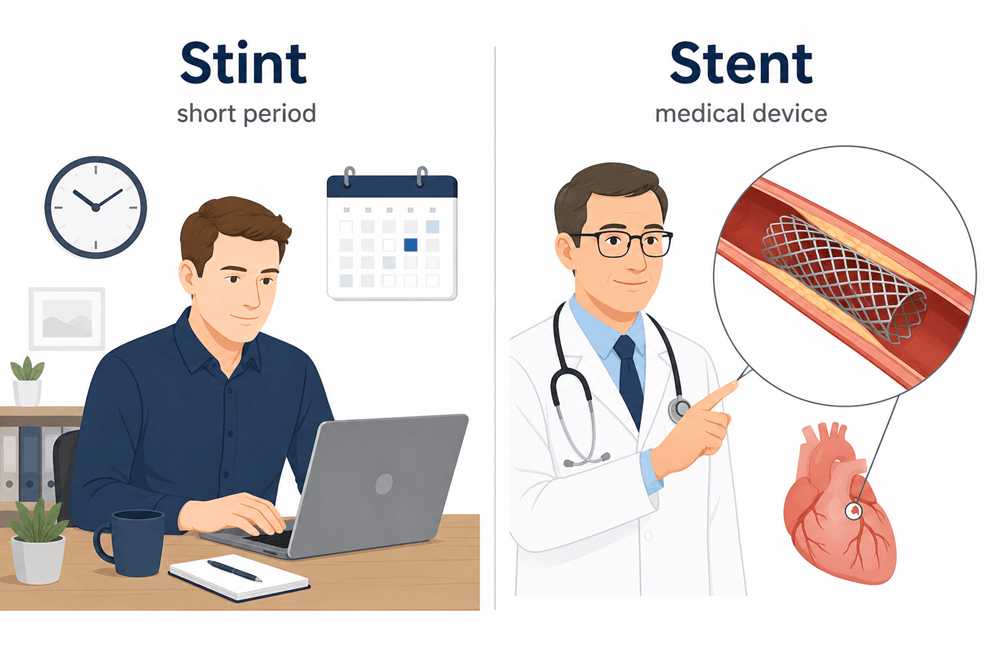
Stint and stent are both real words, but they mean very different things. Use stint when you mean a limited period of time, a fixed amount of work, or a temporary role. Use stent when you mean a small medical tube or device placed inside the body to keep a passage open. The easiest rule is this: stint is about time or limits, while stent is a medical device.
Quick Answer
Use stint when talking about a period of time, a temporary job, or a limited amount of something.
- Correct: She did a short stint as a teacher.
- Correct: He had a brief stint in the military.
- Correct: The actor’s stint on the show lasted one season.
Use stent when talking about a medical device used to keep a blood vessel, duct, or other body passage open.
- Correct: The doctor placed a stent in the blocked artery.
- Correct: He needed a coronary stent after the procedure.
- Correct: A stent can help keep a narrowed passage open.
The simple rule is this: stint means a period or limit. Stent means a medical tube or support device.
Stint or Stent: What Is the Difference?
The difference between stint and stent is meaning. These words look similar and sound somewhat alike, but they are not interchangeable.
Stint is usually a noun meaning a limited period of time spent doing something. You may hear it in phrases like a short stint, a brief stint, a stint in prison, a stint in the army, or a stint as manager.
Stent is a medical noun. It refers to a small tube, mesh, or device inserted into the body to hold open a passage. It is commonly used when talking about arteries, heart procedures, blood vessels, ducts, or other narrowed passages inside the body.
| Word | Main Meaning | Example |
|---|---|---|
| Stint | A limited period of time or amount of work | She had a short stint as editor. |
| Stent | A medical device that keeps a passage open | The surgeon inserted a stent. |
If the sentence is about time, work, service, effort, or a temporary role, use stint. If the sentence is about a medical procedure or a tube-like device in the body, use stent.
What Does Stint Mean?
Stint usually means a fixed, limited, or temporary period of time spent doing something. It often refers to a job, role, assignment, duty, service, or experience that lasts for a while but is not permanent.
Examples:
- She completed a two-year stint overseas.
- He had a short stint as a radio host.
- The chef’s stint at the restaurant made him well known.
- Her first stint in politics lasted only six months.
In these examples, stint points to a span of time. It tells you that someone spent a limited period doing a certain thing.
Stint can also mean a limited amount of work or effort assigned to someone.
- Each volunteer did a two-hour stint at the front desk.
- He finished his morning stint in the garden.
- The workers took turns doing short stints on the late shift.
This use is less about a career role and more about a set amount of work.
What Does Stent Mean?
Stent is a medical word. It refers to a small tube, mesh, or support device placed inside the body to keep a passage open. Stents are often discussed in relation to narrowed or blocked arteries, especially coronary arteries near the heart.
Examples:
- The patient received a stent after the artery was opened.
- The stent helped keep the blood vessel open.
- The doctor explained how the stent would support the narrowed area.
- He had a cardiac stent placed during the procedure.
Stent can appear in many medical phrases, including:
- heart stent
- coronary stent
- artery stent
- ureteral stent
- biliary stent
- stent placement
Because stent is a medical term, it should be spelled carefully. If you are writing about a procedure, artery, vessel, duct, tube, blockage, or internal support device, the word is almost certainly stent, not stint.
Is Stint Wrong?
Stint is not wrong, but it is wrong if you mean the medical device. A stint is a period of time, a role, or a limited amount of work. It is not the tube placed in an artery or other body passage.
Correct:
- She had a short stint as a nurse.
- He did a stint in the navy.
- The singer’s stint on Broadway changed her career.
Incorrect when referring to a medical device:
- He had a stint placed in his artery.
- The doctor inserted a heart stint.
Correct medical spelling:
- He had a stent placed in his artery.
- The doctor inserted a heart stent.
If the sentence involves a medical implant or a body passage, use stent.
Is Stent Wrong?
Stent is not wrong when you are talking about medicine. It is the correct word for a small device used to keep a passage open inside the body.
Examples:
- The stent was placed in the blocked artery.
- The patient asked how long the stent would remain in place.
- The procedure involved placing a stent in the narrowed vessel.
However, stent is wrong if you mean a temporary period of time or job experience.
Incorrect:
- She had a short stent as a teacher.
- He did a stent in the military.
Correct:
- She had a short stint as a teacher.
- He did a stint in the military.
If the sentence is about someone spending time in a role, use stint.
When to Use Stint
Use stint when you mean a temporary job, role, assignment, period of service, or limited amount of work.
Examples:
- He had a brief stint as a bartender.
- She began her career with a stint at a local newspaper.
- The coach’s stint with the team ended after three seasons.
- His stint abroad gave him a wider view of the world.
Stint is often used with words that show time or limitation:
- short stint
- brief stint
- long stint
- two-year stint
- first stint
- second stint
Examples:
- Her brief stint in sales taught her how to speak with customers.
- After a long stint overseas, he returned home.
- The actor’s second stint on the show was more successful than the first.
If you can replace the word with period, spell, term, or stretch of time, stint is probably correct.
When to Use Stent
Use stent when you are writing about a medical device inserted into the body. It is most often used in health, surgery, cardiology, and medical procedure contexts.
Examples:
- The cardiologist recommended a stent.
- The stent was inserted to help blood flow.
- The patient had a stent placed after the blockage was treated.
- The doctor discussed the risks and benefits of stent placement.
Use stent in phrases like:
- heart stent
- coronary stent
- arterial stent
- stent procedure
- stent placement
- stent insertion
If the sentence mentions a doctor, surgery, artery, blockage, narrowed passage, blood flow, catheter, or medical procedure, the correct spelling is usually stent.
Heart Stint or Heart Stent?
The correct phrase is heart stent, not heart stint.
Correct:
- He received a heart stent after the artery was opened.
- The doctor explained the heart stent procedure.
- A heart stent may be used to help keep an artery open.
Incorrect:
- He received a heart stint after the artery was opened.
- The doctor explained the heart stint procedure.
- A heart stint may be used to help keep an artery open.
Stint does not refer to a medical device. If the sentence is about a heart-related procedure, the word is stent.
Short Stint or Short Stent?
The correct phrase is short stint when you mean a brief period of time.
Correct:
- She had a short stint as a substitute teacher.
- His short stint at the company ended quickly.
- The player’s short stint with the team was memorable.
Incorrect:
- She had a short stent as a substitute teacher.
- His short stent at the company ended quickly.
- The player’s short stent with the team was memorable.
A stent is not a period of time. If the sentence means a temporary role or limited time, use stint.
Stint in Prison or Stent in Prison?
The correct phrase is stint in prison.
Correct:
- He served a short stint in prison.
- Her stint in prison changed her outlook.
- The article mentioned his earlier stint in prison.
Incorrect:
- He served a short stent in prison.
- Her stent in prison changed her outlook.
This phrase is about time spent in a place, not a medical device. Use stint.
Stent in Artery or Stint in Artery?
The correct phrase is stent in an artery.
Correct:
- The doctor placed a stent in the artery.
- The stent helped keep the artery open.
- He asked whether the stent in his artery would affect daily activity.
Incorrect:
- The doctor placed a stint in the artery.
- The stint helped keep the artery open.
This phrase is medical, so the correct word is stent.
Stint as a Verb
Stint can also be used as a verb, though this use is less common. As a verb, stint means to limit, restrict, or be sparing with something.
Examples:
- Do not stint on quality when safety matters.
- She never stinted on effort.
- The host did not stint on food for the guests.
This use can sound formal or old-fashioned, but it is correct. It still connects to the idea of limits. If someone does not stint on something, they do not limit it too much.
Common Mistakes With Stint and Stent
The most common mistake is writing stint when the sentence needs the medical word stent.
Incorrect:
- The surgeon inserted a stint.
- He needed a stint after the heart procedure.
- The stint kept the artery open.
Correct:
- The surgeon inserted a stent.
- He needed a stent after the heart procedure.
- The stent kept the artery open.
Another mistake is writing stent when the sentence means a period of time.
Incorrect:
- She had a brief stent as a manager.
- His stent in college radio helped his career.
Correct:
- She had a brief stint as a manager.
- His stint in college radio helped his career.
To avoid confusion, ask whether the sentence is about time or medicine. Time points to stint. Medicine points to stent.
Examples of Stint in Sentences
Here are examples of stint used correctly:
- She had a short stint as a reporter.
- His stint in the army taught him discipline.
- The musician’s stint with the band lasted five years.
- After a brief stint in marketing, he moved into design.
- The coach began his second stint with the team.
- Her stint abroad helped her learn a new language.
- Each worker completed a four-hour stint at the booth.
- The actor’s stint on the show made him famous.
In each sentence, stint refers to a period of time, role, service, or assigned work.
Examples of Stent in Sentences
Here are examples of stent used correctly:
- The doctor placed a stent in the narrowed artery.
- The patient asked questions about the stent procedure.
- The stent helped support the blood vessel.
- He received a coronary stent after the blockage was treated.
- The surgeon checked that the stent was positioned correctly.
- A stent may be used to keep a passage open.
- The medical team discussed whether a stent was needed.
- She read the discharge instructions after stent placement.
In each sentence, stent refers to a medical device, not a period of time.
How to Remember Stint or Stent
A simple way to remember the difference is this:
- Stint = time, term, or limited work
- Stent = medical device
You can also remember that stint has an i, like interval. A stint is often an interval of time. Stent has an e, like equipment. A stent is medical equipment.
Another quick reminder is:
A short stint is time. A heart stent is medical.
If you remember those two phrases, you can choose the right word in most sentences.
Final Answer
Stint and stent are both correct words, but they have different meanings. Stint usually means a limited period of time, a temporary role, or a fixed amount of work. Use it in phrases like short stint, brief stint, stint in prison, or stint as manager.
Stent is a medical device placed inside the body to help keep a passage open. Use it in phrases like heart stent, coronary stent, stent placement, and stent in an artery. The easiest rule is simple: stint is about time or limits, and stent is about medicine.