Eyeing or Eying: Correct Spelling, Meaning, and Easy Ways to Remember It
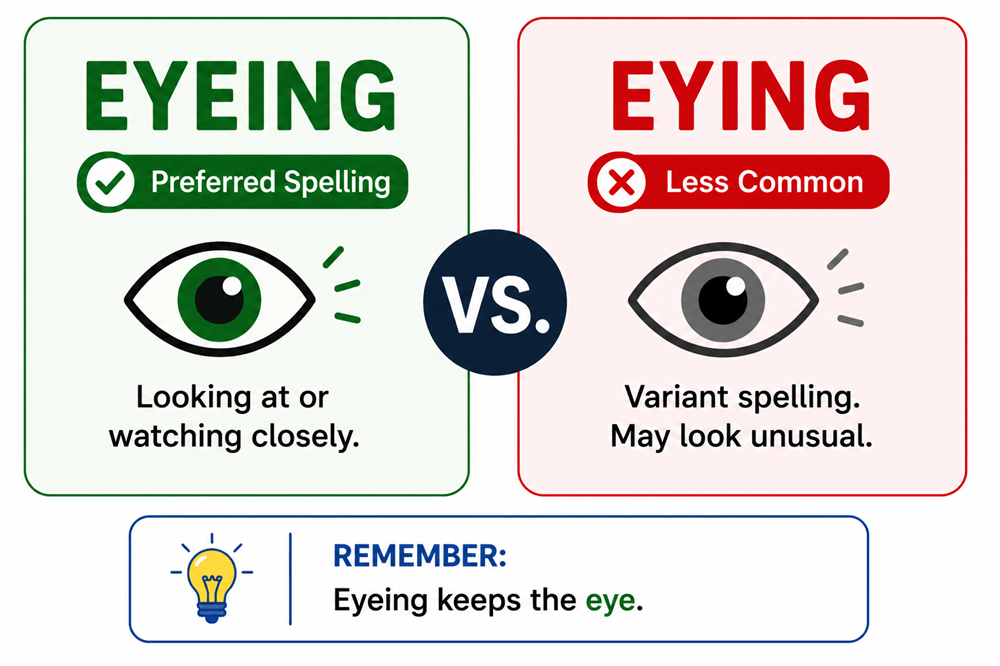
If you are choosing between eyeing or eying, both spellings can be correct, but eyeing is the more common and clearer choice. The word means looking at something carefully, watching it with interest, or considering it as a possibility. Eying is a shorter variant, but it can look unusual to many readers, so eyeing is usually safer.
Eyeing or Eying: Which Spelling Is Correct?
Eyeing and eying are both accepted spellings of the -ing form of eye. However, eyeing is generally the preferred spelling in modern everyday writing.
You should usually write:
Preferred: She was eyeing the last slice of cake.
Also possible: She was eying the last slice of cake.
The meaning is the same in both sentences. The difference is style and familiarity. Eyeing keeps the full word eye visible, which makes the spelling easier to recognize. Eying drops the second e, but that can make the word look strange or less immediately clear.
For most schoolwork, articles, emails, captions, stories, and professional writing, eyeing is the better choice.
What Does Eyeing Mean?
Eyeing is the present participle of the verb eye. As a verb, eye means to look at, watch, observe, inspect, or consider something carefully.
For example:
You were eyeing the shoes in the store window.
This means you were looking at the shoes with interest, maybe because you wanted to buy them.
You might also write:
The company is eyeing a larger office downtown.
Here, eyeing does not mean the company literally has eyes. It means the company is considering or watching that option closely.
The word can be literal or figurative. You can eye a person, a dessert, a prize, a job, a house, a deal, a goal, or an opportunity. In every case, the idea is focused attention.
What Does Eying Mean?
Eying means the same thing as eyeing. It is simply a variant spelling. You may see it in dictionaries, older writing, or certain edited publications, but it is less common in everyday use.
For example:
He was eying the door, hoping for a chance to leave.
This means he was watching the door carefully.
The spelling eying is not automatically wrong, but it may cause a reader to pause. Because it removes the full spelling of eye, it can look a little bare or awkward. Some readers may even wonder whether it is a typo.
That is why eyeing is usually more practical. It keeps the meaning clear at first glance.
Why Eyeing Looks More Natural
Eyeing looks more natural because it preserves the base word eye. When you see eyeing, you can immediately spot the word eye inside it:
eye + ing = eyeing
This is helpful because eye is already an unusual-looking word. It has three letters, but only one spoken syllable. If you shorten it to eying, the word can look less connected to its meaning.
Compare these two spellings visually:
eyeing
eying
The first one clearly shows the word eye. The second one still works, but it may not feel as familiar. Since clarity matters in writing, eyeing is usually the stronger choice.
Why Eying Exists
Eying exists because English often drops a silent final e before adding -ing. You see this pattern in many common words:
make → making
take → taking
use → using
move → moving
Following that pattern, someone might expect:
eye → eying
That is why eying makes some spelling sense. However, eye is a special case because keeping the e helps preserve the recognizable word. Without it, the spelling can look less clear.
So while eying follows a common spelling instinct, eyeing is usually preferred because it is easier to read.
A Simple Way to Remember Eyeing
The easiest memory trick is:
Eyeing keeps the eye.
This works because eyeing keeps the full word eye at the beginning. If you are talking about looking, watching, or observing, it makes sense to keep the word eye visible.
You can also remember:
You use your eye when you are eyeing something.
That sentence connects the meaning directly to the spelling. Since the word is about looking, the spelling with eye is easier to remember.
Another quick clue is:
Eyeing looks like eye + ing.
This is the simplest structure. Start with eye, add ing, and you get eyeing.
Common Uses of Eyeing
Eyeing is useful because it can suggest several kinds of attention. Sometimes it means desire. Sometimes it means suspicion. Sometimes it means careful consideration.
Eyeing something you want means looking at it with interest.
You were eyeing the chocolate cake all evening.
Eyeing someone suspiciously means watching them because something feels questionable.
The guard was eyeing the stranger near the entrance.
Eyeing an opportunity means considering it seriously.
She is eyeing a promotion next year.
Eyeing a purchase means thinking about buying something.
You are eyeing a new laptop before the sale ends.
In each case, eyeing shows focused attention.
Eyeing vs Eying in Example Sentences
Side-by-side examples can help you see why eyeing often feels clearer:
Preferred: The cat was eyeing the fish bowl.
Less common: The cat was eying the fish bowl.
Preferred: You are eyeing a new apartment closer to work.
Less common: You are eying a new apartment closer to work.
Preferred: He kept eyeing the clock during the meeting.
Less common: He kept eying the clock during the meeting.
Preferred: The team is eyeing a championship this season.
Less common: The team is eying a championship this season.
Preferred: She was eyeing the dress but did not buy it.
Less common: She was eying the dress but did not buy it.
Both forms can be understood, but eyeing looks smoother and more familiar in most modern writing.
Is Eyeing Formal or Informal?
Eyeing is not extremely formal, but it is common enough for many types of writing. It works in casual sentences, news-style writing, business commentary, sports writing, storytelling, and everyday descriptions.
For example:
The company is eyeing expansion into new markets.
This sounds normal in business or news writing.
The child was eyeing the cookie jar.
This sounds natural in everyday storytelling.
The athlete is eyeing another record.
This sounds common in sports writing.
If you want a more formal alternative, you can use words like considering, watching, observing, studying, evaluating, or looking at. Still, eyeing is perfectly useful when the tone fits.
How to Check Which Spelling You Need
Before choosing between eyeing and eying, ask yourself one simple question:
Do you want the clearest and most familiar spelling?
If yes, choose eyeing.
You can use this quick check:
Is the word about looking?
Keep eye in the spelling.
Write eyeing.
This works because the full word eye reminds the reader of the meaning. The spelling eying is shorter, but it does not help the reader as much.
The Final Answer on Eyeing or Eying
Eyeing and eying are both possible spellings, but eyeing is the more common and clearer choice. It means looking at, watching, considering, or observing something carefully.
To remember the difference, use the phrase eyeing keeps the eye. Since the word is about looking, keeping eye in the spelling makes sense. Eying may be accepted as a variant, but it can look less familiar or less polished.
So when you are writing about someone watching a prize, considering an opportunity, looking at a dessert, or observing something closely, choose eyeing. It is the cleanest, clearest, and most reader-friendly spelling.