Truly or Truely: Correct Spelling, Meaning, Usage, Examples, and Memory Tips Explained
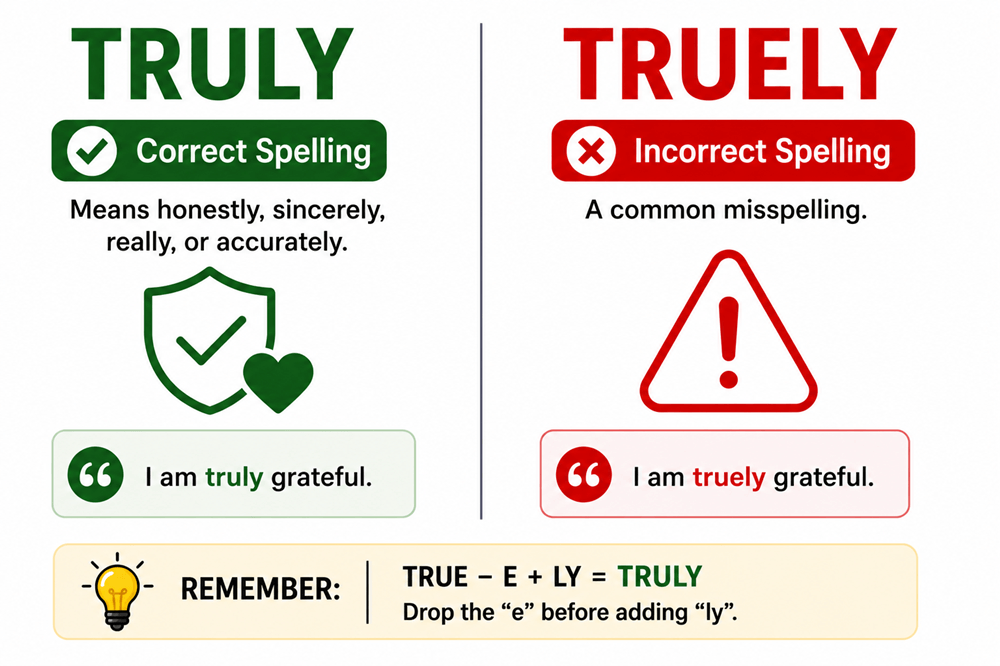
Truly is the correct spelling. Truely is a common misspelling. Use truly when you mean honestly, really, sincerely, accurately, or completely. The spelling is tricky because the base word is true, but when you add -ly, the final e disappears.
Quick Answer
Use truly, not truely.
- Correct: I am truly sorry.
- Correct: She truly cares about her students.
- Correct: That was a truly beautiful moment.
Truely is not the standard spelling.
- Incorrect: I am truely sorry.
- Incorrect: She truely cares about her students.
The simple rule is: true drops the e before adding ly, so the correct spelling is truly.
Truly or Truely: What Is the Difference?
The difference between truly and truely is spelling. Truly is the correct adverb. Truely is a misspelling that happens because people keep the e from true.
| Word | Status | Example |
|---|---|---|
| Truly | Correct spelling | He was truly grateful. |
| Truely | Incorrect spelling | He was truely grateful. |
If you are writing for school, work, emails, captions, articles, cards, or professional content, always use truly.
What Does Truly Mean?
Truly is an adverb. It can mean honestly, sincerely, really, correctly, or completely. It adds emphasis to a sentence and shows that something is genuine or accurate.
Examples:
- I truly appreciate your help.
- She was truly happy for him.
- The story is truly inspiring.
- He truly believed he could succeed.
- The answer was truly surprising.
In each sentence, truly strengthens the meaning. It shows that the feeling, belief, quality, or statement is real rather than fake, exaggerated, or uncertain.
What Does Truely Mean?
Truely is a misspelling of truly. It is easy to understand why this mistake happens. Since the adjective is true, many people assume the adverb should be:
- true + ly = truely
That looks logical, but it is not correct. The standard spelling removes the final e:
- true – e + ly = truly
Even though readers may understand truely, it looks incorrect in polished writing. The correct word is always truly.
Spelling Structure: Why True Becomes Truly
The spelling of truly follows a special change. You start with true, remove the silent e, and add -ly.
- true – e = tru
- tru + ly = truly
The final spelling is:
- truly
The important spelling clue is that truly has no e after u.
- Correct: truly
- Incorrect: truely
This is the part to memorize. The word keeps the meaning of true, but it does not keep the full spelling of true.
Why People Misspell Truly as Truely
People often write truely because many adverbs are made by adding -ly directly to an adjective.
- quick → quickly
- slow → slowly
- clear → clearly
Because of that pattern, true → truely seems reasonable. But English sometimes changes the spelling before adding a suffix. With truly, the final e disappears.
This is similar to words like:
- due → duly
- whole → wholly
The best way to avoid the mistake is to remember the short form: truly has only five letters.
When to Use Truly
Use truly when you mean sincerely or honestly.
- I am truly sorry for the mistake.
- She truly meant what she said.
- We are truly thankful for your support.
Use truly when you mean really or very.
- That was a truly amazing performance.
- The view was truly beautiful.
- It was a truly difficult decision.
Use truly when you mean accurately or correctly.
- The book truly reflects his experience.
- The painting truly captures the mood of the city.
- Her words truly describe how many people feel.
In all of these uses, the spelling stays the same: truly.
Common Phrases With Truly
Truly appears in many everyday phrases. Learning these phrases can help you remember the correct spelling.
- truly sorry
- truly grateful
- truly happy
- truly believe
- truly understand
- truly beautiful
- truly yours
The phrase truly yours is sometimes used as a polite closing in letters. It also uses truly without an e.
Truly vs True
True is usually an adjective. Truly is an adverb.
| Word | Part of Speech | Example |
|---|---|---|
| True | Adjective | That story is true. |
| Truly | Adverb | She truly believed the story. |
Use true to describe a noun or statement. Use truly to describe an action, feeling, quality, or whole idea.
- That is a true statement.
- I truly agree with you.
Common Mistakes
The most common mistake is keeping the e from true.
Incorrect:
- I truely love this song.
- She was truely honest.
- That was a truely special day.
Correct:
- I truly love this song.
- She was truly honest.
- That was a truly special day.
Another mistake is using true when the sentence needs an adverb.
Incorrect:
- I true appreciate it.
Correct:
- I truly appreciate it.
How to Remember Truly
Use these memory tips:
- Truly comes from true, but the final e drops.
- Think: true – e + ly = truly.
- Truly has five letters: t-r-u-l-y.
- If you write truely, you have kept an extra e.
A simple memory sentence is: To spell truly truly, drop the e.
You can also remember it visually:
- true → tru → truly
The word still means something connected to truth, but the spelling becomes shorter.
Final Answer
Truly is the correct spelling. It means honestly, sincerely, really, accurately, or completely. Example: I truly appreciate your help.
Truely is a misspelling and should be avoided. To remember the correct form, use the structure true – e + ly = truly. The correct word has no e after u.