Upmost or Utmost: Correct Spelling, Meaning, Difference, and Examples for Better Writing
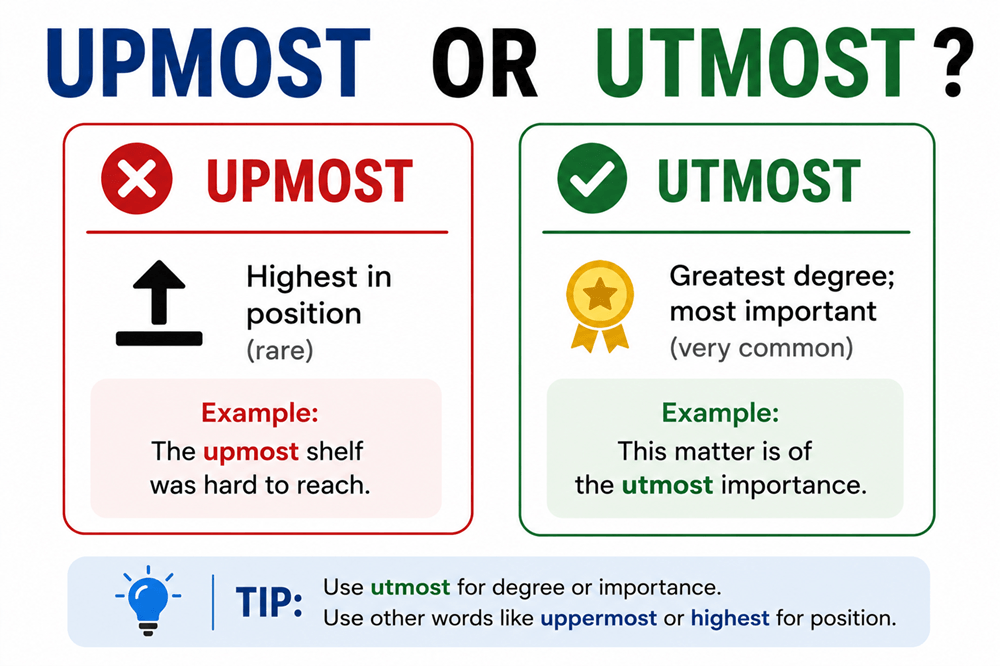
Utmost is the correct word when you mean the greatest, highest, most extreme, or most important degree of something. Upmost is a rare word that can mean highest in position, but it is almost never the word people need in everyday writing. In most sentences, especially phrases like utmost importance, utmost respect, and utmost care, the correct spelling is utmost.
Quick Answer
Use utmost when you mean the greatest amount, highest degree, or most extreme level.
- Correct: This matter is of the utmost importance.
- Correct: Please handle the package with the utmost care.
- Correct: She treated everyone with the utmost respect.
Upmost is not the correct spelling in these common phrases.
- Incorrect: This matter is of the upmost importance.
- Incorrect: Please handle the package with the upmost care.
- Incorrect: She treated everyone with the upmost respect.
The simple rule is this: if you mean “greatest” or “most important,” use utmost.
Upmost or Utmost: What Is the Difference?
The difference between upmost and utmost is meaning and usage. Utmost is the common and standard word. It means greatest, highest in degree, most extreme, or most serious. It is used when talking about care, respect, importance, effort, attention, urgency, secrecy, and similar ideas.
Upmost is a much rarer word. It can mean highest in physical position, similar to uppermost. However, most modern writers do not use upmost often. In everyday English, people who write upmost usually mean utmost.
| Word | Main Meaning | Example |
|---|---|---|
| Utmost | Greatest, highest degree, most extreme | The issue requires the utmost care. |
| Upmost | Highest in physical position; rare | The upmost shelf was hard to reach. |
If you are writing a normal sentence about importance, respect, care, seriousness, or effort, choose utmost.
What Does Utmost Mean?
Utmost means the greatest possible amount, level, degree, or extent. It often adds seriousness or emphasis to a sentence. When something needs your utmost attention, it needs your highest level of attention. When something is of the utmost importance, it is extremely important.
Examples:
- The decision must be made with the utmost care.
- She showed the utmost patience during the delay.
- The safety of the children is of the utmost importance.
- He handled the private information with the utmost discretion.
In each sentence, utmost intensifies the noun that follows it. It tells the reader that the care, patience, importance, or discretion is at the highest level.
Utmost often sounds formal, polished, or serious. You may see it in business writing, legal writing, customer service messages, school essays, formal letters, and professional communication.
What Does Upmost Mean?
Upmost is a rare word that can mean highest or uppermost in position. It is related to the idea of being physically up or at the top. However, it is not commonly used in modern English. Most writers would use uppermost, topmost, or highest instead.
Examples:
- The upmost branch caught the sunlight.
- The box was placed on the upmost shelf.
- The flag flew from the upmost point of the tower.
These sentences are understandable, but they sound unusual. More natural versions would be:
- The uppermost branch caught the sunlight.
- The box was placed on the top shelf.
- The flag flew from the highest point of the tower.
Because upmost is so rare, it is usually better to avoid it unless you have a specific reason to use it. In most situations, utmost or another clearer word is better.
Why Upmost Is Usually a Mistake
Upmost is usually a mistake because many people hear utmost and assume it must be connected to the word up. Since utmost means something like “highest” in degree, upmost may seem logical at first.
However, the standard word for “greatest degree” is utmost, not upmost.
Incorrect:
- This project requires your upmost attention.
- We treat customer privacy with the upmost seriousness.
- The documents must be handled with upmost care.
Correct:
- This project requires your utmost attention.
- We treat customer privacy with the utmost seriousness.
- The documents must be handled with utmost care.
If the sentence is about degree, seriousness, value, effort, or importance, utmost is the correct spelling.
When to Use Utmost
Use utmost when you want to describe the greatest possible level of something. It is especially common before abstract nouns.
Examples:
- utmost care
- utmost respect
- utmost importance
- utmost attention
- utmost urgency
- utmost confidence
- utmost discretion
- utmost sincerity
Examples in full sentences:
- The patient’s comfort is of the utmost importance.
- Please complete the form with the utmost accuracy.
- The teacher listened with the utmost patience.
- They approached the situation with the utmost caution.
Utmost works best when the tone is serious, careful, respectful, or formal. It gives the sentence more weight than words like great or very high.
When to Use Upmost
Use upmost only if you specifically mean highest in physical position. Even then, it may sound old-fashioned or uncommon. Most readers will find uppermost, topmost, or highest more natural.
Possible but rare:
- The upmost window was open.
- The upmost row of seats had the best view.
- The upmost stone was loose.
More natural:
- The top window was open.
- The highest row of seats had the best view.
- The uppermost stone was loose.
For most modern writing, you will rarely need upmost. If your sentence does not involve physical height or position, do not use it.
Utmost Importance or Upmost Importance?
The correct phrase is utmost importance.
Correct:
- This issue is of the utmost importance.
- Your safety is our utmost importance.
- The deadline is of utmost importance to the team.
Incorrect:
- This issue is of the upmost importance.
- Your safety is our upmost importance.
- The deadline is of upmost importance to the team.
Utmost importance means the highest level of importance. Because this phrase is about degree, not physical position, utmost is the correct word.
Utmost Respect or Upmost Respect?
The correct phrase is utmost respect.
Correct:
- She treated her grandparents with the utmost respect.
- We have the utmost respect for your decision.
- He spoke with the utmost respect during the ceremony.
Incorrect:
- She treated her grandparents with the upmost respect.
- We have the upmost respect for your decision.
- He spoke with the upmost respect during the ceremony.
Utmost respect means the greatest respect. Since respect is not a physical location, upmost does not fit.
Utmost Care or Upmost Care?
The correct phrase is utmost care.
Correct:
- Handle the glass with the utmost care.
- The records were reviewed with utmost care.
- The fragile items were packed with the utmost care.
Incorrect:
- Handle the glass with the upmost care.
- The records were reviewed with upmost care.
- The fragile items were packed with the upmost care.
Utmost care means the highest level of care. This is one of the most common phrases where upmost is mistakenly used.
Utmost vs Uttermost
Utmost and uttermost are related words. Both can mean greatest, farthest, or most extreme. However, utmost is much more common in everyday modern writing.
Examples:
- She gave the task her utmost effort.
- The explorers reached the uttermost edge of the island.
Uttermost often sounds more literary, dramatic, or old-fashioned. Utmost is the better choice for normal phrases like utmost care, utmost importance, and utmost respect.
Utmost vs Uppermost
Utmost and uppermost are also different. Utmost usually refers to degree. Uppermost refers to position or priority.
Examples:
- Utmost: Please treat this matter with the utmost care.
- Uppermost: The uppermost shelf is hard to reach.
Uppermost can also mean most important in someone’s thoughts.
- Her family’s safety was uppermost in her mind.
This means it was the main thing she was thinking about. Still, in common phrases like utmost importance, utmost respect, and utmost attention, use utmost.
Common Mistakes With Upmost and Utmost
The most common mistake is using upmost because it sounds like it should mean “highest.” But when the sentence is about the highest degree of something, the correct word is utmost.
Incorrect:
- We will do our upmost to help.
- The matter requires your upmost attention.
- She handled the problem with upmost patience.
- Confidentiality is of the upmost importance.
Correct:
- We will do our utmost to help.
- The matter requires your utmost attention.
- She handled the problem with utmost patience.
- Confidentiality is of the utmost importance.
Another mistake is using utmost when a simpler word would sound more natural. In casual writing, greatest, highest, most serious, or most careful may sometimes be clearer.
- Formal: This requires the utmost care.
- Simple: This requires great care.
Both versions are correct. The best choice depends on tone.
Examples of Utmost in Sentences
Here are examples of utmost used correctly:
- This matter deserves your utmost attention.
- The nurse treated the patient with the utmost kindness.
- We will make every effort to protect your privacy with the utmost care.
- The judge listened with the utmost seriousness.
- He showed the utmost respect for the family’s wishes.
- The team worked with utmost urgency to solve the problem.
- It is of the utmost importance that the report be accurate.
- She acted with the utmost honesty throughout the process.
In each sentence, utmost means greatest, highest, or most complete.
Examples of Upmost in Sentences
Here are rare examples of upmost used in its physical-position sense:
- The upmost shelf held the oldest books.
- The upmost branch moved in the wind.
- The upmost part of the tower was hidden by fog.
These sentences are possible, but they may sound unusual to many readers. More natural versions would be:
- The top shelf held the oldest books.
- The uppermost branch moved in the wind.
- The highest part of the tower was hidden by fog.
Because upmost is rare, most writers should use a clearer word instead.
How to Remember Upmost or Utmost
A simple way to remember the difference is this:
- Utmost = greatest degree
- Upmost = highest position, but rare
You can also remember the common phrase:
Utmost importance uses utmost.
That phrase helps because utmost importance is one of the most common places where people mistakenly write upmost.
Another quick memory trick is:
- If you mean “top,” use uppermost or highest.
- If you mean “greatest,” use utmost.
In most everyday writing, utmost is the word you want.
Final Answer
Utmost is the correct word when you mean the greatest, highest, most serious, or most extreme degree of something. Use it in phrases like utmost importance, utmost respect, utmost care, utmost attention, and utmost effort.
Upmost is rare and can mean highest in physical position, but it is usually not the word you need. The easiest rule is simple: use utmost for degree and importance. Use uppermost, topmost, or highest if you mean physical position.