Engrained or Ingrained: Correct Spelling, Meaning, Usage, and Memory Tips Explained Clearly
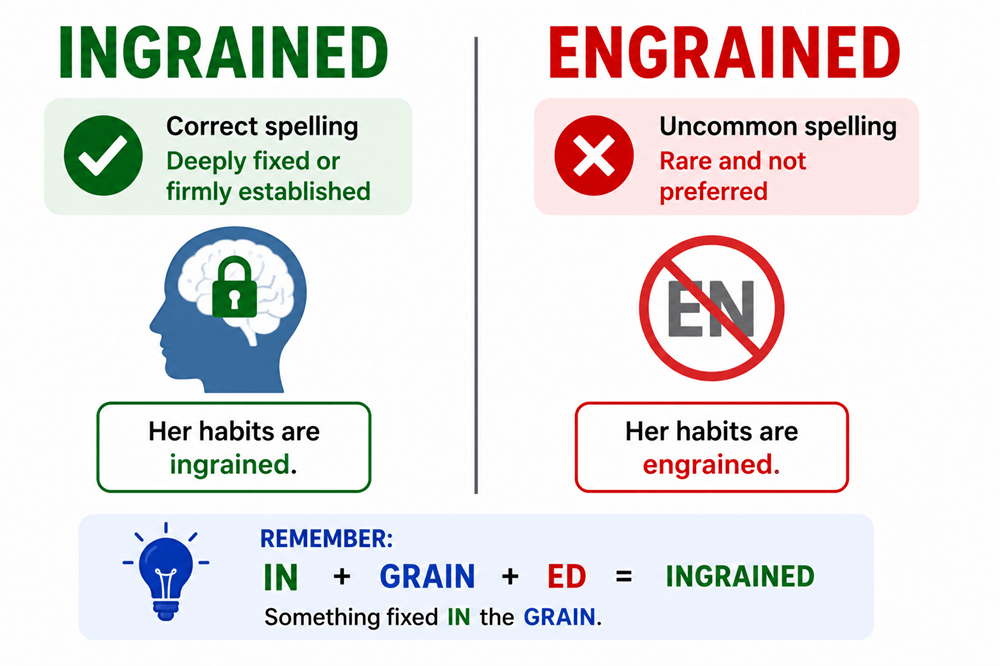
Ingrained is the standard spelling. Engrained is rare and usually not the best choice in modern writing. Use ingrained when something is deeply fixed, firmly established, or hard to change, such as an ingrained habit, belief, fear, custom, or attitude.
Quick Answer
Use ingrained as the normal spelling.
- Correct: Her work habits are deeply ingrained.
- Correct: The belief was ingrained from childhood.
- Correct: Good manners were ingrained in him early.
Engrained is uncommon and can look like a misspelling.
- Less common: The habit was engrained over time.
- Preferred: The habit was ingrained over time.
The simple rule is: ingrained is the standard word for something deeply fixed.
Engrained or Ingrained: What Is the Difference?
The difference between engrained and ingrained is mainly spelling and usage. Ingrained is the common modern spelling. Engrained exists as a much less common variant, but most readers, teachers, editors, and spell-check tools expect ingrained.
| Word | Status | Example |
|---|---|---|
| Ingrained | Standard spelling | The habit is deeply ingrained. |
| Engrained | Rare variant | The habit is deeply engrained. |
If you want your writing to look natural and polished, choose ingrained.
What Does Ingrained Mean?
Ingrained means deeply fixed, firmly established, or difficult to remove. It is often used for habits, beliefs, ideas, behaviors, customs, fears, attitudes, and patterns of thinking.
Examples:
- His fear of failure was deeply ingrained.
- The tradition is ingrained in the community.
- She has an ingrained habit of checking every detail.
- Respect for elders was ingrained in him as a child.
- The company had an ingrained culture of caution.
In each sentence, ingrained describes something that has become part of a person, group, or system over time. It is not temporary or surface-level. It is settled deeply.
What Does Engrained Mean?
Engrained can sometimes be found as a variant of ingrained, but it is uncommon. Because it looks less familiar, many readers may assume it is a spelling error.
Examples:
- Uncommon: The idea was engrained in the culture.
- Preferred: The idea was ingrained in the culture.
Even if engrained appears in some places, it is not the best choice for most writing. For articles, schoolwork, business writing, and everyday use, ingrained is clearer and safer.
Spelling Structure: Why Ingrained Starts With In
The spelling ingrained is easier to remember when you break it into parts:
- in + grain + ed = ingrained
The beginning in is the key. Something ingrained is fixed in someone’s mind, behavior, memory, culture, or routine.
- in the mind
- in the habit
- in the culture
- in the pattern
That makes the spelling easier: if something is deeply fixed in a person or group, it is ingrained.
Why the Word Includes Grain
The middle of ingrained is grain. This connects to the idea of something worked deeply into the grain of a material. Over time, the word came to describe ideas, habits, and beliefs that are deeply worked into a person or culture.
Think of wood grain. If color or dirt is worked into the grain, it is not easy to wipe away. In the same way, an ingrained habit is not easy to remove.
- A surface habit is easy to change.
- An ingrained habit is deep and difficult to change.
This image gives you a strong memory clue: ingrained means worked into the grain.
When to Use Ingrained
Use ingrained when something is strongly established or deeply learned over time.
- The rule became ingrained after years of practice.
- Her politeness was ingrained from a young age.
- The fear was ingrained after a bad experience.
- That attitude is ingrained in the organization.
- The routine became ingrained after months of repetition.
Ingrained often appears with words like deeply, firmly, habit, belief, custom, culture, and behavior.
Common Phrases With Ingrained
These phrases are common and useful:
- deeply ingrained
- ingrained habit
- ingrained belief
- ingrained behavior
- ingrained prejudice
- ingrained tradition
- ingrained in the culture
- ingrained from childhood
In all of these phrases, ingrained is the preferred spelling.
Common Mistakes
The most common mistake is writing engrained because it sounds like other words that begin with en-, such as encourage, enrich, or engrave.
Less common:
- The lesson was engrained in her memory.
- The bias was engrained in the system.
Preferred:
- The lesson was ingrained in her memory.
- The bias was ingrained in the system.
Another mistake is using ingrained for something minor or temporary. If something happened once or changed quickly, ingrained may be too strong.
Too strong:
- He had an ingrained preference after trying it once.
Better:
- He had a preference after trying it once.
Use ingrained when the idea is deep, repeated, and hard to change.
How to Remember Ingrained
Use these memory tips:
- Ingrained starts with in because something is fixed in the mind.
- Ingrained contains grain, like something worked into the grain of wood.
- Think: in + grain + ed = ingrained.
- Use ingrained for deep habits, beliefs, customs, and behaviors.
A simple memory sentence is: If it is deep in the mind, it is ingrained.
You can also picture the spelling this way:
- IN the mind + worked into the GRAIN = INGRAINED
Final Answer
Ingrained is the standard spelling. It means deeply fixed, firmly established, or difficult to change. Example: The habit was deeply ingrained.
Engrained is a rare variant, but it can look like a mistake. For clear modern writing, use ingrained. To remember the spelling, think in + grain + ed: something ingrained is fixed deeply in the mind, habit, or culture.