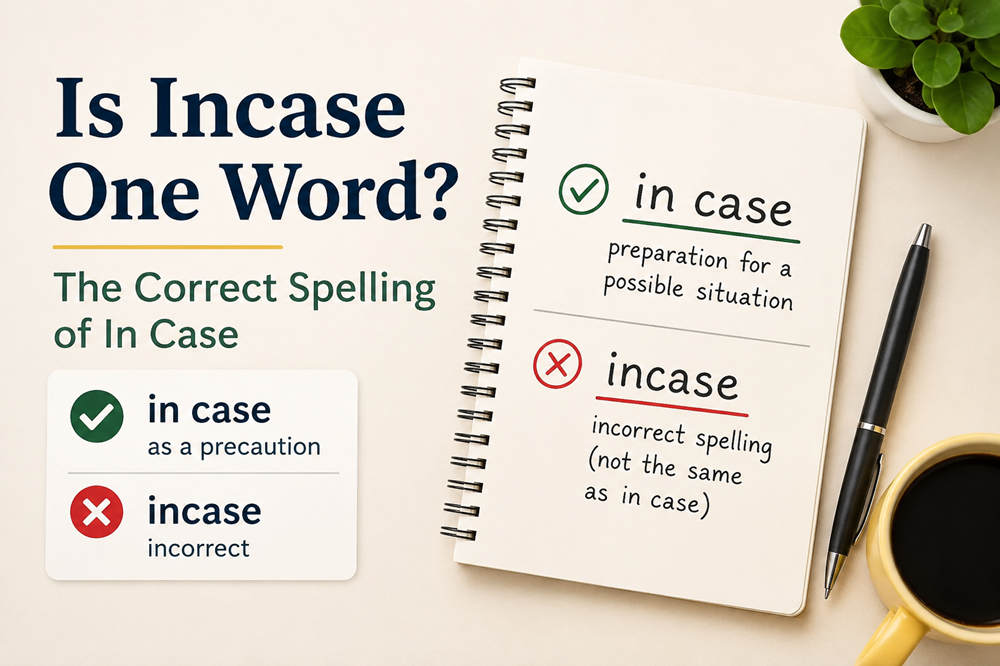
Is Incase One Word? The Correct Spelling of In Case
In case is normally written as two separate words. It is used when someone prepares for something that might happen.
For example:
- Take an umbrella in case it rains.
- Save the receipt in case you need a refund.
The spelling incase should not be used in sentences like these. Although it has a rare dictionary meaning, it is not another spelling of the everyday phrase in case.
Is Incase One Word?
No. When you mean “as a precaution” or “because something might happen,” the correct spelling is in case.
| Correct | Incorrect |
|---|---|
| Bring a jacket in case it gets cold. | Bring a jacket incase it gets cold. |
| Keep a copy in case the original is lost. | Keep a copy incase the original is lost. |
| Leave early in case traffic is heavy. | Leave early incase traffic is heavy. |
Merriam-Webster defines in case as something done as a precaution against a possible event. Although the words may sound joined together in speech, they remain separate in writing.
What Does In Case Mean?
In case introduces a possible situation that someone prepares for in advance. The situation may never happen, but the person takes action so they will be ready.
Consider this example:
I packed a sweater in case the weather turned cold.
The speaker does not know whether the weather will become cold. Packing the sweater is a precaution.
Here are a few more examples:
- Charge your phone in case you cannot find an outlet later.
- Bring some cash in case the card machine is not working.
- Save your work in case the computer crashes.
- Write down the address in case you lose internet access.
- Keep the packaging in case you need to return the product.
In Case vs. If
In case and if are sometimes confused, but they do not always express the same idea.
Use in case when an action is taken before a possible event:
Take an umbrella in case it rains.
You take the umbrella before it starts raining as a precaution.
Use if when one action depends on another event happening:
Open the umbrella if it rains.
You open it only after the rain begins.
| Expression | Meaning | Example |
|---|---|---|
| in case | Preparation before something might happen | Take my number in case you need help. |
| if | An action depends on something happening | Call me if you need help. |
This difference also explains why the following sentence sounds unnatural:
Call me in case your plans change.
If the intended meaning is that the person should call only when their plans change, write:
Call me if your plans change.
In Case vs. In Case Of
Both expressions refer to possible situations, but they are followed by different grammatical structures.
In Case + Clause
Use in case before a clause containing a subject and a verb:
- Take a coat in case it gets cold.
- Keep the receipt in case you need a refund.
- Bring your charger in case your battery runs low.
In Case Of + Noun
Use in case of before a noun or noun phrase. This form often appears in warnings and safety instructions.
- In case of fire, use the stairs.
- Call this number in case of an emergency.
- The event will move indoors in case of heavy rain.
Cambridge explains that in case of is followed by a noun and means “if and when” an event happens.
| Pattern | Example |
|---|---|
| in case + subject + verb | Bring an umbrella in case it rains. |
| in case of + noun | Bring an umbrella in case of rain. |
Is Incase Ever Correct?
Incase does appear in some dictionaries, but not with the meaning “as a precaution.”
Collins lists incase as a variant spelling of encase, a verb meaning to surround or enclose something.
For example:
- The wires were encased in plastic.
- The painting was encased in protective glass.
- The fossil was encased in rock.
Encase is the familiar modern spelling and is less likely to confuse readers. In ordinary writing, use:
- in case for a possible situation or precaution
- encase for surrounding or enclosing something
What Does Just in Case Mean?
Just in case means taking an extra precaution even though it may not be needed.
- I brought an extra shirt just in case.
- Keep my number just in case you need help.
- We booked a table just in case the restaurant was busy.
- I saved another copy, just in case.
The possible situation does not always need to be stated. In the sentence “I brought some cash just in case,” the context usually makes the reason clear.
Like in case, the expression just in case is written with a space between in and case.
Final Answer
In case is written as two words when it refers to a precaution or something that might happen.
Correct:
Bring your ID in case they ask to see it.
Incorrect:
Bring your ID incase they ask to see it.
Incase has been recorded as a variant of encase, but it should not replace the phrase in case. A simple way to remember the spelling is this: if the phrase means “as a precaution,” write in case as two words.