Requester or Requestor: Difference, Correct Usage, Meaning, Examples, and Memory Tips Explained
Requester and requestor are both used for someone who makes a request, but requester is usually the better everyday choice. Requestor appears more often in legal, technical, business, or system-related contexts. If you are writing normally, use requester. If you are following a form, contract, software field, or official document that uses requestor, keep that spelling.
Quick Answer
Use requester for the person who asks for something.
- The requester must include a valid email address.
- The requester asked for a copy of the report.
- Each requester will receive a confirmation message.
Use requestor when it appears in formal, legal, business, or technical wording.
- The requestor must submit proof of identity.
- The system sends the requestor an approval notice.
- The requestor agrees to the terms listed below.
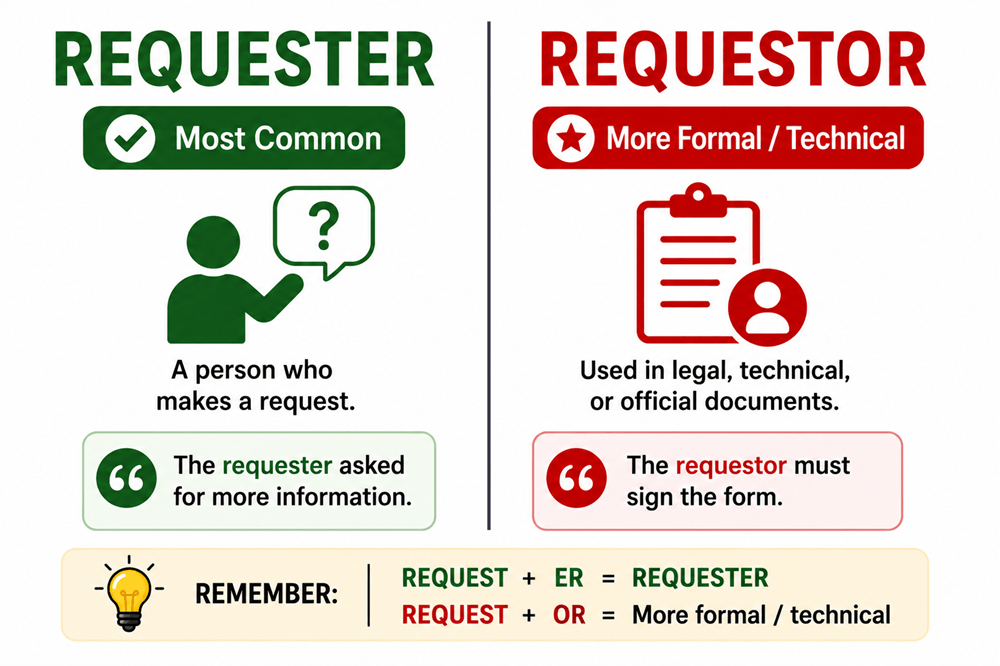
The simple rule is: requester is the common spelling, while requestor is more formal or specialized.
Requester or Requestor: What Is the Difference?
The difference between requester and requestor is mostly style and context. Both words can mean a person who requests something. However, requester is more natural in general English because many English nouns for people use the -er ending.
Requestor uses the -or ending, which often appears in formal roles, legal wording, and technical systems. That is why you may see requestor on forms, contracts, help desk software, database fields, ticketing systems, and compliance documents.
| Word | Best Use | Example |
|---|---|---|
| Requester | General English | The requester asked for more details. |
| Requestor | Legal, technical, or formal documents | The requestor must sign the form. |
What Does Requester Mean?
Requester means a person who makes a request. A requester may ask for information, permission, service, access, support, documents, money, or approval.
Examples:
- The requester filled out the application.
- Please contact the requester before closing the ticket.
- The requester needs access to the shared folder.
- The requester asked for a refund.
- The requester should receive a response within two business days.
Requester sounds clear and direct. It works well in everyday writing, customer service, emails, workplace communication, instructions, and website copy.
What Does Requestor Mean?
Requestor also means someone who makes a request. The meaning is usually the same as requester, but the tone is more official or system-like.
Examples:
- The requestor must provide a case number.
- The requestor’s identity will be verified.
- The requestor may withdraw the application in writing.
- The requestor is responsible for accurate information.
You may see requestor in policy documents, legal notices, software labels, insurance forms, medical records, access requests, and government paperwork. In these settings, it may be the preferred spelling because the organization has chosen it as part of its official terminology.
Spelling Structure: Why Requester Ends in ER
Requester follows a very common English pattern:
- request + er = requester
The ending -er often means “a person who does something.”
- teach → teacher
- write → writer
- work → worker
- request → requester
This makes requester easy to understand. A requester is a person who requests. If you are unsure which spelling to use, requester is usually the safer choice because it follows this familiar pattern.
Spelling Structure: Why Requestor Ends in OR
Requestor uses the ending -or:
- request + or = requestor
The -or ending also appears in many role words, especially formal ones.
- actor
- director
- contractor
- administrator
Because of that formal feel, requestor often appears in official systems or documents. It may sound more legal, administrative, or technical than requester.
When to Use Requester
Use requester in normal writing when you mean someone who asks for something.
- The requester should explain the reason for the request.
- Send the file to the requester after approval.
- The requester forgot to attach the document.
- Each requester must complete the form.
Requester is a good choice for blog posts, help articles, internal instructions, support tickets, customer service pages, and general business communication.
When to Use Requestor
Use requestor when you are following a specific document, form, legal template, or software system that already uses that spelling.
- The requestor must certify that the information is correct.
- The requestor ID appears at the top of the form.
- The requestor will be notified when the case is reviewed.
The biggest rule is consistency. If a form uses requestor throughout, do not switch to requester halfway through the same document. If your article or guide uses everyday English, requester is usually better.
Requester vs Applicant
Requester and applicant are related, but they are not always the same. A requester asks for something. An applicant formally applies for something.
| Word | Meaning | Example |
|---|---|---|
| Requester | Someone making a request | The requester asked for access. |
| Applicant | Someone applying formally | The applicant applied for the job. |
If the person is simply asking, use requester. If the person is applying for a job, program, license, school, or grant, applicant may be more exact.
Common Mistakes
A common mistake is assuming one spelling is always wrong. Requester and requestor both exist, but they do not feel equally natural in every context.
Less natural in everyday writing:
- The requestor asked for a meeting.
More natural:
- The requester asked for a meeting.
Another mistake is switching between both spellings in one document.
Inconsistent:
- The requester must submit the form. The requestor will receive a confirmation.
Better:
- The requester must submit the form. The requester will receive a confirmation.
How to Remember the Difference
Use these memory tips:
- Requester ends in -er, like worker and teacher.
- Requester is the normal everyday spelling.
- Requestor ends in -or, like formal role words such as director or contractor.
- Use requester unless a form, system, or organization uses requestor.
A simple memory sentence is: A requester is someone who requests; a requestor sounds more official.
Final Answer
Requester is the best general spelling for a person who makes a request. Example: The requester asked for more information.
Requestor is also used, especially in legal, technical, business, or official contexts. Example: The requestor must sign the form.
To remember the difference, use this rule: requester is common and everyday; requestor is formal and specialized.