Whoa or Woah: Which Spelling Is Correct When You Express Sudden Surprise?
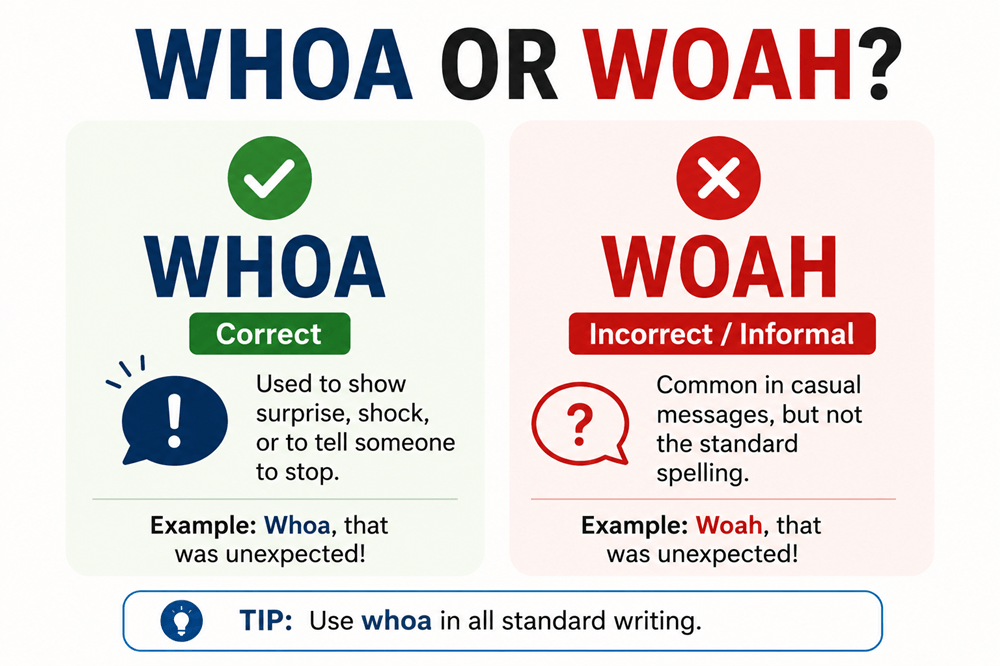
Whoa and woah are both used to show surprise, shock, amazement, or a sudden pause, but only whoa is the standard spelling. Woah is common online and in casual messages, but it is usually treated as a misspelling or informal variant. If you want the spelling that looks correct in polished writing, use whoa.
Quick Answer
Use whoa when you want to express surprise, amazement, alarm, or a sudden request to stop.
- Correct: Whoa, that was close.
- Correct: Whoa, you finished that fast.
- Correct: Whoa there, slow down.
Woah is a common informal spelling, especially in texting, social media posts, and casual online writing. However, it is not the preferred spelling in standard English.
- Informal: Woah, that looks amazing.
- Preferred: Whoa, that looks amazing.
The simple rule is this: whoa is standard. Woah is casual and less accepted.
Whoa or Woah: What Is the Difference?
The difference between whoa and woah is spelling, not meaning. Both are used as interjections. That means they are words you use to express a reaction, feeling, or sudden response rather than to name an object or describe an action.
Whoa is the traditional and widely accepted spelling. It is the form you should use in articles, school writing, professional writing, captions, dialogue, and most edited content.
Woah is a newer-looking informal spelling. Many people write it because it seems to match the sound of the word. Since the word is usually pronounced like “woah,” the spelling without the h after w can look natural at first. Still, the accepted spelling is whoa.
| Word | Status | Example |
|---|---|---|
| Whoa | Standard spelling | Whoa, that was unexpected. |
| Woah | Informal variant or misspelling | Woah, that was unexpected. |
If you are choosing between the two, whoa is almost always the better choice.
What Does Whoa Mean?
Whoa is used to show surprise, shock, excitement, disbelief, or caution. It can also mean “stop” or “slow down,” especially in older or traditional use.
For example, if someone tells you an unbelievable story, you might say:
- Whoa, really?
- Whoa, I did not expect that.
- Whoa, that changes everything.
If something almost goes wrong, you might use whoa as a startled reaction:
- Whoa, that car came out of nowhere.
- Whoa, be careful with that glass.
- Whoa, you almost dropped it.
You can also use whoa when something impresses you:
- Whoa, this view is beautiful.
- Whoa, your drawing is incredible.
- Whoa, that cake looks amazing.
The meaning depends on the situation. Sometimes whoa means “I am amazed.” Sometimes it means “I am surprised.” Sometimes it means “stop for a second.” But in every case, whoa is the standard spelling.
What Does Woah Mean?
Woah usually means the same thing as whoa. People use it to express surprise, shock, excitement, or disbelief. The difference is that woah is not the preferred spelling.
You may see woah in casual online conversations like these:
- Woah, that video is wild.
- Woah, I forgot about that.
- Woah, this song is good.
These sentences are understandable, and many readers will know exactly what the writer means. The issue is not meaning. The issue is correctness and polish.
In edited writing, these sentences should usually be spelled with whoa instead:
- Whoa, that video is wild.
- Whoa, I forgot about that.
- Whoa, this song is good.
Woah may feel natural because it follows the sound of the word, but whoa is the spelling most style-conscious readers expect.
Why Whoa Is the Correct Spelling
Whoa is the correct spelling because it is the established form in standard English. It may look a little strange because the letters do not seem to match the pronunciation perfectly. However, English has many words like that. Spelling often preserves older forms, historical patterns, or traditional usage.
The spelling whoa is also connected to the older use of the word as a command. A rider or driver could say whoa to a horse to make it stop or slow down. Over time, the word became useful in ordinary speech too. Now you can say whoa even when there is no horse, no vehicle, and no literal stopping involved.
For example:
- Whoa, slow down.
- Whoa there, let me explain.
- Whoa, that is too much information.
In these examples, whoa works as a pause signal. It tells the other person that something is surprising, too fast, too intense, or worth stopping to notice.
Is Woah Wrong?
Woah is common, but it is not the best spelling for standard writing. Many people would consider it a misspelling of whoa. Others may call it an informal variant because it appears so often in casual digital communication.
That means woah is not always a serious mistake in a text message or casual comment. If you are chatting with a friend and write “woah,” your meaning will be clear. But if you are writing a blog article, school assignment, professional caption, story, or edited post, whoa is safer.
Compare these examples:
- Less polished: Woah, that was a huge mistake.
- Preferred: Whoa, that was a huge mistake.
- Less polished: Woah, I did not see that coming.
- Preferred: Whoa, I did not see that coming.
- Less polished: Woah there, slow down.
- Preferred: Whoa there, slow down.
The meaning stays the same, but the standard spelling makes the sentence look cleaner.
When to Use Whoa
Use whoa whenever you want the accepted spelling. It works in casual writing, formal writing, dialogue, captions, and everyday messages.
Use whoa to show surprise:
- Whoa, I was not expecting that ending.
- Whoa, you changed your room completely.
- Whoa, that price is higher than I thought.
Use whoa to show amazement:
- Whoa, the sunset looks unreal tonight.
- Whoa, your garden grew so fast.
- Whoa, that performance was powerful.
Use whoa to tell someone to slow down, pause, or stop:
- Whoa, slow down and explain that again.
- Whoa there, you are skipping an important detail.
- Whoa, do not touch that yet.
Use whoa to show disbelief:
- Whoa, are you serious?
- Whoa, that cannot be right.
- Whoa, did that really happen?
In each case, whoa gives the sentence emotion. It makes the reaction feel immediate.
When to Use Woah
Use woah only if you are intentionally writing in a very casual style and do not mind using a less standard spelling. It may fit a relaxed text message, a social media comment, or a piece of dialogue where the character’s voice matters more than formal correctness.
Examples:
- Woah, that was intense.
- Woah, I forgot you were coming today.
- Woah, this looks different.
Even then, whoa would still be correct. The only reason to choose woah is tone. It can look more internet-like, casual, or expressive. But for most writing, especially on a website that explains word usage, whoa should be treated as the preferred form.
Whoa in Everyday Expressions
Whoa appears in several common expressions. These phrases are useful because they show how flexible the word can be.
Whoa there is used when you want someone to pause, slow down, or stop getting ahead of themselves.
- Whoa there, let’s not make a decision too quickly.
- Whoa there, you have not heard the full story yet.
Whoa now has a similar meaning. It can sound slightly playful, surprised, or cautious.
- Whoa now, that is a big claim.
- Whoa now, nobody said we were leaving yet.
Whoa can also stand alone as a complete reaction.
- Whoa.
- Whoa!
A single-word whoa can say a lot. Depending on the tone, it can mean shock, admiration, fear, confusion, or disbelief.
Common Mistakes With Whoa and Woah
The most common mistake is writing woah because it seems simpler or more phonetic. Since the word sounds like it starts with “wo,” many writers assume woah must be right.
Less preferred:
- Woah, this place is huge.
- Woah, you scared me.
- Woah there, wait a second.
Preferred:
- Whoa, this place is huge.
- Whoa, you scared me.
- Whoa there, wait a second.
Another mistake is using whoa in writing where a calmer word would fit better. Because whoa is emotional and informal, it may not belong in very formal writing unless you are quoting someone or using a conversational tone.
For example:
- Too casual: Whoa, the report shows a major increase in costs.
- More formal: The report shows a major increase in costs.
Whoa is correct, but it still has a casual, expressive sound. Use it when that tone fits.
How to Remember Whoa or Woah
A simple way to remember the correct spelling is to think of whoa as the word that tells someone to stop. The h comes early, almost like it is stopping the word before it rushes forward.
You can also remember it this way:
- Whoa has the standard spelling.
- Woah has the letters in the wrong order for polished writing.
Another useful trick is to connect whoa with the phrase whoa there. That phrase almost always looks right with whoa, not woah.
- Correct: Whoa there, slow down.
- Not preferred: Woah there, slow down.
If you remember whoa there, you can remember the spelling whoa.
Final Answer
Whoa is the correct and standard spelling when you want to show surprise, shock, amazement, disbelief, or a sudden request to stop. Woah is common in casual online writing, but it is usually treated as an informal variant or misspelling.
If you are writing for school, work, a website, or any polished setting, choose whoa. It is the spelling most readers expect, and it keeps your writing clear, correct, and professional.