Advise or Advice: Difference, Meaning, Correct Usage, Spelling, and Memory Tips Explained
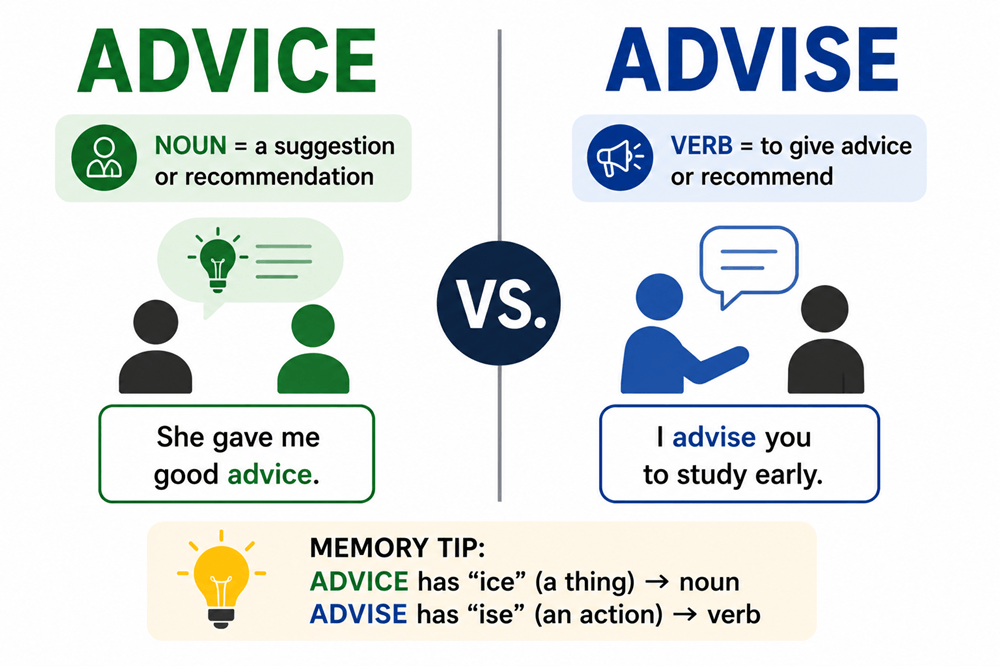
Advise and advice are easy to confuse because they look almost the same. The difference is grammar. Advice is a noun. It means a suggestion, recommendation, or helpful opinion. Advise is a verb. It means to give advice. The spelling clue is the final letter: advice ends in c, while advise ends in s.
Quick Answer
Use advice when you mean a suggestion or recommendation.
- She gave me good advice.
- I need advice about my resume.
- His advice helped me make a decision.
Use advise when you mean to give advice.
- Please advise me on what to do next.
- The doctor advised him to rest.
- They advise students to apply early.
The simple rule is: advice is the thing you give, and advise is the action of giving it.
Advise or Advice: What Is the Difference?
The main difference between advise and advice is part of speech. Advice is a noun, so it names an idea, suggestion, or recommendation. Advise is a verb, so it shows an action.
| Word | Part of Speech | Meaning | Example |
|---|---|---|---|
| Advice | Noun | A suggestion or recommendation | Her advice was useful. |
| Advise | Verb | To give a suggestion | She will advise you. |
If the sentence needs a thing, use advice. If the sentence needs an action, use advise.
What Does Advice Mean?
Advice is a noun. It means guidance, a recommendation, or an opinion meant to help someone decide what to do.
Examples:
- My teacher gave me helpful advice.
- That was the best advice I received all year.
- You should ask a lawyer for legal advice.
- She ignored my advice and regretted it later.
- His advice was simple: save more and spend less.
In each sentence, advice is something that can be given, received, followed, ignored, or requested. It is not the action. It is the information or suggestion itself.
What Does Advise Mean?
Advise is a verb. It means to recommend, suggest, warn, guide, or tell someone what you think they should do.
Examples:
- I advise you to check the details first.
- The coach advised the players to stay focused.
- Experts advise people to read the contract carefully.
- She advised him against quitting too soon.
- Please advise us if your plans change.
In each sentence, advise shows an action. Someone is giving guidance or making a recommendation.
Spelling Structure: Why Advice Ends in C
Advice ends in c because it is the noun. The final sound is soft, like the s sound in ice. That gives you a useful memory clue:
- advice contains ice
- ice is a noun
- advice is also a noun
This is one of the easiest ways to remember the spelling. If the word names the suggestion itself, choose advice with c.
Think of this sentence:
- Good advice is a thing you can keep.
The word thing is the key. A noun names a thing, and advice is the noun form.
Spelling Structure: Why Advise Ends in S
Advise ends in s because it is the verb. The final sound is like a z, similar to words such as rise, surprise, and choose.
- advise = verb
- to advise = to give advice
A helpful spelling trick is to connect advise with rise. Both end with se, and both are action words.
- rise = action
- advise = action
If someone is doing something, such as recommending, warning, or guiding, choose advise with s.
When to Use Advice
Use advice when you are talking about the recommendation itself. It often appears with verbs like give, get, need, ask for, follow, or ignore.
- Can you give me advice?
- I need advice about buying a car.
- She followed her mother’s advice.
- They asked for financial advice.
- He ignored the doctor’s advice.
Another important point: advice is usually uncountable. That means you normally do not say an advice or advices.
Incorrect:
- She gave me an advice.
- He shared many advices.
Correct:
- She gave me advice.
- He shared a piece of advice.
- He shared several pieces of advice.
When to Use Advise
Use advise when the sentence is about giving guidance or making a recommendation. It often appears after a subject, such as a person, expert, teacher, doctor, lawyer, or organization.
- I advise you to wait.
- The lawyer advised her to keep records.
- The school advises students to arrive early.
- Doctors advise regular exercise.
- Please advise me if anything changes.
Advise can change form because it is a verb:
- advise
- advises
- advised
- advising
Examples:
- She advises new employees.
- He advised me yesterday.
- They are advising the company.
Common Mistakes
The most common mistake is using advise when the sentence needs the noun advice.
Incorrect:
- Thank you for your advise.
Correct:
- Thank you for your advice.
Another common mistake is using advice when the sentence needs the verb advise.
Incorrect:
- Please advice me on the next step.
Correct:
- Please advise me on the next step.
Use this quick test: if you can replace the word with suggestion, use advice. If you can replace it with recommend, use advise.
Advice vs Advise in One Sentence
You can use both words in the same sentence when each one has its correct role.
- She advised me to follow his advice.
- The doctor advised rest, and his advice helped.
- I need advice, so please advise me.
In these examples, advised is the action, while advice is the recommendation.
How to Remember the Difference
Use these memory tips:
- Advice has ice, and ice is a thing. A thing is a noun.
- Advise has ise, like rise. Both are action words.
- Advice = noun = suggestion.
- Advise = verb = recommend.
A simple memory sentence is: You advise someone by giving them advice.
Final Answer
Advice is a noun that means a suggestion, recommendation, or guidance. Example: She gave me good advice.
Advise is a verb that means to give advice. Example: She advised me to wait.
To remember the difference, look at the ending. Advice ends in ice, which is a thing, so it is the noun. Advise ends in ise, like an action word, so it is the verb.