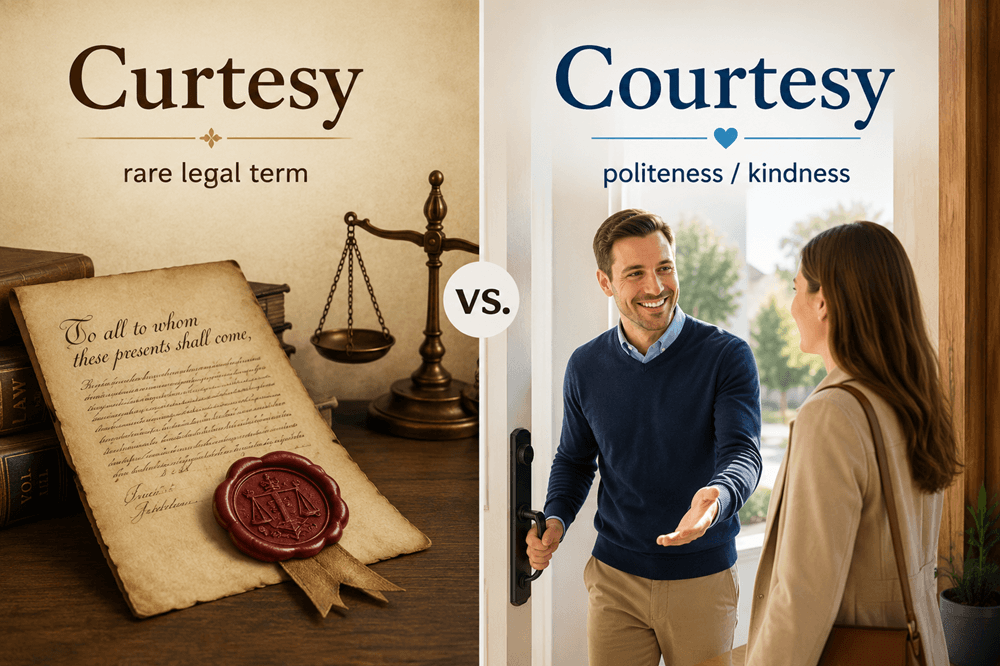
Curtesy or Courtesy: Which Spelling Is Correct?
The word you usually want is courtesy.
Courtesy means polite behavior, kindness, respect, or something done as a thoughtful gesture.
Examples:
- Please show some courtesy to other guests.
- The hotel offered a courtesy shuttle.
- She sent a thank-you note as a courtesy.
- Common courtesy means listening when someone is speaking.
Curtesy is a real word, but it is rare and mostly legal. It does not mean politeness. In everyday writing, curtesy is usually a misspelling of courtesy.
Quick Answer
Use courtesy when you mean politeness, respect, kindness, or a free/helpful service.
Correct:
- He held the door open as a courtesy.
Incorrect for this meaning:
- He held the door open as a curtesy.
Use curtesy only in a rare legal context.
For almost all modern writing, the correct spelling is:
courtesy
What Does Courtesy Mean?
Courtesy means polite, respectful, or considerate behavior.
Examples:
- Saying “thank you” is a simple courtesy.
- Please have the courtesy to reply.
- She treated everyone with warmth and courtesy.
- Out of courtesy, he waited until she finished speaking.
Courtesy can also mean something provided for free or as a helpful service.
Examples:
- The hotel provides a courtesy breakfast.
- A courtesy car picked us up from the airport.
- The company made a courtesy call to confirm the appointment.
- Guests may use the courtesy phone in the lobby.
In these examples, courtesy means the service is offered as a polite or helpful gesture.
What Does Curtesy Mean?
Curtesy is a rare legal word. Traditionally, it referred to a husband’s legal right or life interest in his deceased wife’s property under old property laws.
Example:
- The lawyer explained the old rule of curtesy.
Most people will never need this word in everyday writing. It appears mainly in legal history, property law, old legal documents, or discussions of common-law inheritance.
So if you are writing about manners, kindness, politeness, respect, customer service, or helpful gestures, do not use curtesy.
Use courtesy.
Courtesy vs Curtesy: The Main Difference
The main difference is meaning:
Courtesy = politeness, kindness, respectful behavior, or a helpful service
Curtesy = rare legal term related to property rights
Compare:
- She showed great courtesy to the visitors.
- The document mentioned the husband’s right of curtesy.
The first sentence is about politeness.
The second sentence is about a legal concept.
For most readers, curtesy will look like a spelling mistake unless the context is clearly legal.
Why People Misspell Courtesy as Curtesy
People often misspell courtesy as curtesy because of pronunciation. The word may sound like it begins with cur-, especially in fast speech.
But the correct common word has cour- at the beginning:
c-o-u-r-t-e-s-y
Not:
c-u-r-t-e-s-y
The hidden letter people forget is o.
That o is important because courtesy is related to words like courteous and courtly, which connect historically to polite manners and proper behavior.
Courtesy and Courteous
A helpful way to remember courtesy is to connect it with courteous.
Courtesy is the noun.
Example:
- She showed courtesy.
Courteous is the adjective.
Example:
- She was courteous.
Both words begin with:
cour-
So if you can remember courteous, you can remember courtesy.
Correct:
- courtesy
- courteous
Incorrect:
- curtesy, when you mean politeness
- curteous
The spelling family helps you keep the o in place.
Common Courtesy
The phrase common courtesy means basic politeness or the respectful behavior people normally expect.
Examples:
- It is common courtesy to say thank you.
- Common courtesy means not interrupting others.
- Please have the common courtesy to clean up after yourself.
Do not write:
- common curtesy
That is incorrect unless you are somehow discussing the rare legal word, which would not fit this phrase.
Courtesy Of
The phrase courtesy of means provided by, supplied by, or thanks to someone or something.
Examples:
- Photos are courtesy of the museum.
- The drinks were provided courtesy of the host.
- The update came courtesy of the support team.
This phrase always uses courtesy, not curtesy.
Correct:
- Image courtesy of the author.
Incorrect:
- Image curtesy of the author.
Courtesy Call, Courtesy Car, and Courtesy Shuttle
Many common phrases use courtesy.
Examples:
- courtesy call
- courtesy car
- courtesy shuttle
- courtesy phone
- courtesy reminder
- courtesy notice
- courtesy copy
A courtesy call is a polite call, often made to check in, confirm something, or maintain goodwill.
A courtesy car is a car provided as a helpful service, often by a dealership, repair shop, or hotel.
A courtesy shuttle is a free or helpful transportation service.
All of these use courtesy because they are connected to helpfulness or polite service.
Courtesy vs Curtsy
There is another word that can cause confusion: curtsy.
A curtsy is a formal movement, usually made by bending the knees slightly as a sign of respect.
Example:
- The girl made a curtsy before leaving the stage.
This is different from both courtesy and curtesy.
Here is the difference:
Courtesy = politeness or kind behavior
Curtesy = rare legal term
Curtsy = formal respectful gesture
Examples:
- She treated the guest with courtesy.
- The legal document mentioned curtesy.
- The dancer gave a graceful curtsy.
These three words look similar, but they have different meanings.
How to Remember the Correct Spelling
A simple memory trick:
Courtesy has “cour” like courteous.
Think:
courtesy = courteous behavior
Both words begin with cour-.
Another way to remember it:
Courtesy includes “court,” and courtly manners are polite.
Look at the spelling:
courtesy = court + esy
This is not a perfect word breakdown, but it helps visually. The first five letters are:
c-o-u-r-t
That can remind you of courtly manners, politeness, and respect.
So remember:
courtesy = polite behavior
curtesy = rare legal word
Spelling Structure
The correct common spelling is:
c-o-u-r-t-e-s-y
The common mistake is:
c-u-r-t-e-s-y
The difference is the missing o after c.
Correct:
courtesy
Incorrect for politeness:
curtesy
If you mean kindness, politeness, respect, or a helpful service, always include the o:
courtesy
Common Mistakes
Mistake 1: Dropping the o
Incorrect:
- Thank you for your curtesy.
Correct:
- Thank you for your courtesy.
The polite behavior word needs cour- at the beginning.
Mistake 2: Using curtesy in customer service writing
Incorrect:
- This is a curtesy reminder about your appointment.
Correct:
- This is a courtesy reminder about your appointment.
A reminder sent politely or helpfully is a courtesy reminder.
Mistake 3: Confusing courtesy and curtsy
Incorrect:
- She made a courtesy before the queen.
Correct:
- She made a curtsy before the queen.
A respectful bending gesture is a curtsy. Polite behavior is courtesy.
Example Sentences With Courtesy
- Please show courtesy to other passengers.
- He had the courtesy to apologize.
- The staff treated every guest with courtesy.
- The hotel offers a courtesy shuttle.
- She sent a courtesy email before the meeting.
- As a courtesy, we will call you before arrival.
- Common courtesy goes a long way.
- The photo was used courtesy of the library.
Example Sentence With Curtesy
- The old legal text referred to a husband’s right of curtesy.
This is a specialized legal use. It is not the spelling you want for politeness.
Final Answer: Curtesy or Courtesy?
Use courtesy when you mean politeness, respect, kindness, or a helpful service.
Curtesy is a rare legal word and is usually a misspelling when people mean courtesy.
The easiest way to remember the correct spelling is:
courtesy = courteous behavior
Both words begin with cour-.
So the correct spelling for everyday writing is:
courtesy
Not:
curtesy