Hunny or Honey: Correct Spelling, Meaning, Usage, Examples, and Memory Tips Explained
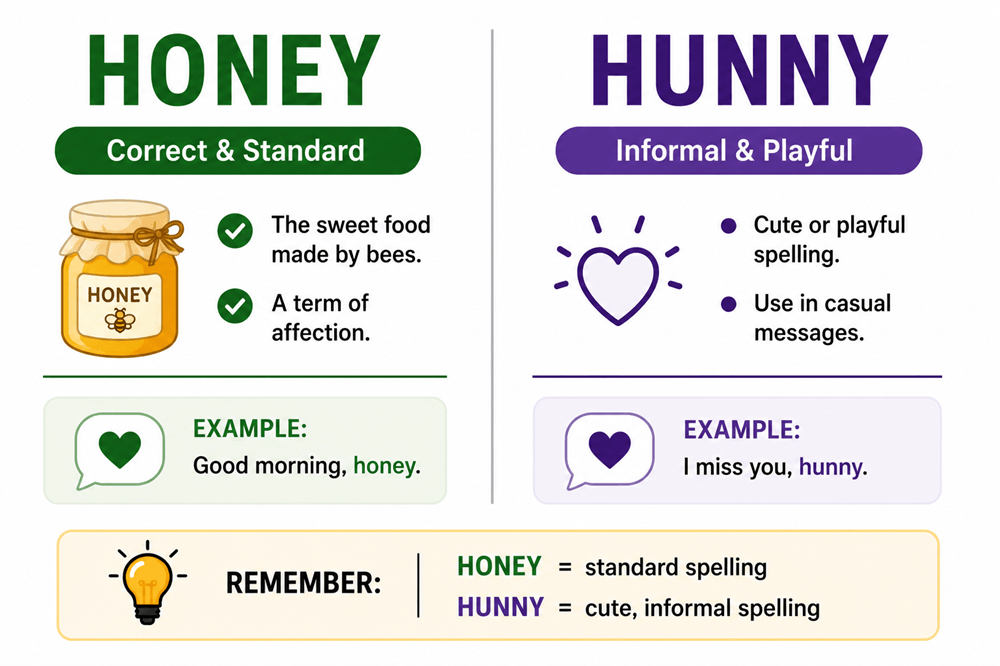
Honey is the correct standard spelling. Hunny is an informal, playful, or affectionate spelling. Use honey when talking about the sweet food made by bees or when using the word as a term of affection. Use hunny only when you want a cute, childish, or stylized tone.
Quick Answer
Use honey in standard writing.
- Correct: I added honey to my tea.
- Correct: The bees made honey in the hive.
- Correct: Good morning, honey.
Use hunny only as a playful or nonstandard spelling.
- Playful: I miss you, hunny.
- Playful: Goodnight, hunny.
- Stylized: The cartoon bear wanted more hunny.
The simple rule is: honey is correct; hunny is cute or informal.
Hunny or Honey: What Is the Difference?
The difference between hunny and honey is spelling and tone. Honey is the real standard word. It can mean the golden sweet food made by bees, or it can be used as a loving name for someone. Hunny is not the normal dictionary spelling for the food. It is usually a playful version of honey.
| Word | Status | Example |
|---|---|---|
| Honey | Standard spelling | The toast needs honey. |
| Hunny | Informal or playful spelling | I love you, hunny. |
If you are writing for school, work, recipes, articles, labels, menus, emails, or polished content, choose honey. If you are writing a private message, nickname, card, character dialogue, or playful caption, hunny may fit the mood.
What Does Honey Mean?
Honey is a noun. Its main meaning is the sweet, sticky food made by bees from flower nectar. It is used in tea, baking, sauces, skincare products, and many home remedies.
Examples:
- She stirred honey into her tea.
- The jar of honey came from a local farm.
- Honey can make yogurt taste sweeter.
- The recipe calls for two tablespoons of honey.
- The bees stored honey inside the hive.
Honey can also be a term of affection. People may call a partner, child, friend, or family member honey in a warm or loving way.
- Are you okay, honey?
- Honey, dinner is ready.
- Thanks for helping me, honey.
In standard writing, this affectionate use is still spelled honey, not hunny.
What Does Hunny Mean?
Hunny is a nonstandard spelling of honey. It is often used to sound cute, sweet, silly, childish, or affectionate. It may appear in texts, pet names, cartoons, baby talk, social media captions, or playful branding.
Examples:
- Good morning, hunny.
- Miss you, hunny.
- You are the best, hunny.
Hunny is usually not appropriate for formal writing. It may look too casual, too childish, or simply misspelled if the reader is expecting standard English.
Use it only when the playful tone is intentional.
Spelling Structure: Why Honey Uses O
The correct standard spelling is:
- h-o-n-e-y
The middle letter is o, even though the word may sound close to “hunny” in casual speech. This is the part many people need to remember:
- Correct: honey
- Nonstandard: hunny
The spelling honey has one n and ends in ey. It does not use double n. It does not use u.
Think of the word in chunks:
- hon + ey = honey
The ey ending is also found in other friendly-looking words and names, such as money, journey, and key. For honey, the key is to remember the o.
Why People Spell Honey as Hunny
People often write hunny because the word honey can sound like “hunny” when spoken. The vowel sound is soft, and many speakers do not clearly pronounce the o as a separate sound.
Another reason is tone. Hunny looks cuter and less formal than honey. It feels like a nickname rather than a standard word. That is why people may use it in romantic messages, playful comments, or character voices.
Still, if you are writing about the food, always use honey.
- Correct: honey jar
- Correct: honey bee
- Correct: honey cake
- Correct: honey butter
Hunny jar or hunny bee would look intentionally childish or incorrect unless used for a brand, joke, or fictional style.
When to Use Honey
Use honey when talking about the sweet food made by bees.
- The honey tasted floral and rich.
- He bought raw honey from the market.
- Honey is sweeter than plain sugar in tea.
Use honey as the standard affectionate word.
- I love you, honey.
- Honey, please call me when you arrive.
- That was kind of you, honey.
Use honey in recipes, product descriptions, articles, menus, business writing, schoolwork, and professional content.
When to Use Hunny
Use hunny only when you want a cute, casual, or stylized effect.
- Love you, hunny.
- Hey hunny, how was your day?
- This little bear loves hunny.
Hunny works best in informal messages, nicknames, creative writing, or playful branding. It should not be used when accuracy matters.
Formal or standard:
- Honey is made by bees.
Playful or stylized:
- The bear wanted more hunny.
Common Mistakes
The most common mistake is using hunny when the sentence needs the standard spelling.
Incorrect:
- I put hunny in my tea.
- The bees made hunny.
- This cake has hunny in it.
Correct:
- I put honey in my tea.
- The bees made honey.
- This cake has honey in it.
Another mistake is assuming hunny is always wrong. It is not always wrong as a playful spelling. But it is not the standard spelling, so it should be used carefully.
How to Remember Honey
Use these memory tips:
- Honey is the standard spelling.
- Honey has o, like gold, and honey is golden.
- Hunny has u, like a cute nickname for you.
- Use honey for food and standard affection.
- Use hunny only for playful tone.
A simple memory sentence is: Honey is golden, so it gets the “o.”
You can also remember it this way: honey is real; hunny is cute.
Final Answer
Honey is the correct standard spelling. It can mean the sweet food made by bees or a loving name for someone. Example: I added honey to my tea.
Hunny is an informal, playful spelling of honey. Example: I miss you, hunny.
To remember the difference, use this rule: honey is standard; hunny is playful. If you are writing about food, recipes, bees, or polished content, always choose honey.