Zeros or Zeroes: Correct Plural Spelling, Meaning, Usage, and Examples Explained Clearly
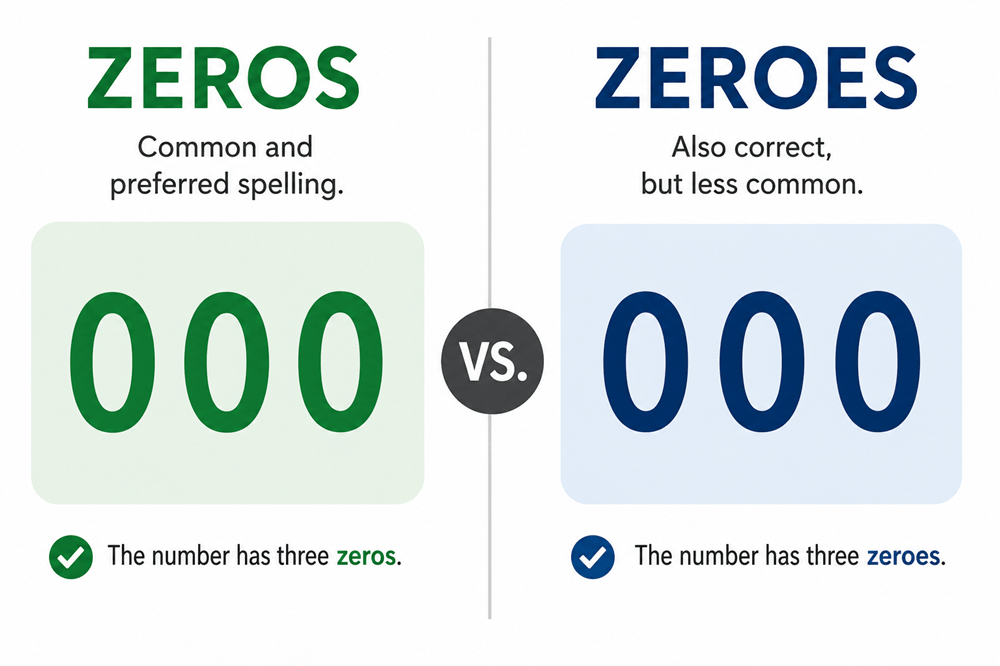
Zeros and zeroes are both correct plural forms of zero, but zeros is the more common and usually preferred spelling. Use zeros when talking about numbers, scores, measurements, math, data, or ordinary plural use. Zeroes is also acceptable, but it is less common and can look more old-fashioned or formal.
Quick Answer
Use zeros as the standard plural of zero.
- The number has three zeros.
- She added two zeros to the total.
- The final score was two zeros on the board.
Zeroes is also correct, but it is less common as a plural noun.
- The number has three zeroes.
- She added two zeroes to the total.
The simple rule is: zeros is the safer modern plural, while zeroes is an accepted variant.
Zeros or Zeroes: What Is the Difference?
The difference between zeros and zeroes is mainly spelling preference. Both can mean more than one zero. However, zeros is more widely used in modern English, especially in math, science, finance, technology, sports, and everyday writing.
| Word | Use | Example |
|---|---|---|
| Zeros | Common standard plural | The password contains two zeros. |
| Zeroes | Accepted variant | The password contains two zeroes. |
If you want the spelling that feels natural to most readers, choose zeros.
What Does Zeros Mean?
Zeros is the plural form of zero. A zero is the number 0. It can also mean nothing, no amount, no score, or the lowest possible level.
Examples:
- The account balance showed several zeros.
- The student forgot to include the zeros after the decimal point.
- The team finished the first half with zeros on the scoreboard.
- The temperature dropped below zero, but the chart had no zeros marked.
- The code failed because one of the zeros was missing.
In these examples, zeros refers to more than one written 0 or more than one value of nothing.
What Does Zeroes Mean?
Zeroes can also be the plural of zero. It has the same meaning as zeros, but it is less common in modern writing.
Examples:
- The number ended with four zeroes.
- The report included too many zeroes in the estimate.
- Both answers had extra zeroes after the decimal.
These sentences are not wrong. Still, many readers are more used to seeing zeros, especially in practical or technical writing.
Why Is Zeros More Common?
Most English nouns form the plural by adding -s. Since zero ends in o, both zeros and zeroes are possible, but modern usage favors the simpler form.
Many words ending in o simply add -s:
- piano → pianos
- photo → photos
- radio → radios
- zero → zeros
Some words ending in o take -es, such as potato becoming potatoes and tomato becoming tomatoes. That is why zeroes may look natural to some writers. However, with zero, the shorter spelling zeros is the common modern choice.
When to Use Zeros
Use zeros in most regular writing. It is clear, simple, and widely accepted. It works well in school assignments, articles, charts, reports, business writing, math problems, coding, and financial writing.
Examples:
- Add two zeros to turn 50 into 5,000.
- The number 1,000 has three zeros.
- The spreadsheet removed the leading zeros.
- The company’s profit had more zeros than expected.
- The answer should include all zeros after the decimal point.
If you are writing for WordBriefs, a classroom, a workplace, or a general audience, zeros is usually the best choice.
When to Use Zeroes
Use zeroes only if you prefer that spelling, are following a style guide that allows it, or want a slightly more traditional look. It is acceptable as a plural noun, but it is not as common.
Examples:
- The old ledger showed several zeroes in the final column.
- The writer used zeroes throughout the document.
- The serial number contained two zeroes and one letter O.
Because zeroes can look less modern, zeros is usually the cleaner option.
Zeros and Zeroes as Verbs
Zero can also be a verb. It can mean to set something to zero, aim at a target, or focus closely on something.
Examples:
- She zeroes the scale before weighing the flour.
- The camera zeroes in on the subject.
- The technician zeroes out the meter.
As a verb, zeroes is common in the third-person singular form: he zeroes, she zeroes, or it zeroes. You may also see zeros as a verb form, but zeroes often looks more familiar in phrases like zeroes in and zeroes out.
Common Mistake
A common mistake is thinking zeroes is always wrong. It is not wrong, but it is less common as a plural noun.
Correct:
- The number has five zeros.
- The number has five zeroes.
Better for most modern writing:
- The number has five zeros.
Another mistake is confusing the number zero with the letter O. In passwords, codes, serial numbers, and product labels, it helps to be specific.
- The code has two zeros, not two letter O’s.
- Make sure you type the zero before the final letter.
Zeros in Math and Data
In math, science, technology, and data writing, zeros is strongly preferred because it is short and clear.
- Leading zeros can affect how data is stored.
- The equation has two zeros.
- Do not remove the zeros after the decimal point.
- The file name includes three zeros at the end.
For technical content, zeros is the better default.
How to Remember the Difference
Remember this simple guide:
- Zeros = common plural of zero
- Zeroes = accepted but less common plural
- Zeroes = common verb form in “zeroes in” or “zeroes out”
If you are unsure, use zeros for the plural noun. It is the simplest and most widely accepted choice.
Final Answer
Zeros and zeroes are both correct plurals of zero. However, zeros is more common and is usually the better choice in modern writing.
Use zeros when referring to more than one 0. Use zeroes mainly if you prefer the variant spelling or when using the verb form, as in she zeroes in on the problem.