Roofs or Rooves: Correct Plural Form, Meaning, Usage, and Examples Explained Clearly
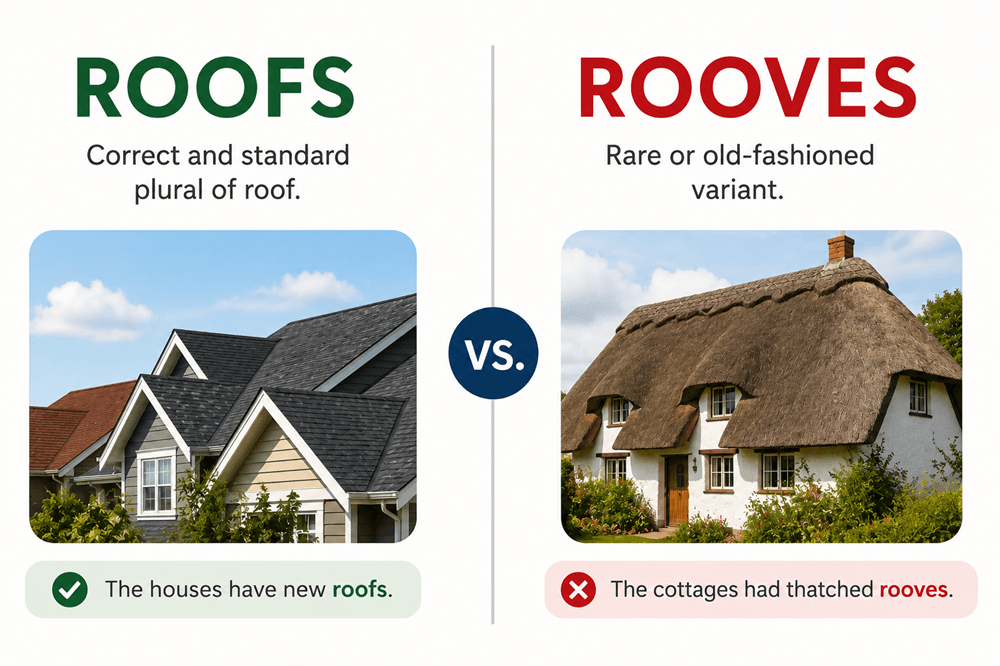
Roofs is the standard plural of roof. Rooves is an older or less common variant, but it is not the preferred spelling in modern English. In most writing, especially for school, work, articles, real estate, construction, or everyday use, you should write roofs.
Quick Answer
Use roofs as the normal plural form of roof.
- The houses have red roofs.
- Heavy snow damaged several roofs.
- The workers repaired three roofs this week.
Rooves is rare and may look incorrect to many readers.
- Less common: The cottages had thatched rooves.
- Preferred: The cottages had thatched roofs.
The simple rule is: roof becomes roofs, not rooves.
Roofs or Rooves: What Is the Difference?
The difference between roofs and rooves is mainly standard usage. Both words have been used as plural forms of roof, but only roofs is widely accepted as the modern standard.
| Word | Use | Example |
|---|---|---|
| Roofs | Standard plural | The roofs were covered in snow. |
| Rooves | Rare or old-fashioned variant | The rooves were covered in snow. |
If you want your writing to look natural and correct, choose roofs. Most readers, editors, teachers, and spell-check tools expect this spelling.
What Does Roofs Mean?
Roofs is the plural form of roof. A roof is the top covering of a building, vehicle, or structure. It protects the inside from rain, snow, sun, wind, and other weather.
Examples:
- The roofs of the buildings were damaged in the storm.
- Solar panels were installed on several roofs.
- The village has houses with steep roofs.
- Flat roofs are common on many modern buildings.
- The roofs leaked after days of heavy rain.
In each sentence, roofs refers to more than one roof. This is the spelling you should use in standard English.
What Does Rooves Mean?
Rooves is a rare plural form of roof. Some people may recognize it as an older spelling or a regional form, but it is not the usual choice today.
You may occasionally see rooves in older writing, informal speech, dialect writing, or discussions about language. Still, it can seem unusual or incorrect in modern writing because roofs has become the accepted standard.
Examples:
- Old-fashioned: Smoke rose from the cottage rooves.
- Modern standard: Smoke rose from the cottage roofs.
Unless you have a special reason to use rooves, it is better to avoid it.
Why Is Roofs Correct?
Many English nouns form the plural by adding -s. That is what happens with roof. The word does not usually change its spelling before adding the plural ending.
- one roof
- two roofs
- many roofs
This pattern is similar to other simple plural forms:
- one cliff, two cliffs
- one belief, two beliefs
- one chief, two chiefs
- one roof, two roofs
Some words ending in f or fe do change to ves, such as leaf becoming leaves and knife becoming knives. But roof does not follow that pattern in standard modern English.
Why Do People Say Rooves?
People may say or write rooves because many English words ending in f change to ves in the plural. That pattern can make rooves feel logical, even though it is not the standard form.
Compare these words:
| Singular | Plural |
|---|---|
| leaf | leaves |
| wolf | wolves |
| knife | knives |
| roof | roofs |
Because English has many exceptions, it is easy to assume roof should become rooves. However, the accepted spelling is roofs.
When to Use Roofs
Use roofs in nearly every normal situation. This includes formal writing, casual writing, website articles, property listings, repair guides, building descriptions, insurance documents, and school assignments.
Examples:
- The roofs need regular maintenance.
- Metal roofs can last for many years.
- The neighborhood is known for its orange tile roofs.
- Several roofs were repaired after the hurricane.
- Birds nested under the roofs of the old barns.
This spelling is clear, current, and widely understood.
When to Use Rooves
Use rooves only if you are quoting someone, copying an old text, writing dialect, or intentionally using an old-fashioned style. Even then, it is worth considering whether readers may think it is a typo.
Examples:
- The poem used the old spelling “rooves.”
- The character’s dialogue included the word “rooves.”
- The historical sign referred to “the rooves of the town.”
For regular modern writing, roofs is the safer choice.
Common Mistake
The most common mistake is changing roof to rooves because it seems similar to leaf and leaves.
Incorrect or uncommon:
- The storm damaged several rooves.
- The town has houses with flat rooves.
Correct:
- The storm damaged several roofs.
- The town has houses with flat roofs.
If you are unsure, remember that roofs is the spelling most readers expect.
Roof’s, Roofs, or Roofs’?
These forms have different meanings.
| Form | Meaning | Example |
|---|---|---|
| Roof’s | Belonging to one roof | The roof’s edge was damaged. |
| Roofs | More than one roof | The roofs were repaired. |
| Roofs’ | Belonging to more than one roof | The roofs’ surfaces were cleaned. |
Use roofs when you simply mean more than one roof. Use an apostrophe only when showing possession.
How to Remember the Difference
A simple way to remember the correct spelling is this:
- Roof + s = roofs
- Rooves is rare and not the usual modern spelling
You can also remember the phrase: The standard roof has a standard plural: roofs.
Final Answer
Roofs is the correct and standard plural of roof. Use it in almost all modern writing.
Rooves is an older or uncommon variant. It may appear in dialect, older texts, or informal usage, but it is not the preferred spelling today. If you are writing for clarity, choose roofs.