Afterward or Afterwards: Correct Usage, Regional Differences, and Examples for Clear Writing
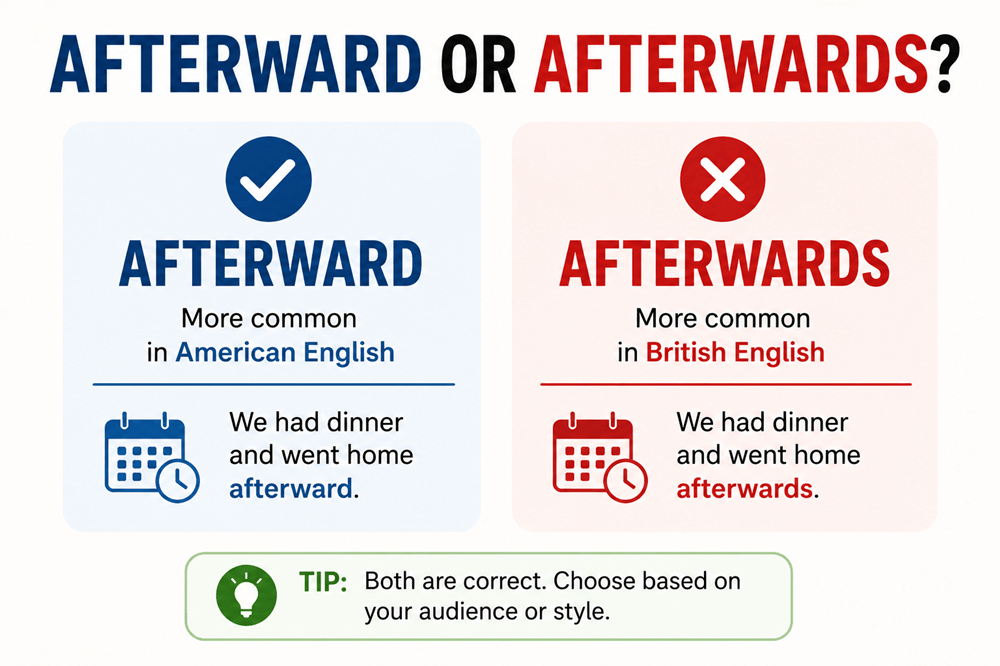
Afterward and afterwards both mean “later” or “after something has happened.” The main difference is regional preference. Afterward is more common in American English, while afterwards is more common in British English. Both are correct, but if you are writing for an American audience, afterward is usually the cleaner choice.
Quick Answer
Use afterward or afterwards when you mean something happened later, after a previous event.
- Correct: We had dinner and went home afterward.
- Correct: We had dinner and went home afterwards.
Both sentences are grammatically correct. The difference is not meaning. The difference is mostly style and region.
- Afterward is more common in American English.
- Afterwards is more common in British English.
If you want the safest spelling for American writing, choose afterward. If you are writing in British English, afterwards may feel more natural.
Afterward or Afterwards: What Is the Difference?
The difference between afterward and afterwards is mainly a matter of regional usage. Both words are adverbs, and both refer to something that happens later in time.
You might say that a meeting ended, and afterward, everyone left the room. You could also say the meeting ended, and afterwards, everyone left the room. The meaning stays the same.
| Word | Meaning | Best Use |
|---|---|---|
| Afterward | Later; after something happened | Common in American English |
| Afterwards | Later; after something happened | Common in British English |
Neither spelling is wrong. However, consistency matters. If the rest of your writing uses American spellings like color, center, and favorite, afterward will usually fit better. If your writing uses British spellings like colour, centre, and favourite, afterwards may fit better.
What Does Afterward Mean?
Afterward means later, after that, or after a certain event. It points to something that happens once another thing is finished.
Examples:
- You finished your homework and watched a movie afterward.
- She apologized afterward for sounding impatient.
- The guests ate dinner and talked afterward.
- He looked nervous during the interview but relaxed afterward.
In each sentence, afterward tells you that one action happened later than another action. It does not usually name a specific time. It simply places the second event after the first one.
For example, “She called afterward” does not tell you whether she called five minutes later, two hours later, or the next morning. It only tells you that the call happened after something else.
What Does Afterwards Mean?
Afterwards has the same meaning as afterward. It also means later or after something happened.
Examples:
- You finished your homework and watched a movie afterwards.
- She apologized afterwards for sounding impatient.
- The guests ate dinner and talked afterwards.
- He looked nervous during the interview but relaxed afterwards.
These sentences mean the same thing as the examples with afterward. The only real difference is the spelling style. Afterwards is more common in British English and often sounds natural to readers who are used to British spelling patterns.
In American writing, afterwards may still be understood, and it is not incorrect. It may simply look a little less typical than afterward.
Is Afterwards Wrong?
Afterwards is not wrong. It is a standard word, especially in British English. The mistake is thinking that only one form can be correct in every situation.
If you are writing for a British audience, afterwards may be the better fit. If you are writing for an American audience, afterward is usually preferred. Both words are accepted, but your choice should match your audience and style.
Compare these examples:
- American style: We talked for an hour afterward.
- British style: We talked for an hour afterwards.
The meaning is the same. The spelling choice simply reflects the style of English being used.
When to Use Afterward
Use afterward when you are writing in American English or when you want the shorter, more common American form.
Examples:
- The children played outside and came in afterward.
- You can ask questions afterward.
- She felt embarrassed afterward.
- They cleaned the kitchen afterward.
Afterward works well in both formal and informal writing. You can use it in essays, articles, emails, stories, reports, and everyday messages.
It is especially useful when you want to connect two events without repeating a longer phrase like “after that happened.”
- Longer: The meeting ended, and after that happened, everyone left.
- Smoother: The meeting ended, and everyone left afterward.
The second sentence sounds cleaner because afterward does the work in one word.
When to Use Afterwards
Use afterwards when you are writing in British English or when the -s form sounds more natural for your audience.
Examples:
- The children played outside and came in afterwards.
- You can ask questions afterwards.
- She felt embarrassed afterwards.
- They cleaned the kitchen afterwards.
These examples are just as understandable as the American-style versions. The word afterwards may feel slightly more conversational or familiar to some readers, depending on where they live.
If you are writing for a global audience, either word can work. However, it is still a good idea to choose one style and stay consistent throughout the article or document.
Afterward and Afterwards at the End of a Sentence
Both afterward and afterwards often appear at the end of a sentence. This is one of their most natural positions.
Examples with afterward:
- We went to the concert and got coffee afterward.
- He made a mistake but corrected it afterward.
- The storm passed, and the sky cleared afterward.
Examples with afterwards:
- We went to the concert and got coffee afterwards.
- He made a mistake but corrected it afterwards.
- The storm passed, and the sky cleared afterwards.
When the word comes at the end, it usually does not need a comma before it. The sentence flows naturally without extra punctuation.
Afterward and Afterwards at the Beginning of a Sentence
You can also place afterward or afterwards at the beginning of a sentence. When you do, a comma often follows the word.
Examples:
- Afterward, everyone stood up to leave.
- Afterward, you may wonder why it mattered so much.
- Afterwards, everyone stood up to leave.
- Afterwards, you may wonder why it mattered so much.
This structure is useful when you want to guide the reader through a sequence of events. It creates a clear sense of time.
However, do not overuse it. If too many sentences begin with afterward or afterwards, the writing may start to feel repetitive. Use it when the time order matters.
Afterward vs After
Afterward and after are related, but they are not used in exactly the same way. Afterward is an adverb. It can stand by itself and usually means “later.” After is often used as a preposition or conjunction, which means it usually connects to another word, phrase, or clause.
Compare these examples:
- Correct: We ate lunch afterward.
- Correct: We ate lunch after the meeting.
In the first sentence, afterward stands alone. It tells you lunch happened later. In the second sentence, after needs the meeting to complete the idea.
Here are more examples:
- Afterward, she went home.
- After the party, she went home.
- They spoke afterward.
- They spoke after the ceremony.
If you want a one-word adverb meaning “later,” use afterward or afterwards. If you want to name the event that came first, use after.
Common Mistakes With Afterward and Afterwards
The most common mistake is treating one spelling as completely wrong. Unlike pairs such as laid and layed, this pair does not have one correct word and one misspelling. Afterward and afterwards are both real words.
Another mistake is mixing American and British styles in the same article. For example, a sentence like this may feel inconsistent:
- The colour looked different afterward.
The spelling colour is British, while afterward is more American. This is not a grammar disaster, but it may look inconsistent in edited writing. A more consistent British-style sentence would be:
- The colour looked different afterwards.
A more consistent American-style sentence would be:
- The color looked different afterward.
Another common issue is using afterward when the sentence needs after.
- Incorrect: We left afterward the show.
- Correct: We left after the show.
- Correct: The show ended, and we left afterward.
Afterward cannot directly take a noun like the show. If you want to name the event, use after.
Examples of Afterward in Sentences
Here are examples of afterward used naturally in American-style writing:
- You can finish the form and submit it afterward.
- She cried during the movie and laughed about it afterward.
- The class ended early, so we talked afterward.
- He seemed upset at first but calmed down afterward.
- They took photos during the ceremony and celebrated afterward.
- The door slammed, and everything felt quiet afterward.
In each sentence, afterward means later or after that happened.
Examples of Afterwards in Sentences
Here are examples of afterwards used naturally in British-style writing:
- You can finish the form and submit it afterwards.
- She cried during the film and laughed about it afterwards.
- The class ended early, so we talked afterwards.
- He seemed upset at first but calmed down afterwards.
- They took photos during the ceremony and celebrated afterwards.
- The door slammed, and everything felt quiet afterwards.
These sentences have the same meaning as the afterward examples. The spelling difference simply reflects a different style preference.
How to Remember Afterward or Afterwards
A simple way to remember the difference is to connect the shorter word with American English:
- Afterward = American English
- Afterwards = British English
You can also remember that both words point forward in time. They tell you what happened after something else.
If your writing uses American spelling, choose afterward. If your writing uses British spelling, choose afterwards. If you are not sure which style you need, afterward is often the safer choice for American-based websites and general U.S. audiences.
Final Answer
Afterward and afterwards are both correct adverbs meaning “later” or “after that.” The difference is mainly regional. Afterward is more common in American English, while afterwards is more common in British English.
For American writing, use afterward. For British writing, afterwards is perfectly acceptable. The most important rule is to stay consistent with the style of English you are using.