Thru or Through: Correct Spelling, Meaning, Usage, and Examples for Clear Writing
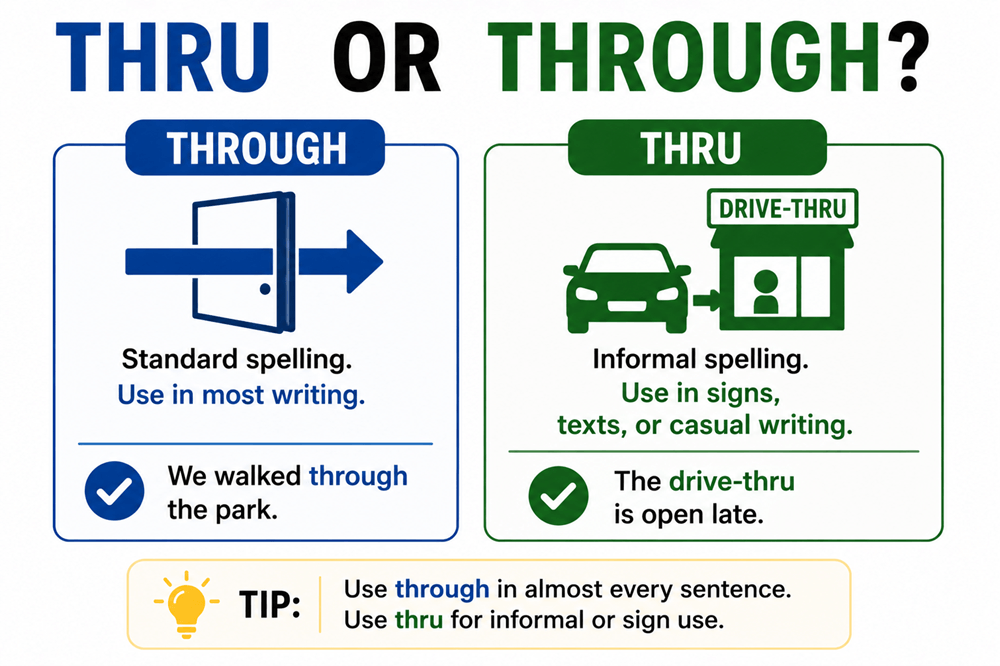
Through and thru mean the same thing in many contexts, but they are not equally appropriate. Through is the standard spelling for formal, professional, academic, and everyday writing. Thru is an informal shortened spelling, mostly used in signs, texting, branding, and casual messages. If you want your writing to look correct and polished, use through.
Quick Answer
Use through in almost every normal sentence.
- Correct: We walked through the park.
- Correct: She read through the instructions carefully.
- Correct: The store is open Monday through Friday.
Thru is an informal spelling. It is common on signs, in drive-thru labels, casual notes, text messages, and advertising, but it is not the standard spelling in most writing.
- Informal: The drive-thru is open late.
- Informal: I’ll be there 2 thru 5.
- Preferred: I’ll be there 2 through 5.
The simple rule is this: through is standard. Thru is casual, shortened, and best saved for informal use.
Thru or Through: What Is the Difference?
The difference between thru and through is mainly spelling and formality. Both can point to movement from one side to another, completion of a process, a period of time, or a connection across something. However, through is the full standard spelling, while thru is a shorter informal version.
You can use through in school assignments, business emails, website articles, reports, books, captions, instructions, and professional messages. It is the spelling readers expect.
Thru is much narrower. You may see it when space is limited, when the writing is intentionally casual, or when a brand wants a simple, quick-looking style. A sign may say drive-thru because the shorter spelling fits the fast, commercial feel. But in a normal sentence, through usually looks better.
| Word | Status | Best Use | Example |
|---|---|---|---|
| Through | Standard spelling | Most formal, professional, and everyday writing | She walked through the door. |
| Thru | Informal shortened spelling | Signs, texting, branding, casual notes | The drive-thru closes at midnight. |
If you are not sure which spelling to choose, use through.
What Does Through Mean?
Through has several meanings, but the main idea is movement, passage, completion, or connection from one point to another. It can show physical movement, time, progress, method, or experience.
When through shows physical movement, it means going in one side and out the other, or moving across an area.
- The dog ran through the gate.
- Sunlight came through the window.
- We drove through the tunnel.
- She pushed the thread through the needle.
When through refers to time, it can mean from the beginning to the end of a period.
- The museum is open Tuesday through Sunday.
- He worked through the night.
- The sale runs through Friday.
When through refers to completion, it can mean finished, done, or having reached the end of something.
- Are you through with the report?
- She read through the entire chapter.
- They worked through the problem together.
Because through has many uses, it appears often in clear everyday writing.
What Does Thru Mean?
Thru is a shortened informal spelling of through. It usually means the same thing, but it carries a more casual or practical tone. It is not the spelling you should use in most polished writing.
Examples:
- The drive-thru line was long.
- Use the thru lane for faster service.
- Tickets are valid June 1 thru June 5.
- I’m working 9 thru 3 today.
These examples are understandable, but they do not all have the same level of formality. Drive-thru is widely recognized as a common commercial phrase. However, in a full sentence, especially one meant to look edited, through is usually better.
- Informal: I read thru the notes.
- Preferred: I read through the notes.
Thru may save a few letters, but through gives the sentence a more standard and polished appearance.
Is Thru Wrong?
Thru is not always wrong, but it is informal. It is best to think of it as a shortened spelling rather than the normal spelling. Readers will usually understand it, but some may see it as too casual or unprofessional outside certain contexts.
In a text message, thru may not matter much. In a sign or brand name, it can be perfectly acceptable. In a business report, school paper, professional email, article, or formal instruction, through is the safer choice.
Compare these examples:
- Informal: I looked thru the file.
- Standard: I looked through the file.
- Informal: The offer is valid Monday thru Thursday.
- Standard: The offer is valid Monday through Thursday.
- Informal: We drove thru the city.
- Standard: We drove through the city.
The meaning is the same, but the standard spelling looks more careful.
When to Use Through
Use through whenever you are writing in a normal, polished, or standard context. This includes school writing, business messages, website articles, reports, resumes, essays, instructions, stories, and formal communication.
Use through for movement:
- They walked through the forest.
- The ball went through the window.
- Cold air came through the crack in the door.
Use through for time:
- The office is open Monday through Friday.
- The discount lasts through the weekend.
- She studied through the evening.
Use through for completion or progress:
- He worked through the assignment.
- We made it through the hardest part.
- She read through the final draft.
Use through when something happens by means of another thing:
- They met through a friend.
- You can apply through the website.
- The message came through email.
In all of these examples, through is the correct standard spelling.
When to Use Thru
Use thru only when the informal spelling fits the context. It can work on signs, menus, casual notes, text messages, advertisements, labels, and certain brand names.
The most common example is drive-thru. Many restaurants, banks, pharmacies, and coffee shops use this spelling because it is short, familiar, and easy to read quickly.
- The drive-thru opens at 6 a.m.
- We ordered coffee at the drive-thru.
- The pharmacy has a drive-thru window.
You might also see thru in signs or short labels where space matters.
- No thru traffic
- Thru lane
- Open March 1 thru March 8
These uses are common, but they do not mean thru should replace through everywhere. In normal sentences, the full spelling is still preferred.
Through or Thru in Dates?
In formal writing, use through when writing date ranges.
- Correct: The event runs June 1 through June 5.
- Correct: The sale lasts Monday through Friday.
- Correct: Registration is open today through Sunday.
Thru may appear in signs, flyers, tickets, or casual announcements because it is shorter.
- Informal: Sale runs June 1 thru June 5.
- Informal: Open Monday thru Friday.
If you are writing a polished article, school paper, business email, or official notice, choose through. If you are designing a short sign where space is limited, thru may be acceptable.
Drive-Thru or Drive-Through?
Both drive-thru and drive-through are used, but drive-thru is especially common in commercial signs and restaurant language. It looks quick and informal, which matches the idea of fast service.
- The drive-thru line moved quickly.
- She picked up dinner at the drive-thru.
- The bank has a drive-thru window.
Drive-through is the more formal full spelling.
- The restaurant has a drive-through lane.
- The city approved a new drive-through pharmacy.
For everyday commercial wording, drive-thru is widely accepted. For formal writing, drive-through may look more polished. Either way, the phrase usually works as a compound modifier before a noun.
Common Mistakes With Thru and Through
The most common mistake is using thru in writing that should look polished.
Informal:
- Please read thru the contract.
- The report covers January thru March.
- We walked thru the old neighborhood.
Better:
- Please read through the contract.
- The report covers January through March.
- We walked through the old neighborhood.
Another mistake is assuming that thru is always acceptable because it appears on signs. Signs often use shortened words because they need to be quick and compact. That does not mean the shortened form belongs in every kind of writing.
For example:
- Good for a sign: No thru traffic.
- Better in a formal sentence: No through traffic is allowed on this road.
The context decides whether the shortened spelling feels natural.
Examples of Through in Sentences
Here are examples of through used correctly:
- She walked through the hallway quietly.
- The train passed through several small towns.
- He read through the email twice before replying.
- The program runs Monday through Friday.
- They got through the difficult season together.
- The light shone through the curtains.
- You can submit the form through the website.
- The team worked through every issue on the list.
In each sentence, through is the standard spelling and the best choice.
Examples of Thru in Sentences
Here are examples of thru in informal or sign-style contexts:
- The drive-thru was busy after the game.
- The sign said, “No thru traffic.”
- The coupon is valid March 3 thru March 9.
- Use the thru lane if you already paid.
These examples show where thru often appears naturally. It is short, practical, and easy to read quickly. Still, if you are writing a complete polished sentence, through is usually better.
How to Remember Thru or Through
A simple way to remember the difference is this:
- Through = standard spelling
- Thru = shortcut spelling
You can also remember that through is the longer word, and it belongs in longer, more careful writing. Thru is shorter, so it fits short signs, quick labels, and casual messages.
Another helpful trick is to use through unless you are writing something that looks like a sign.
- Article: through
- Essay: through
- Email: through
- Report: through
- Road sign: thru
- Drive-thru sign: thru
When in doubt, choose through. It is almost always accepted.
Final Answer
Through is the correct standard spelling for most writing. Use it when you mean movement from one side to another, a time range, completion, progress, or connection by means of something. Thru is an informal shortened spelling used mainly in signs, texting, branding, and casual messages.
The easiest rule is simple: use through in polished writing, and save thru for informal or sign-style contexts like drive-thru. If you are unsure, through is the safer choice.