Ingrained or Engrained: Difference, Correct Usage, Meaning, and Memory Tips Explained
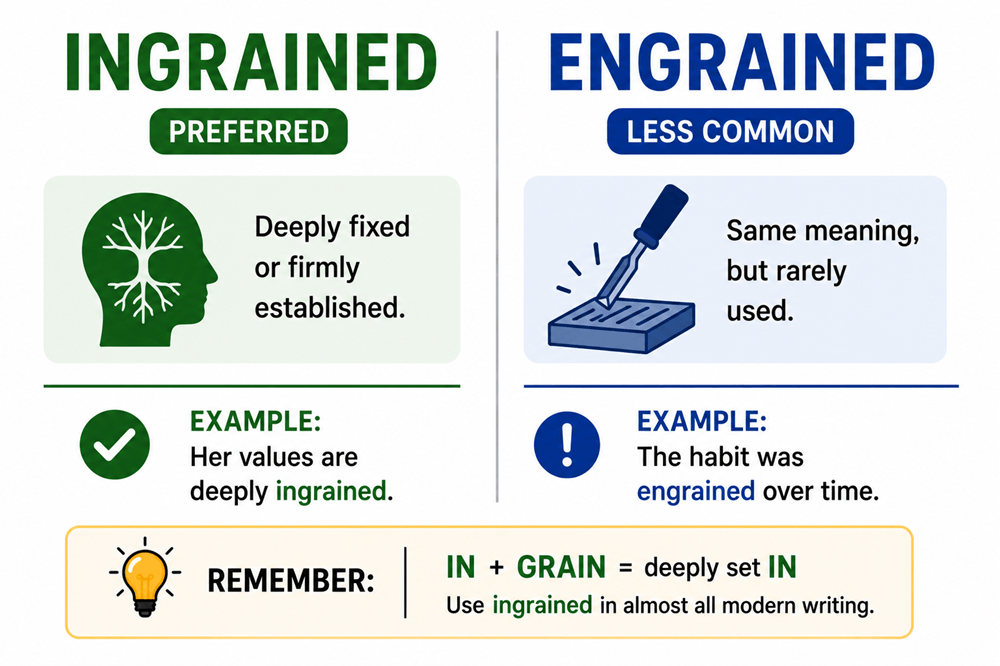
Ingrained is the preferred modern spelling. Engrained is a less common variant, but most readers and editors expect ingrained. Use ingrained when something is deeply fixed, firmly established, or hard to change, such as a habit, belief, attitude, pattern, or memory. The easiest rule is: use ingrained in almost all modern writing.
Quick Answer
Use ingrained as the standard spelling.
- Her morning routine is deeply ingrained.
- The belief was ingrained from childhood.
- Bad habits can become ingrained over time.
Engrained is rare and usually not the best choice.
- Less common: The lesson was engrained in his memory.
- Preferred: The lesson was ingrained in his memory.
The simple rule is: ingrained is preferred; engrained is an uncommon variant.
Ingrained or Engrained: What Is the Difference?
The difference between ingrained and engrained is mostly spelling and common usage. Both can mean deeply fixed or firmly established, but ingrained is the spelling used far more often in modern English. Engrained may appear occasionally, but it can look old-fashioned, unusual, or like a spelling mistake.
| Word | Status | Example |
|---|---|---|
| Ingrained | Preferred modern spelling | Those habits are deeply ingrained. |
| Engrained | Rare variant | Those habits are deeply engrained. |
If you are writing an article, essay, email, report, story, or professional document, ingrained is almost always the safer and cleaner choice.
What Does Ingrained Mean?
Ingrained means deeply fixed, strongly established, or difficult to remove. It is often used for thoughts, habits, beliefs, behaviors, customs, fears, memories, prejudices, skills, and routines.
Examples:
- The habit became ingrained after years of practice.
- Respect for elders was ingrained in her upbringing.
- His fear of failure was deeply ingrained.
- The company has an ingrained culture of caution.
- Some assumptions are so ingrained that people rarely question them.
In these sentences, ingrained suggests that something has gone deep below the surface. It is not temporary. It is not light. It has become part of the way someone thinks, behaves, reacts, or understands the world.
What Does Engrained Mean?
Engrained means the same thing as ingrained, but it is much less common. You may see it in older texts or in writing where the author prefers the variant spelling. Still, for most modern readers, engrained can look strange.
Examples:
- Rare: The memory was engrained in her mind.
- Preferred: The memory was ingrained in her mind.
- Rare: The rule became engrained in the culture.
- Preferred: The rule became ingrained in the culture.
Because engrained is uncommon, it may distract readers. Even if it is understandable, ingrained usually looks more polished.
Spelling Structure: Why Ingrained Starts With In
The preferred spelling ingrained starts with in:
- in + grained = ingrained
The beginning in- helps you remember the meaning. Something ingrained feels as if it is set in something deeply.
- in the mind
- in the memory
- in the habit
- in the culture
This is the best memory clue. If something is deeply set in a person, group, routine, or belief system, it is ingrained.
Why Does Ingrained Include “Grain”?
The word ingrained is connected to the idea of grain, texture, or something worked deeply into material. Over time, the word came to describe things that are deeply fixed in the mind or character.
You can picture the meaning this way: if dirt, color, or dye is worked into the grain of wood or fabric, it becomes hard to remove. In the same way, an ingrained habit or belief is worked deeply into someone’s behavior or thinking.
That image makes the word easier to remember:
- in = inside
- grain = deep texture or structure
- ingrained = worked deeply inside
This is why ingrained often sounds stronger than words like common, usual, or familiar. It suggests depth and difficulty changing.
Why People Write Engrained
People may write engrained because English has many words beginning with en-, such as enclose, engage, encourage, and enforce. The prefix en- can mean to put into or make something happen, so engrained may seem logical.
Another reason is that engrained looks similar to engraved. Since both words can suggest something fixed or marked deeply, writers may accidentally choose en instead of in.
Still, the standard modern spelling is:
- ingrained
If you want your writing to look natural and correct, use ingrained.
When to Use Ingrained
Use ingrained when something has become deeply rooted, fixed, or hard to change.
- Her work ethic is deeply ingrained.
- The custom is ingrained in the local culture.
- That reaction became ingrained after years of stress.
- His distrust of strangers was ingrained from childhood.
- The training became so ingrained that she acted automatically.
Ingrained often appears with words like deeply, firmly, culturally, and socially.
- deeply ingrained habit
- firmly ingrained belief
- culturally ingrained practice
- socially ingrained expectation
These phrases show that the idea is not easy to remove or change.
When to Use Engrained
Use engrained only if you are following a source, quote, title, or style guide that uses that spelling. Otherwise, choose ingrained.
- Keep engrained if it appears in an official title.
- Keep engrained if it appears in a direct quote.
- Use ingrained in your own regular writing.
For most WordBriefs-style writing, engrained is not necessary. It may make readers pause and wonder whether the word is misspelled.
Ingrained vs Embedded
Ingrained and embedded are similar, but they are not always the same. Embedded means placed inside or built into something. Ingrained means deeply fixed or established, especially in habits, beliefs, or behavior.
| Word | Meaning | Example |
|---|---|---|
| Ingrained | Deeply fixed or hard to change | The habit is ingrained. |
| Embedded | Placed inside or built in | The video is embedded. |
Use ingrained for mental, emotional, cultural, or behavioral patterns. Use embedded when something is inserted, included, or built into something else.
Common Mistakes
The most common mistake is using engrained when ingrained would be more standard.
Less preferred:
- Her habits are engrained.
- The belief was engrained in the community.
- The lesson became engrained over time.
Preferred:
- Her habits are ingrained.
- The belief was ingrained in the community.
- The lesson became ingrained over time.
Another mistake is spelling the word as ingrane, ingraineded, or engrainned. The correct standard form is simple:
- ingrain
- ingrained
- ingraining
How to Remember Ingrained
Use these memory tips:
- Ingrained starts with in.
- Something ingrained is deeply set in the mind, memory, habit, or culture.
- Grain reminds you of something worked deeply into material.
- Engrained is rare, so use ingrained for modern writing.
A simple memory sentence is: If it is deep in you, it is ingrained.
You can also remember the structure visually:
- in + grain + ed = ingrained
Final Answer
Ingrained is the preferred modern spelling. It means deeply fixed, firmly established, or hard to change. Example: The habit was deeply ingrained.
Engrained is a rare variant with the same meaning, but it is not the best choice for most modern writing.
To remember the difference, focus on the beginning: ingrained starts with “in” because something ingrained is deeply set in the mind, habit, or culture.