Realise or Realize: Correct Spelling, Regional Difference, Usage, and Examples Explained Clearly
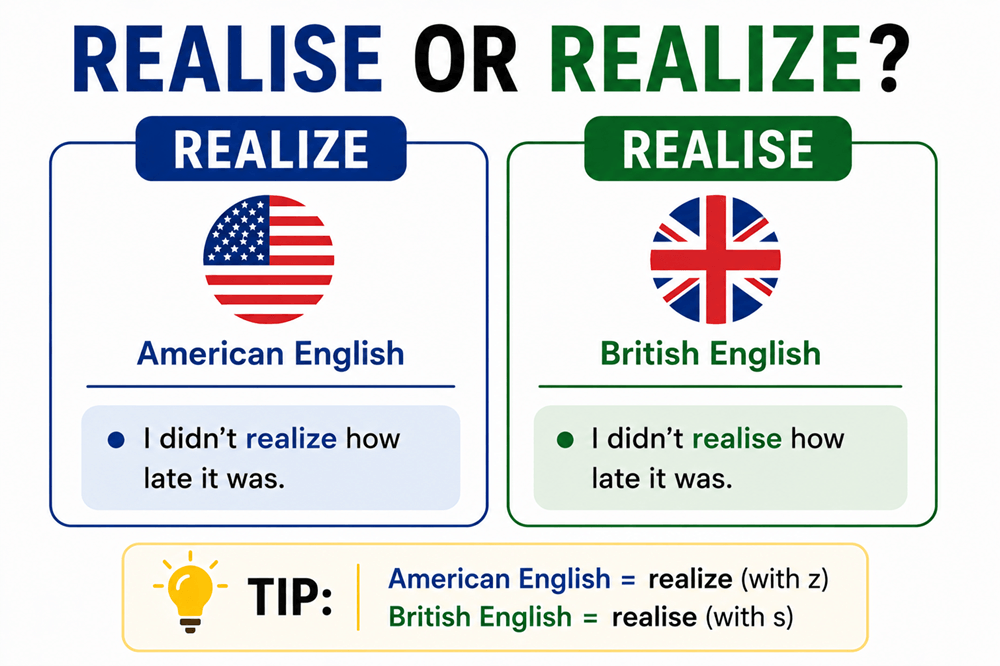
Realize and realise are both correct spellings, but they belong to different forms of English. Realize is the preferred spelling in American English, while realise is more common in British English and many other English varieties. The meaning is the same. The easiest rule is this: use realize for U.S. writing and realise for British-style writing.
Quick Answer
Use realize with a z in American English.
- Correct: I did not realize how late it was.
- Correct: She began to realize the mistake.
- Correct: The company hopes to realize its goals this year.
Use realise with an s in British English.
- Correct: I did not realise how late it was.
- Correct: She began to realise the mistake.
- Correct: The company hopes to realise its goals this year.
The simple rule is this: realize is American, and realise is British. Both are correct, but you should choose one spelling style and stay consistent.
Realise or Realize: What Is the Difference?
The difference between realise and realize is spelling, not meaning. Both words mean to become aware of something, understand something clearly, or make something actual or complete.
In American English, the standard spelling is realize. You will usually see this form in U.S. books, school assignments, business emails, websites, newspapers, and professional writing.
In British English, the common spelling is realise. You may see it in British, Australian, New Zealand, and other English varieties that often use -ise endings instead of -ize endings.
| Word | Best Use | Example |
|---|---|---|
| Realize | American English | She did not realize the answer was wrong. |
| Realise | British English | She did not realise the answer was wrong. |
If you are writing for a U.S.-focused audience, realize is usually the safer choice. If you are writing in British-style English, realise may look more natural.
What Does Realize Mean?
Realize means to understand something, become aware of something, or recognize something as true. It can describe the moment when you notice a fact, understand a situation, or see something clearly for the first time.
Examples:
- I finally realize why the plan failed.
- She did not realize the store had already closed.
- He realized that he had forgotten his keys.
- They realized the problem was bigger than expected.
In these sentences, realize is about awareness. Someone comes to understand something that was not clear before.
Realize can also mean to make something real, complete, or successful. This use is more formal, but it is common in business, personal goals, finance, and planning.
- She worked hard to realize her dream of opening a bakery.
- The team hopes to realize its vision for the project.
- The investment helped the company realize a profit.
In American English, realize is the normal spelling for both meanings.
What Does Realise Mean?
Realise means the same thing as realize. It can mean to become aware of something, understand something, or make something real. The only difference is that realise uses an s, which is common in British-style spelling.
Examples:
- I finally realise why the plan failed.
- She did not realise the shop had already closed.
- He realised that he had forgotten his keys.
- They realised the problem was bigger than expected.
These sentences would have the same meaning with realize. The spelling simply follows a different regional convention.
If the rest of your writing uses British spellings like colour, favour, centre, and organise, then realise will usually fit that style better.
Is Realise Wrong?
Realise is not wrong. It is a standard spelling in British English and is widely understood by English readers. The issue is not correctness but audience.
If you are writing for American readers, realise may look unfamiliar or inconsistent. American readers usually expect realize with a z.
Compare these examples:
- American style: I did not realize the deadline had changed.
- British style: I did not realise the deadline had changed.
Both sentences are correct. The better choice depends on the spelling style of the document.
Is Realize Wrong?
Realize is not wrong. It is the preferred spelling in American English and is also accepted in some British-style contexts, especially where a style guide allows -ize endings.
Examples:
- He realized the answer too late.
- She did not realize how much work the project required.
- The organization wants to realize its long-term goals.
For most U.S. websites, school papers, business documents, captions, and articles, realize is the best default. It looks clean, familiar, and standard to American readers.
When to Use Realize
Use realize when you are writing in American English. This spelling is best for U.S.-focused content, professional emails, school assignments, resumes, essays, articles, website pages, and general communication.
Examples:
- You may realize the answer after reading the question again.
- She realized that the meeting was scheduled for noon.
- He did not realize how important the message was.
- The business hopes to realize stronger growth next year.
Use realize if the rest of your writing uses American spellings like:
- color
- favor
- center
- organize
- realize
This keeps your article consistent. For a U.S.-focused site like WordBriefs, realize is usually the better spelling.
When to Use Realise
Use realise when you are writing in British English or following a style guide that prefers -ise endings.
Examples:
- You may realise the answer after reading the question again.
- She realised that the meeting was scheduled for noon.
- He did not realise how important the message was.
- The business hopes to realise stronger growth next year.
Use realise if the rest of your writing uses British spellings like:
- colour
- favour
- centre
- organise
- realise
The key is consistency. Do not write realize in one paragraph and realise in another unless you are quoting directly from different sources.
Realized or Realised?
The same regional difference appears in the past tense: realized or realised.
Use realized in American English.
- She realized her mistake.
- He realized the truth after reading the note.
- The company realized a profit last quarter.
Use realised in British English.
- She realised her mistake.
- He realised the truth after reading the note.
- The company realised a profit last quarter.
The meaning does not change. Only the spelling changes.
| American English | British English |
|---|---|
| realize | realise |
| realizing | realising |
| realized | realised |
| realization | realisation |
If you choose one spelling style, use the matching forms throughout your writing.
Realizing or Realising?
Realizing is the American spelling, and realising is the British spelling.
American English:
- She is realizing how much she has learned.
- He is finally realizing the cost of the decision.
- They are realizing their dream of starting a business.
British English:
- She is realising how much she has learnt.
- He is finally realising the cost of the decision.
- They are realising their dream of starting a business.
Again, both spellings are correct. The best choice depends on whether you are using American or British spelling.
Realization or Realisation?
The noun form also changes by region. Use realization in American English and realisation in British English.
American English:
- The realization came too late.
- Her realization changed the way she saw the situation.
- The project was the realization of years of work.
British English:
- The realisation came too late.
- Her realisation changed the way she saw the situation.
- The project was the realisation of years of work.
For WordBriefs and other U.S.-focused writing, realization is usually the better default.
Common Mistakes With Realise and Realize
The most common mistake is treating one spelling as always wrong. Both realise and realize are correct, but they belong to different spelling systems.
Another mistake is mixing both styles in the same article.
Inconsistent:
- She realized the mistake immediately. Later, she began to realise why it happened.
Better American consistency:
- She realized the mistake immediately. Later, she began to realize why it happened.
Better British consistency:
- She realised the mistake immediately. Later, she began to realise why it happened.
A third mistake is mixing related forms.
Inconsistent American-style writing:
- realize, realised, realization
Better American-style writing:
- realize, realized, realization
Better British-style writing:
- realise, realised, realisation
Consistency makes your writing look polished and intentional.
Examples of Realize in Sentences
Here are examples of realize used in American-style writing:
- I did not realize the door was unlocked.
- She realized that she had sent the email to the wrong person.
- He began to realize how much effort the project required.
- They realized the plan would need more time.
- You may realize the answer once you see the pattern.
- The company hopes to realize its goals by December.
- The artist finally realized her vision for the painting.
- We realized too late that the tickets were sold out.
In each sentence, realize uses the American spelling with a z.
Examples of Realise in Sentences
Here are examples of realise used in British-style writing:
- I did not realise the door was unlocked.
- She realised that she had sent the email to the wrong person.
- He began to realise how much effort the project required.
- They realised the plan would need more time.
- You may realise the answer once you see the pattern.
- The company hopes to realise its goals by December.
- The artist finally realised her vision for the painting.
- We realised too late that the tickets were sold out.
These sentences mean the same thing as the American examples. Only the spelling changes.
How to Remember Realise or Realize
A simple way to remember the difference is this:
- Realize = American English
- Realise = British English
You can also remember that American English often uses z in words like:
- realize
- organize
- recognize
- apologize
British English often uses s in those same words:
- realise
- organise
- recognise
- apologise
If your article is written for a U.S. audience, choose realize. If your article follows British spelling, choose realise. The most important thing is to avoid mixing both spellings in the same piece.
Final Answer
Realize and realise are both correct spellings of the same verb. They mean to become aware of something, understand something, or make something real. The difference is regional: realize is preferred in American English, while realise is common in British English.
The easiest rule is simple: use realize for U.S. writing and realise for British-style writing. For a U.S.-focused website like WordBriefs, realize is usually the safer default.