Burry or Bury: Correct Spelling, Meaning, and Easy Ways to Remember It
If you are choosing between burry or bury, the word you almost always want is bury. It means to place something underground, hide something, cover something, or push a feeling or memory out of view. Burry is a rare word with a different meaning, but it is usually a misspelling when you mean “put underground” or “cover.”
Burry or Bury: Which Spelling Is Correct?
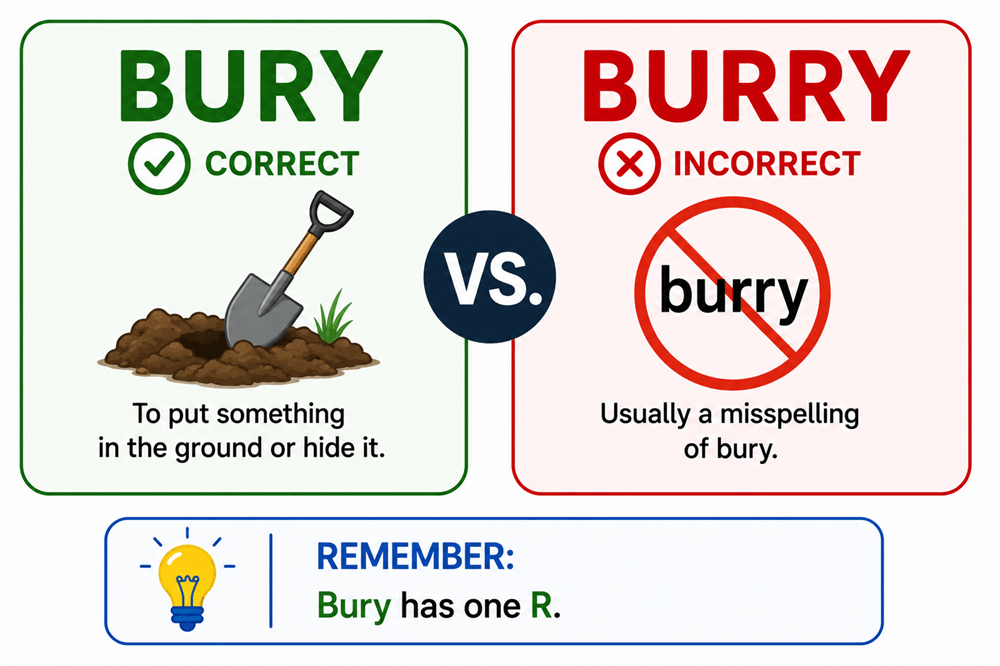
The correct spelling is bury when you mean to place something in the ground, cover something, hide something, or keep something from being noticed.
Burry is not the correct spelling for that meaning. It may look believable because many English words double a consonant before adding a suffix, but bury does not need a double r.
You should write:
Correct: You need to bury the box in the garden.
Incorrect: You need to burry the box in the garden.
You should also write:
Correct: She tried to bury her sadness.
Incorrect: She tried to burry her sadness.
The spelling is short and simple: b-u-r-y. There is only one r.
What Does Bury Mean?
Bury is a verb. Its most literal meaning is to place something underground and cover it with soil, sand, snow, leaves, or another material.
For example:
You buried the seeds beneath a thin layer of soil.
This means you placed the seeds under the ground.
You might also write:
The dog tried to bury the bone near the fence.
Here, bury means the dog tried to hide the bone under dirt.
Bury can also be used in a more emotional or figurative way. When someone buries a feeling, memory, fear, secret, or thought, it means they try to hide it, ignore it, or push it away.
For example:
You cannot bury every painful feeling forever.
This does not mean placing feelings in actual dirt. It means hiding emotions instead of facing them.
Why Burry Looks Like It Could Be Right
The misspelling burry often happens because English has many words with double consonants. You see double letters in words like hurry, worry, carry, marry, and furry. Because bury has a similar short sound in many accents, your mind may expect the same kind of spelling.
But bury does not follow the same pattern as hurry or furry. It has only one r. The word may sound like berry in many forms of English, but it is not spelled like berry or burry.
This is why spelling by sound alone can lead you in the wrong direction. You may hear a sound that feels like it needs double r, but the correct written form is still bury.
Is Burry Ever a Real Word?
Burry can be a real word, but it is rare. It can mean covered with burs, full of burs, rough, prickly, or burr-like. A bur is a small prickly seed case that can stick to clothing, fur, or fabric.
For example:
The dog came back from the field with a burry coat.
That would mean the dog’s coat had burs stuck in it or felt rough with burs.
However, this use is uncommon. Most people do not use burry in everyday writing. If you are talking about putting something underground, hiding something, or covering something, burry is wrong. The word you need is bury.
A Simple Way to Remember Bury
The easiest memory trick is:
Bury has one R because one hole is enough.
This works because bury often means placing something in one hole or covered place. You do not need two rs, just as you do not need two holes for one thing.
You can also remember:
To bury is to put under.
Both bury and under have the letter u. That can help you connect the spelling with the meaning. When you bury something, you put it under something else.
Another useful reminder is:
Bury is short because it hides quickly.
The word is only four letters long. Do not add an extra r. Keep it simple: bury.
How to Remember the Pronunciation
One reason bury is tricky is that its pronunciation does not perfectly match its spelling. In many accents, bury sounds like berry. That can make people want to spell it with rr, as in berry.
But the spelling stays:
bury
Not:
burry
You can remember it with this sentence:
Bury may sound like berry, but it has only one R.
This is especially helpful because the sound is the main source of the mistake. If you train yourself to separate sound from spelling, the word becomes easier to write correctly.
Common Phrases With Bury
Bury appears in many everyday phrases. Seeing these phrases can help the spelling feel more natural.
Bury a body means place a dead person or animal in the ground.
The family gathered to bury their loved one.
Bury treasure means hide valuable things underground.
The pirates planned to bury the treasure on the island.
Bury a bone means hide a bone underground, often said about dogs.
The dog wanted to bury the bone in the yard.
Bury your feelings means hide or suppress emotions.
You tried to bury your anger instead of talking about it.
Bury the past means move on from old pain, conflict, or memory.
They wanted to bury the past and start over.
Bury your head in the sand means ignore a problem instead of facing it.
You cannot bury your head in the sand forever.
In every phrase, the correct spelling is bury.
Bury as a Literal Verb
The literal meaning of bury is about covering something physically. This can happen with dirt, snow, sand, leaves, rubble, or any other material.
For example:
The storm buried the road under several feet of snow.
You buried the wires beneath the floorboards.
The landslide buried part of the old path.
The children buried their feet in the warm sand.
In these examples, something is physically covered or hidden. The spelling remains bury, with one r.
Bury as a Figurative Verb
Bury is also common in figurative writing. It can mean to hide, suppress, ignore, or cover something emotionally, socially, or mentally.
For example:
She buried the memory for years.
You buried yourself in work after the argument.
He tried to bury the truth, but it came out later.
The report buried the important details near the end.
In these sentences, bury does not always mean underground. It means something is hidden, pushed down, covered, or made harder to notice.
Burry vs Bury in Example Sentences
Side-by-side examples make the difference easy to see:
Correct: You should bury the seeds in soft soil.
Incorrect: You should burry the seeds in soft soil.
Correct: The snow buried the front steps.
Incorrect: The snow burried the front steps.
Correct: She tried to bury the secret.
Incorrect: She tried to burry the secret.
Correct: He buried his face in his hands.
Incorrect: He burried his face in his hands.
Correct: Do not bury the main point too late in the article.
Incorrect: Do not burry the main point too late in the article.
The correction is simple: use bury for the base verb and buried for the past tense.
What Is the Past Tense of Bury?
The past tense of bury is buried.
Because bury ends in a consonant plus y, the y changes to ied in the past tense:
bury → buried
For example:
You buried the old box behind the shed.
The ruins were buried under layers of ash.
She buried her disappointment behind a smile.
Be careful not to write burried. That is another common mistake. The correct past tense has one r:
bury → buried
How to Check Yourself Before Writing Bury
Before choosing between burry and bury, ask what you mean.
If you mean place underground, use bury.
If you mean cover or hide, use bury.
If you mean suppress a feeling or memory, use bury.
If you mean become deeply involved in something, use bury.
Then check the spelling:
Does it have one R?
If yes, bury is correct.
If it has two rs, it is probably wrong for the meaning you want.
The Final Answer on Burry or Bury
The correct spelling is bury when you mean to place something underground, cover something, hide something, or suppress something. Burry is a rare adjective meaning covered with burs or rough like burs, but it is not the correct spelling for the common verb.
To remember the spelling, use this simple clue: bury has one R because one hole is enough. You can also remember that bury means to put something under, and both words contain u.
So when you are writing about hiding a bone, planting seeds, covering something with snow, suppressing feelings, or putting something underground, choose bury. Keep the spelling short, clean, and correct with only one r.