Forrest or Forest: Correct Spelling, Meanings, and Easy Ways to Remember Clearly
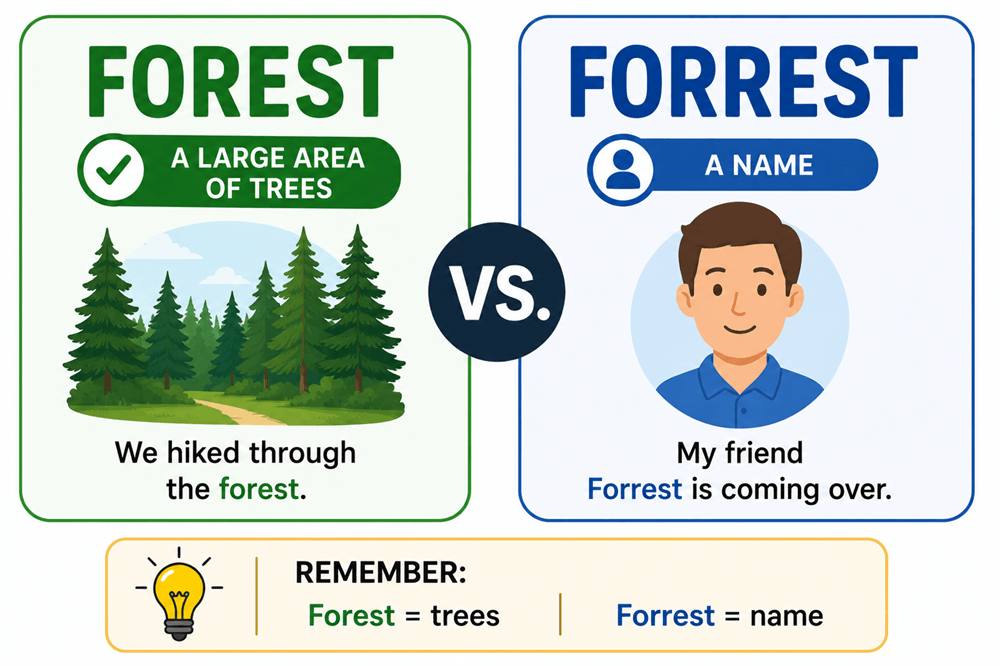
If you are choosing between forrest or forest, the correct spelling depends on what you mean. Forest is the common word for a large area filled with trees. Forrest is usually a proper name, such as a first name or surname. If you mean woods, trees, trails, wildlife, or nature, the word you almost always want is forest.
Forrest or Forest: Which Spelling Is Correct?
The standard spelling for a wooded area is forest.
Forrest is not the correct spelling when you are talking about trees or land covered with trees. It is usually a name, not a nature word. Because the two spellings look almost the same, it is easy to add an extra r by mistake.
You should write:
Correct: You walked through the forest at sunrise.
Incorrect: You walked through the forrest at sunrise.
You should also write:
Correct: The cabin was hidden deep in the forest.
Incorrect: The cabin was hidden deep in the forrest.
The correct nature word has only one r in the middle: forest.
What Does Forest Mean?
Forest is a noun. It means a large area of land covered mainly with trees, plants, undergrowth, and wildlife. A forest may be wild, protected, managed, tropical, cold, dense, dry, ancient, or newly planted.
For example:
The forest was quiet except for birds and wind moving through the leaves.
This means the area was full of trees and natural life.
You might also write:
You followed the trail into the forest.
Here, forest means a wooded place where trees grow closely together.
The word can also be used in phrases like rain forest, national forest, pine forest, forest fire, forest floor, and forest animals. In every one of these phrases, the correct spelling is forest.
What Does Forrest Mean?
Forrest is usually a proper name. It can be a person’s first name, last name, place name, brand name, character name, or title spelling. Because names do not always follow the same rules as ordinary words, Forrest can be correct when it refers to someone or something officially spelled that way.
For example:
Forrest is coming to dinner tonight.
In this sentence, Forrest is a person’s name, so the spelling with two rs can be correct.
You might also write:
That book was written by someone named Forrest.
Again, this is a name. You should preserve the spelling of a person’s name exactly as they use it.
However, if the sentence is about trees, woods, or nature, Forrest is usually wrong. The correct word is forest.
Why Forrest Looks Like It Could Be Right
The misspelling forrest looks believable because English has many words with double consonants. You see double letters in words like hurry, berry, carry, mirror, and borrow. Since forest has a soft middle sound, your mind may think the word needs an extra r.
Another reason for the confusion is the name Forrest. If you have seen that spelling as a name, it may feel familiar. Your brain may then apply the name spelling to the nature word.
But the ordinary word for a wooded area is shorter:
forest
Not:
forrest
When you mean a place full of trees, keep the spelling simple.
A Simple Way to Remember Forest
The easiest memory trick is:
A forest has one row of trees, so forest has one R.
This helps because the main mistake is adding a second r. Imagine one long row of trees. One row, one r. That gives you the correct spelling:
f-o-r-e-s-t
You can also remember:
Forest is for trees, and trees do not need an extra R.
This sentence connects the meaning with the spelling. If you are writing about nature, trees, trails, parks, woods, animals, or plants, use the shorter spelling forest.
Another Memory Trick: Forest Has Rest Inside It
Look closely at the word forest:
fo + rest = forest
The ending rest can help you remember the spelling. A forest is a place where you might rest in the shade, rest on a trail, or feel peaceful among trees.
You can remember this phrase:
You can rest in a forest.
Since forest ends in rest, this trick gives your eye something familiar to hold onto. If you write forrest, the word no longer has the clean rest ending in the same simple way.
Common Phrases With Forest
Seeing forest in common phrases can make the spelling feel natural.
Forest trail means a path through a wooded area.
You walked along the forest trail after lunch.
Forest fire means a fire burning through trees and wild land.
The dry weather increased the risk of a forest fire.
Forest floor means the ground under the trees, often covered with leaves, moss, roots, and small plants.
The forest floor was covered with pine needles.
National forest means a protected or managed forest area.
You spent the weekend camping in a national forest.
Rain forest means a dense forest in a rainy climate.
The rain forest is home to many unusual plants and animals.
In all these phrases, the spelling is forest, not forrest.
Forest as a Figurative Word
Forest can also be used figuratively. Sometimes it describes a large, crowded, or confusing collection of things.
For example:
You tried to find one useful detail in a forest of paperwork.
This does not mean the paperwork is literally made of trees standing in the ground. It means there is so much paperwork that it feels dense, overwhelming, or hard to move through.
You might also write:
The city skyline looked like a forest of glass towers.
Here, forest creates an image of many tall buildings standing close together, almost like trees.
Even in figurative writing, the spelling remains forest.
Forrest as a Name
Use Forrest when it is someone’s actual name or part of an official title. Proper names are different from ordinary vocabulary words because they follow personal, family, historical, or creative spelling choices.
For example:
Forrest called you this morning.
Her grandfather’s last name was Forrest.
The street was named after the Forrest family.
In these examples, Forrest is not a mistake because it refers to a name. It should also be capitalized because names are proper nouns.
The key difference is meaning. If it names a person, Forrest may be right. If it names a wooded place, forest is right.
Forrest vs Forest in Example Sentences
Side-by-side examples make the difference easier to see:
Correct: The deer disappeared into the forest.
Incorrect: The deer disappeared into the forrest.
Correct: You could smell pine trees throughout the forest.
Incorrect: You could smell pine trees throughout the forrest.
Correct: Forrest is the name written on the invitation.
Incorrect: Forest is the name written on the invitation, if the person spells it Forrest.
Correct: The forest was thick with fog.
Incorrect: The forrest was thick with fog.
Correct: You met a guide named Forrest near the trail entrance.
Correct: You met a guide in the forest near the trail entrance.
The spelling depends on whether you mean a name or a wooded place.
What About Forested?
Forested is an adjective that means covered with trees or forest. It also uses only one r.
For example:
The cabin sat on a forested hillside.
This means the hillside was covered with trees.
You might also write:
The road passed through a heavily forested area.
The spelling family stays consistent:
forest
forests
forested
forestry
None of these common nature-related words need a double r.
How to Check Yourself Before Writing Forest
Before choosing between forrest and forest, ask what you mean.
If you mean a wooded area, use forest.
If you mean trees, use forest.
If you mean nature, trails, wildlife, or land covered with trees, use forest.
If you mean a person’s name, check the official spelling. It may be Forrest.
Then use this quick spelling check:
Forest has one R.
Forrest is usually a name.
This simple test will solve most sentences.
The Final Answer on Forrest or Forest
The correct spelling for a large area filled with trees is forest. Use it for woods, tree-covered land, trails, wildlife, rain forests, national forests, forest fires, forest floors, and forest animals.
Forrest is usually a proper name. It may be correct when referring to a person, family name, place name, brand name, character, or official title spelled that way.
To remember the difference, use this simple clue: a forest has one row of trees, so forest has one R. You can also remember that you can rest in a forest, because forest ends with rest. When you mean trees and nature, choose forest. When you mean a name, check whether Forrest is the correct proper spelling.