Benefitting or Benefiting: Correct Spelling, Regional Difference, Usage, and Examples Clearly Explained
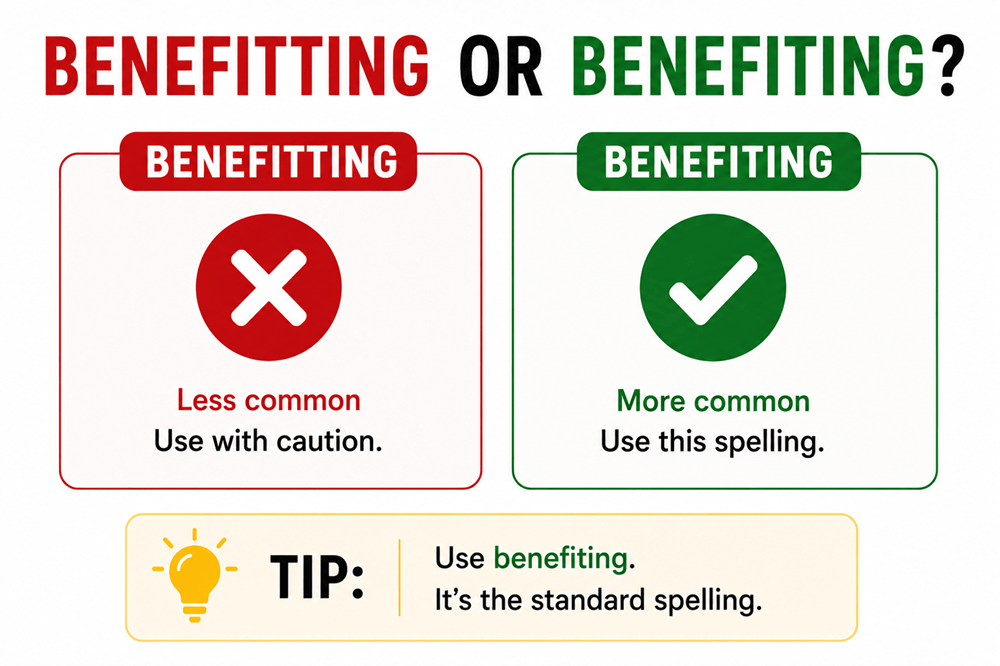
Benefiting and benefitting are both used as forms of the verb benefit, but benefiting is the more common and widely preferred spelling, especially in American English. Benefitting is a less common variant, often seen more in British English or in writing that follows a doubled-consonant style. If you want the safest choice for most modern writing, use benefiting.
Quick Answer
Use benefiting as the standard spelling in most situations.
- Correct: Students are benefiting from the new tutoring program.
- Correct: The company is benefiting from better customer service.
- Correct: Many families are benefiting from the policy change.
Benefitting is also used, but it is less common. It may appear in British English or in contexts where doubled final consonants are more accepted.
- Also acceptable: Students are benefitting from the new tutoring program.
- More common: Students are benefiting from the new tutoring program.
The simple rule is this: benefiting is the safer standard choice, while benefitting is a less common variant.
Benefitting or Benefiting: What Is the Difference?
The difference between benefitting and benefiting is spelling, not meaning. Both words come from the verb benefit, which means to receive help, gain an advantage, or have a positive result from something.
When you add -ing to benefit, the usual spelling is benefiting, with one t. This is the spelling most readers expect, especially in American English.
Benefitting, with two ts, is a variant. It is not meaningless, and it is not always wrong, but it can look unusual to some readers. In polished American writing, editors usually prefer benefiting.
| Word | Status | Example |
|---|---|---|
| Benefiting | More common standard spelling | The school is benefiting from extra funding. |
| Benefitting | Less common variant | The school is benefitting from extra funding. |
If you are writing for a general audience, benefiting is usually the better choice.
What Does Benefiting Mean?
Benefiting means receiving a benefit, gaining something helpful, or being improved by something. It is the present participle form of benefit, so it is often used with forms of be, such as is, are, was, and were.
Examples:
- The children are benefiting from smaller class sizes.
- The business is benefiting from its new location.
- Local farmers are benefiting from the rainfall.
- The patient was benefiting from the new treatment plan.
In each sentence, someone or something is receiving a positive result. The children receive help from smaller classes. The business gains an advantage from its location. The farmers receive a positive effect from rain.
Benefiting can also describe something that helps another person, group, or cause.
- The charity event is benefiting local shelters.
- The fundraiser is benefiting families in need.
- The concert is benefiting the hospital’s children’s wing.
In these examples, benefiting means helping or supporting a cause. This spelling is clear, familiar, and widely accepted.
What Does Benefitting Mean?
Benefitting means the same thing as benefiting. It also means receiving help, gaining an advantage, or giving support to a person, group, or cause. The difference is simply that benefitting doubles the final t.
Examples:
- The community is benefitting from the new park.
- Small businesses are benefitting from increased tourism.
- The charity dinner is benefitting a local school.
These sentences are understandable. Many readers will know exactly what they mean. However, the spelling may look less familiar, especially to American readers. In most U.S. writing, benefiting is preferred.
That does not mean benefitting never appears. It can appear in British English, Canadian English, Australian English, and other varieties where some doubled-consonant spellings are more common. Still, even there, benefiting is also widely used.
Why Benefiting Usually Has One T
Benefiting usually has one t because of the way English often handles final consonants when adding endings like -ing or -ed. In many words, the final consonant is doubled only when the stress falls on the final syllable.
For example:
- begin → beginning
- forget → forgetting
- admit → admitting
In those words, the final syllable is stressed, so the final consonant doubles.
With benefit, the main stress is usually on the first syllable: BEN-uh-fit. Because the final syllable is not strongly stressed, the final t is usually not doubled. That gives you benefiting, not benefitting.
This is the same basic pattern you see in words like:
- visit → visiting
- limit → limiting
- edit → editing
- profit → profiting
Since benefit works like these words in standard American spelling, benefiting is the expected form.
Is Benefitting Wrong?
Benefitting is not always wrong, but it is less common. It may be accepted as a variant spelling, especially outside American English. However, because it is not the preferred form in many style guides and edited contexts, it can look unusual.
For example:
- Less common: The program is benefitting students.
- More common: The program is benefiting students.
- Less common: The city is benefitting from tourism.
- More common: The city is benefiting from tourism.
If you are writing for a school assignment, business email, website article, report, or professional document, benefiting is usually the safer choice. It is less likely to distract readers or look like a spelling mistake.
When to Use Benefiting
Use benefiting when you want the more common and standard spelling. It works in American English, professional writing, academic writing, business writing, website content, news-style writing, and everyday communication.
Examples:
- The new policy is benefiting working parents.
- The nonprofit is benefiting from community donations.
- Employees are benefiting from flexible schedules.
- The students are benefiting from extra reading support.
- The company is benefiting from stronger online sales.
Use benefiting when you want your sentence to look clean and standard. For a U.S.-focused website like WordBriefs, this is the spelling that will usually feel most natural to readers.
When to Use Benefitting
Use benefitting only if you are following a style guide, regional spelling preference, or existing document that uses the double-t form. It may also appear in British-style writing, though benefiting is still common there too.
Examples:
- The project is benefitting the wider community.
- Several departments are benefitting from the new system.
- The campaign is benefitting families affected by the storm.
These sentences are not hard to understand. Still, unless you have a reason to use benefitting, benefiting is usually better.
One important rule is consistency. Do not write benefiting in one paragraph and benefitting in another unless you are quoting someone directly. Pick one spelling and use it throughout the same piece.
Benefited or Benefitted?
The same spelling issue appears with the past tense: benefited or benefitted. The more common American spelling is benefited, with one t.
- Correct and common: The students benefited from the program.
- Less common variant: The students benefitted from the program.
Both forms may appear, but benefited is the safer choice in American English. It matches benefiting.
| Base Verb | Preferred American Form | Less Common Variant |
|---|---|---|
| benefit | benefiting | benefitting |
| benefit | benefited | benefitted |
If you choose benefiting, you should usually choose benefited as the past tense for consistency.
Common Mistakes With Benefitting and Benefiting
The most common mistake is assuming that the final t must always double before -ing. English does not work that way for every word.
Less preferred in American English:
- The program is benefitting children.
- The team is benefitting from better tools.
- The fundraiser is benefitting a local charity.
Preferred in American English:
- The program is benefiting children.
- The team is benefiting from better tools.
- The fundraiser is benefiting a local charity.
Another mistake is mixing the two forms in the same article.
- Inconsistent: The school is benefiting from the grant. Parents are also benefitting from the new schedule.
Better:
- Consistent: The school is benefiting from the grant. Parents are also benefiting from the new schedule.
Consistency helps the writing look intentional and polished.
Examples of Benefiting in Sentences
Here are examples of benefiting used correctly:
- The neighborhood is benefiting from the new community center.
- Workers are benefiting from improved safety rules.
- The organization is benefiting from more public support.
- The children are benefiting from daily reading practice.
- The new software is benefiting the entire team.
- The fundraiser is benefiting animal rescue groups.
- Customers are benefiting from faster delivery times.
- The town is benefiting from increased tourism.
In each sentence, benefiting means receiving help, gaining an advantage, or supporting a cause. This is the spelling most readers expect.
Examples of Benefitting in Sentences
Here are examples of benefitting as a less common variant:
- The school is benefitting from new equipment.
- The campaign is benefitting local families.
- Several small shops are benefitting from the festival.
- The charity is benefitting from a large donation.
These sentences are understandable, but many editors would change benefitting to benefiting, especially in American English. The meaning stays the same, but the spelling looks more standard with one t.
How to Remember Benefitting or Benefiting
A simple way to remember the preferred spelling is to compare benefit with similar words:
- visit → visiting
- limit → limiting
- edit → editing
- benefit → benefiting
These words do not usually double the final consonant because the stress is not on the final syllable. That makes benefiting the natural spelling.
You can also remember this sentence:
Most writing benefits from using benefiting.
The spelling with one t is the cleaner default. If you are unsure, choose benefiting.
Final Answer
Benefiting and benefitting are both used, but benefiting is the more common and preferred spelling, especially in American English. Benefitting is a less common variant that may appear in British-style writing or in documents that prefer doubled consonants.
The easiest rule is simple: use benefiting for most modern writing. Use benefitting only if a specific style guide, region, or existing document calls for that spelling. For a U.S.-focused website, benefiting is usually the best choice.