Is Onto One Word? Onto vs. On To Explained
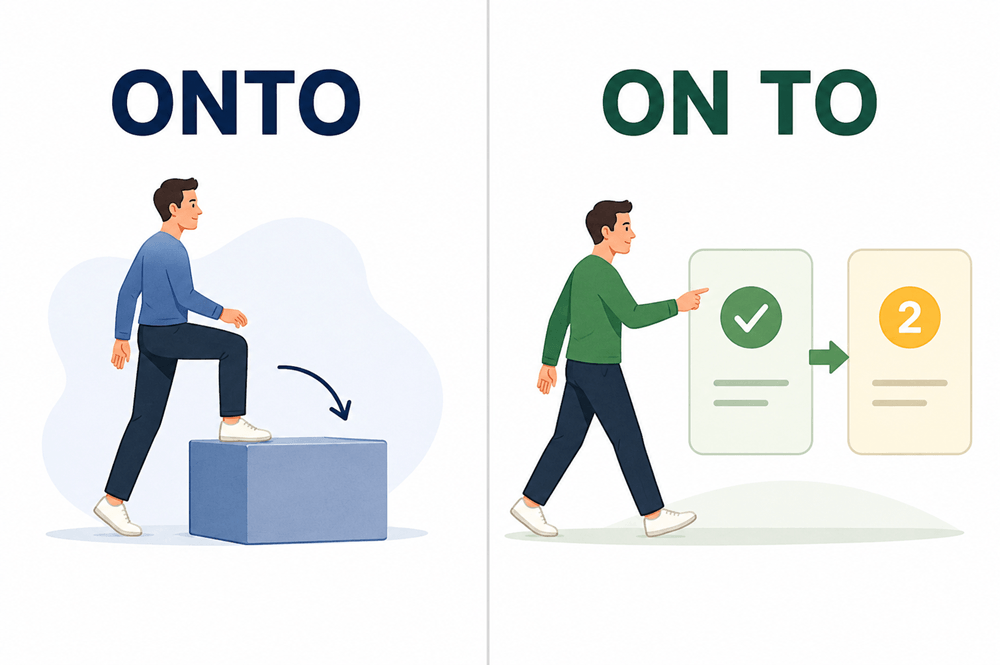
Onto is one word when it shows movement toward a surface, position, or state.
On to is two words when on belongs to one part of the sentence and to belongs to another.
Examples:
- The cat jumped onto the table.
- She moved on to the next question.
- He climbed onto the roof.
- We are on to something important.
The words sound alike, but their grammar and meanings are different.
Quick Answer
Use onto when something moves to a position on top of or against a surface:
- Step onto the platform.
- Put the books onto the shelf.
- The child climbed onto the chair.
Use on to when on completes a verb or expression and to introduces the next object or action:
- Let’s move on to the next topic.
- She held on to the railing.
- He passed the message on to his manager.
A simple memory rule is:
Onto shows movement. On to keeps two separate ideas.
What Does Onto Mean?
Onto is usually a preposition.
It often describes movement from one position to another, especially toward a surface.
Examples:
- The dog jumped onto the couch.
- She placed the cup onto the tray.
- Rainwater flowed onto the road.
- He stepped onto the stage.
In each sentence, something changes position and ends up on a surface or location.
Is Onto One Word or Two?
Onto is one word when the meaning involves movement or placement.
Correct:
- She climbed onto the ladder.
- The ball rolled onto the field.
- He uploaded the file onto the website.
Incorrect in these examples:
- She climbed on to the ladder.
- The ball rolled on to the field.
Although some older or British styles may occasionally use on to in movement sentences, onto is the clearest modern choice when the words function as one preposition.
What Does On To Mean?
On to appears when the two words serve different grammatical purposes.
For example:
- We moved on to the next chapter.
Here:
- on is part of the verb phrase move on
- to introduces the next chapter
You can separate the ideas:
- We moved on.
- We moved to the next chapter.
Because the words belong to different parts of the sentence, they remain separate.
Onto vs. On To
The main difference is whether the words work together.
| Form | Use | Example |
|---|---|---|
| Onto | Movement toward a surface or position | She stepped onto the bus. |
| On to | Separate words in a verb phrase | She moved on to another task. |
Compare:
- He climbed onto the platform.
- He moved on to the next platform.
The first sentence describes physical movement onto a surface.
The second means he continued to another platform.
Onto for Physical Movement
Use onto when something moves from one place to a surface or position.
Examples:
- The child climbed onto the bed.
- The bird flew onto the fence.
- She placed the groceries onto the counter.
- The actor walked onto the stage.
- Snow fell onto the roof.
A useful test is to see whether on top of or to a position on expresses the same basic idea.
Example:
- The cat jumped onto the sofa.
- The cat jumped to a position on the sofa.
Because the movement ends on the sofa, onto is correct.
Onto for Movement Into a Position
The movement does not always need to be upward.
Examples:
- The car turned onto the highway.
- The crowd spilled onto the street.
- The document was copied onto a drive.
- She was invited onto the committee.
In these cases, onto shows movement or transfer into a new position, route, system, or role.
Move On To
The correct phrase is usually:
move on to
Examples:
- Let’s move on to the next question.
- She moved on to a new job.
- After discussing the budget, we moved on to staffing.
- He finished the first chapter and moved on to the second.
The phrase move on means continue or proceed. The word to introduces what comes next.
That is why the words remain separate.
Hold On To
The correct phrase is:
hold on to
Examples:
- Hold on to the railing.
- She held on to the old letters.
- He tried to hold on to his balance.
- They want to hold on to their traditions.
The phrasal verb is hold on, and to introduces the object.
Do not normally write:
- hold onto
However, hold onto is common in informal writing, and many dictionaries accept it. In careful writing, hold on to makes the structure clearer.
Hang On To
Similarly, the traditional form is:
hang on to
Examples:
- Hang on to the rope.
- She hung on to the receipt.
- He is trying to hang on to his job.
The form hang onto is also widespread and often accepted, especially in informal English.
When following a strict style guide, check its preference.
Pass On To
Use on to when passing something from one person to another.
Examples:
- Please pass the message on to David.
- She passed the information on to the police.
- The story was passed on to future generations.
Here, pass on means transfer or communicate. The word to identifies the receiver.
Be On To Something
The phrase be on to something means to have discovered an important clue, idea, or possibility.
Examples:
- I think you’re on to something.
- The researchers may be on to a new solution.
- She knew the detective was on to her.
- We could be on to a better approach.
This phrase is always written with two words because on and to serve separate roles.
Is It “Get Onto” or “Get On To”?
Both can be correct, depending on the meaning.
Get onto
Use get onto for physical movement or entering a platform, vehicle, or surface.
Examples:
- Get onto the bus.
- The cat got onto the counter.
- She managed to get onto the stage.
Get on to
Use get on to when get on means begin dealing with, contact, or continue to something.
Examples:
- I’ll get on to the next task.
- She got on to the supplier about the delay.
- Let’s get on to the main issue.
Context determines the spelling.
Is It “Log Onto” or “Log On To”?
Both forms are common.
Traditional:
- Log on to your account.
Modern and widely accepted:
- Log onto your account.
This happens because log on is a phrasal verb, but onto is also understood as movement into a digital system.
In technical writing, many editors prefer:
- log in to
- sign in to
These forms make the verb phrase clearer.
Is It “Turn Onto” or “Turn On To”?
The meaning changes.
Turn onto
Use turn onto when changing direction onto a road or route.
Examples:
- Turn onto Pine Street.
- The car turned onto the highway.
Turn on to
Use turn on to when turn on is a separate expression and to introduces something else.
Example:
- She turned the light on to check the room.
This sentence is less natural than:
- She turned on the light to check the room.
The two-word sequence is possible, but it is not the same as turn onto.
Common Mistakes
Writing on to for clear physical movement
Less natural:
- The child climbed on to the chair.
Preferred:
- The child climbed onto the chair.
Writing onto after a phrasal verb
Less clear:
- Let’s move onto the next subject.
Preferred in careful writing:
- Let’s move on to the next subject.
Confusing hold on to with physical movement
Correct:
- Hold on to the handle.
The phrase does not mean moving onto the handle. It means keeping your grip.
Writing onto in “on to something”
Incorrect:
- I think you’re onto something.
This closed form is increasingly common and may be accepted informally, but the traditional and clearer spelling is:
- I think you’re on to something.
The Movement Test
Ask whether something is moving to a position on a surface, route, or platform.
If yes, use onto.
Examples:
- jump onto the bed
- step onto the stage
- turn onto the road
- load the file onto the server
The Pause Test
Try pausing after on.
- move on / to the next topic
- hold on / to the rope
- pass it on / to your friend
If the sentence still makes sense with a pause after on, use on to.
This shows that on completes one expression and to starts another.
How to Remember Onto or On To
Use this simple rule:
Onto means movement. On to means continuation or connection.
Think:
- jump onto a surface
- move on to a new subject
Another memory trick is:
If you can say “on top of,” use onto.
Example:
- The book fell onto the floor.
- The book fell to a position on the floor.
For on to, remember that the phrase can usually be split:
- hold on / to the rail
- move on / to the next step
Is Onto Hyphenated?
No.
Correct:
- onto
Incorrect:
- on-to
The two-word form is written without a hyphen:
- on to
Final Answer
Onto is one word when it shows movement toward a surface, position, route, or system.
Examples:
- The cat jumped onto the table.
- She stepped onto the stage.
- The car turned onto the highway.
On to is two words when on completes one expression and to introduces what follows.
Examples:
- Let’s move on to the next topic.
- Hold on to the railing.
- Pass the message on to your manager.
Remember:
Use onto for movement. Use on to when the two words have separate jobs.