Respondent or Respondant: Correct Spelling, Meaning, and Examples for Clear English Writing
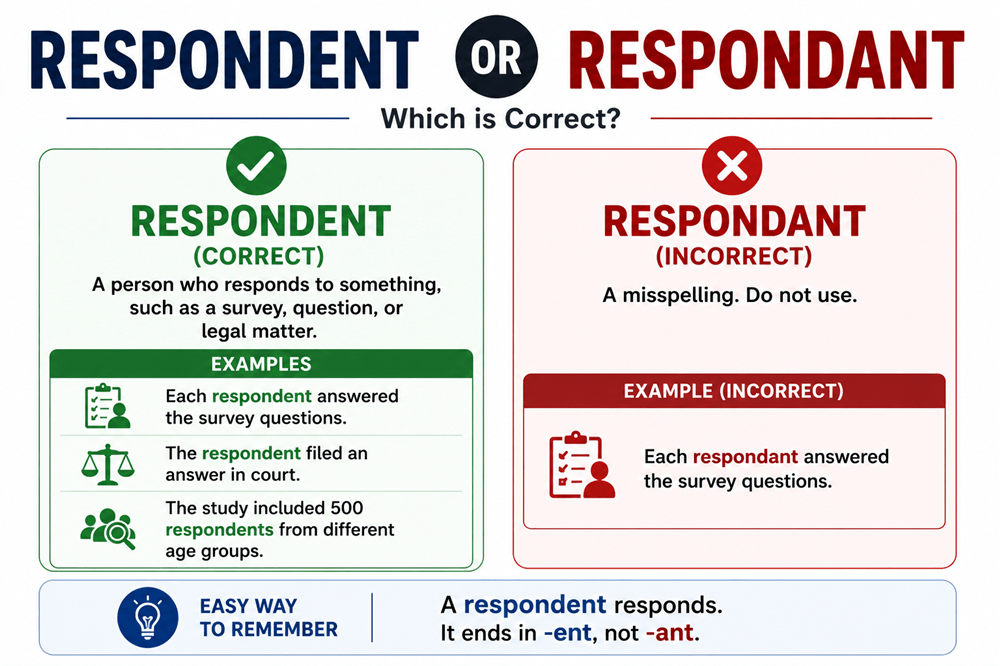
The correct spelling is respondent. Respondant is a misspelling and should not be used in standard English. A respondent is a person who responds to something, such as a survey, legal case, questionnaire, complaint, or formal request. The word ends in -ent, not -ant.
Quick Answer
Use respondent, not respondant.
- Correct: Each respondent answered five survey questions.
- Incorrect: Each respondant answered five survey questions.
Respondent is the standard spelling. Respondant is a common mistake, but it is not the correct form.
Respondent or Respondant: Which One Is Correct?
Respondent is correct. Respondant is incorrect.
This spelling mistake is understandable because many English words end in -ant, such as assistant, participant, applicant, and consultant. Since a respondent can be similar to a participant or applicant in some contexts, the ending -ant may feel natural.
However, the correct word is respondent with -ent. It comes from the verb respond, meaning to answer, reply, or react. A respondent is someone who responds.
| Word | Correct? | Meaning |
|---|---|---|
| Respondent | Yes | A person who responds, especially in a survey, case, or formal setting |
| Respondant | No | A misspelling of respondent |
What Does Respondent Mean?
A respondent is a person who gives a response. The word is often used in formal, legal, research, business, and academic settings.
In a survey, a respondent is someone who answers the questions.
- Each respondent completed the online questionnaire.
- The survey included 500 respondents from different age groups.
- Most respondents said they preferred email updates.
In a legal case, a respondent is often the person or party who responds to a petition, appeal, complaint, or legal action.
- The respondent filed an answer through an attorney.
- The court asked the respondent to provide additional documents.
- The petitioner and the respondent appeared before the judge.
In general writing, respondent can also mean someone who replies or reacts to a question, request, or situation.
- The first respondent gave a thoughtful answer.
- One respondent disagreed with the statement.
- The interviewer thanked every respondent for their time.
Why Respondant Is Incorrect
Respondant is incorrect because the standard English spelling is respondent. The word does not end with -ant.
The mistake may happen because -ant and -ent endings often sound similar. In spoken English, the final syllable may be soft or unstressed, so it can be hard to hear whether the word should end in ant or ent.
Words like these can cause confusion:
- assistant
- participant
- applicant
- defendant
- consultant
Because those words end in -ant, some writers may assume respondent should follow the same pattern. But it does not. The correct spelling is:
- respond + ent = respondent
Examples of Respondent in Sentences
Here are natural examples of respondent used correctly:
- The respondent answered all the questions honestly.
- Each survey respondent received a small gift card.
- The study included one respondent from each department.
- The respondent denied the claims in the complaint.
- The court sent a notice to the respondent.
- One respondent said the instructions were unclear.
- The researcher removed one respondent from the data set.
- The petitioner and respondent reached an agreement.
In each sentence, respondent refers to someone who answers, replies, or formally responds.
Respondent in Survey and Research Writing
The word respondent is especially common in surveys, research reports, polls, questionnaires, and academic studies. In these contexts, a respondent is a person who provides answers or information.
Examples:
- The survey asked each respondent about their shopping habits.
- Only one respondent skipped the final question.
- The researchers grouped respondents by age and location.
- Several respondents said they wanted more flexible work options.
- The report is based on answers from 1,200 respondents.
In this kind of writing, respondent sounds formal and precise. It is more specific than simply saying person or participant, because it focuses on the act of responding.
Respondent in Legal Writing
Respondent is also common in legal writing. In many legal contexts, the respondent is the person or party who responds to a legal filing, petition, appeal, or complaint.
Examples:
- The respondent must reply within thirty days.
- The judge reviewed the respondent’s statement.
- The respondent appeared in court with legal counsel.
- The petitioner filed the request, and the respondent filed an answer.
- The court ruled in favor of the respondent.
Because legal writing depends on exact wording, it is especially important to spell respondent correctly. Respondant may look unprofessional in a legal document, court form, or formal letter.
Respondent vs Participant
Respondent and participant can sometimes refer to similar people, but the words are not exactly the same.
A participant is someone who takes part in an activity, event, study, program, or process.
A respondent is someone who gives a response, usually by answering questions or replying to a formal matter.
| Word | Meaning | Example |
|---|---|---|
| Participant | Someone who takes part | Each participant joined the workshop. |
| Respondent | Someone who answers or replies | Each respondent answered the survey. |
In a research study, one person can be both a participant and a respondent. If the person is taking part in the study, they are a participant. If they are answering survey questions, they are a respondent.
Respondent vs Defendant
Respondent and defendant can both appear in legal writing, but they are not always the same.
A defendant is usually the person or party accused or sued in a case. A respondent is the person or party responding to a legal petition, appeal, or proceeding.
The exact use can depend on the type of case and legal system, but the basic idea is this:
- Defendant often answers a lawsuit or charge.
- Respondent often answers a petition, appeal, complaint, or formal request.
Examples:
- The defendant denied the accusation.
- The respondent replied to the petition.
For a general word guide, the key point is spelling: respondent ends in -ent, while defendant ends in -ant.
Common Mistakes to Avoid
The biggest mistake is spelling the word as respondant.
Incorrect:
- The respondant completed the survey.
- The court notified the respondant.
- Each respondant gave a different answer.
Correct:
- The respondent completed the survey.
- The court notified the respondent.
- Each respondent gave a different answer.
Another mistake is confusing respondent with response. A response is the answer itself. A respondent is the person who gives the answer.
- The respondent gave a detailed response.
In that sentence, the respondent is the person, and the response is what the person said or wrote.
How to Remember Respondent
Here is an easy way to remember the spelling:
A respondent responds.
The word respondent begins with respond, so keep that connection in mind. Then remember that the ending is -ent.
- respond + ent = respondent
You can also remember this simple rule:
Respondent has an e, just like response.
That reminder can help you avoid the incorrect spelling respondant.
Final Answer
Respondent is the correct spelling. Respondant is a misspelling and should be avoided. A respondent is a person who responds, especially in a survey, research study, legal case, questionnaire, or formal situation. Remember: respondent ends in -ent, not -ant.