Another Word for “Is”: Alternatives and Better Ways to Rewrite a Sentence
Finding another word for is depends on what the sentence means.
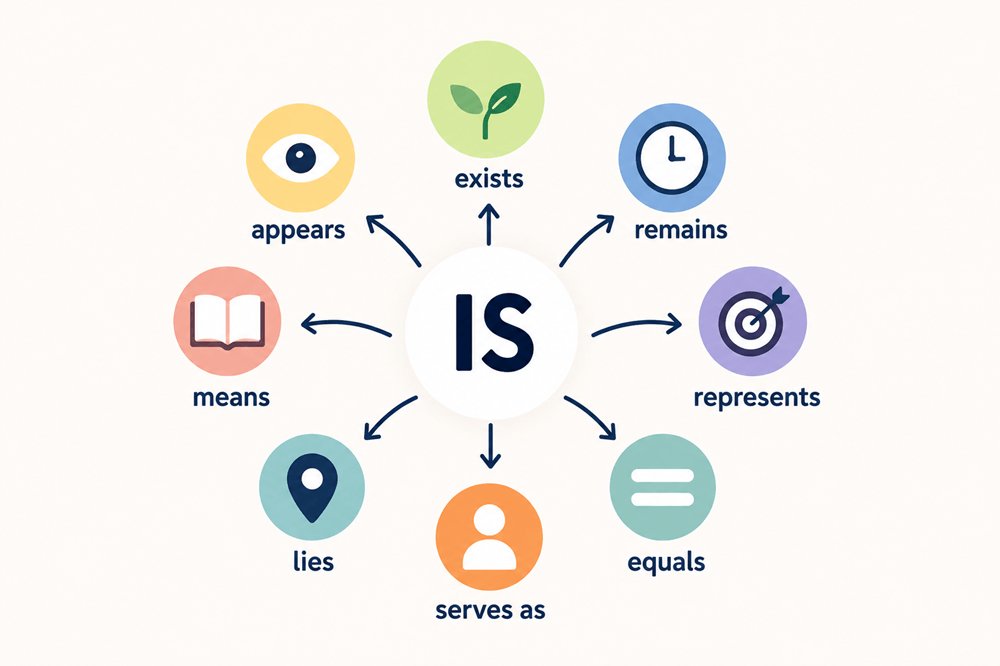
Possible alternatives include:
- exists
- remains
- appears
- seems
- represents
- means
- equals
- occurs
- belongs
- serves as
However, these words are not interchangeable in every sentence. Is is a form of the verb be, and it can express identity, description, location, condition, existence, or meaning.
For example:
- The problem is serious.
- The problem appears serious.
The second sentence suggests uncertainty, while the first presents the statement as a fact.
Quick Answer
Common alternatives for is include:
| Intended meaning | Possible alternative |
|---|---|
| Exists | exists |
| Continues in a condition | remains |
| Seems to be | appears, seems |
| Has a meaning | means, signifies |
| Stands for something | represents |
| Has the same value | equals |
| Performs a function | serves as |
| Happens | occurs, takes place |
| Has a location | sits, stands, lies |
| Belongs to a group | belongs, falls within |
The best replacement depends on the complete sentence.
What Does “Is” Mean?
Is is the third-person singular present form of be.
It is used with subjects such as:
- he
- she
- it
- a person’s name
- one object
- one idea
Examples:
- She is ready.
- Daniel is outside.
- The answer is correct.
- This book is mine.
The other present forms of be are:
- I am
- you are
- we are
- they are
Because is performs several grammatical jobs, it does not have one perfect synonym.
Another Word for “Is” When Something Exists
When is means that something exists, use:
- exists
- remains
- occurs
- lives
- stands
Examples:
- There is a solution.
- A solution exists.
- There is still hope.
- Hope remains.
- There is a problem in the system.
- A problem exists in the system.
The rewritten sentence may require changing the word order.
Less natural:
- There exists a solution.
More direct:
- A solution exists.
Another Word for “Is” When Describing a Condition
When is connects a subject to a condition, possible alternatives include:
- remains
- appears
- seems
- feels
- looks
- becomes
Examples:
- The room is quiet.
- The room remains quiet.
- The plan is complicated.
- The plan seems complicated.
- The fabric is soft.
- The fabric feels soft.
- The sky is dark.
- The sky looks dark.
These alternatives may change the meaning slightly.
Is states the condition directly. Seems, appears, looks, and feels describe an impression.
Another Word for “Is” When Defining Something
When a sentence explains what a term means, use:
- means
- refers to
- describes
- signifies
- represents
- denotes
Examples:
- Resilience is the ability to recover from difficulty.
- Resilience means the ability to recover from difficulty.
- A noun is a word that names a person, place, thing, or idea.
- A noun refers to a word that names a person, place, thing, or idea.
- The red symbol is a warning.
- The red symbol represents a warning.
Use the replacement that matches the relationship between the two ideas.
Another Word for “Is” When Showing Equality
In mathematics, measurement, or comparison, is may mean:
- equals
- amounts to
- totals
- corresponds to
- is equivalent to
Examples:
- Two plus three is five.
- Two plus three equals five.
- The total is fifty dollars.
- The total amounts to fifty dollars.
- One kilometer is approximately 0.62 miles.
- One kilometer is equivalent to approximately 0.62 miles.
These alternatives are useful when the sentence expresses numerical or logical equality.
Another Word for “Is” When Identifying a Role
When is explains someone’s role or an object’s purpose, use:
- serves as
- acts as
- functions as
- works as
- operates as
Examples:
- She is the team leader.
- She serves as the team leader.
- This room is our office.
- This room functions as our office.
- The wooden box is a temporary table.
- The wooden box acts as a temporary table.
These replacements emphasize function rather than identity.
Another Word for “Is” When Describing Location
When is tells where something is located, use a more specific verb such as:
- sits
- stands
- lies
- rests
- remains
- stays
- occupies
Examples:
- The house is beside the river.
- The house stands beside the river.
- The village is in the valley.
- The village lies in the valley.
- The book is on the table.
- The book rests on the table.
- The statue is near the entrance.
- The statue stands near the entrance.
Specific verbs can make descriptive writing more vivid.
Another Word for “Is” When Something Belongs to a Category
When is places something in a category, use:
- belongs to
- falls under
- qualifies as
- counts as
- ranks as
Examples:
- A whale is a mammal.
- A whale belongs to the mammal group.
- This topic is part of grammar.
- This topic falls under grammar.
- The activity is a sport.
- The activity qualifies as a sport.
Be careful with words such as qualifies as and counts as, because they may suggest that the classification is debatable.
Another Word for “Is” When Expressing Importance
Possible alternatives include:
- matters
- remains
- proves
- plays
- represents
Examples:
- Communication is important.
- Communication matters.
- Patience is essential.
- Patience remains essential.
- Timing is a major factor.
- Timing plays a major role.
The rewrite may be stronger because it replaces a general linking verb with a more active verb.
Strong Verbs to Replace “Is”
Writers are sometimes advised to replace forms of be with stronger verbs.
For example:
Weak:
- The report is an explanation of the problem.
Stronger:
- The report explains the problem.
Weak:
- The new policy is a cause of confusion.
Stronger:
- The new policy causes confusion.
Weak:
- The dog is in the yard.
Stronger:
- The dog runs in the yard.
- The dog waits in the yard.
- The dog sleeps in the yard.
A stronger verb often shows what the subject actually does.
How to Rewrite a Sentence Without “Is”
Instead of searching for a direct synonym, identify the main action or idea.
Turn a noun into a verb
Original:
- Her response is an indication of concern.
Rewrite:
- Her response indicates concern.
Use a more precise action
Original:
- The teacher is in front of the class.
Rewrite:
- The teacher stands in front of the class.
Remove unnecessary words
Original:
- The reason is because the road was closed.
Rewrite:
- The road was closed.
Change passive voice to active voice
Original:
- The decision is made by the manager.
Rewrite:
- The manager makes the decision.
These changes improve clarity without forcing an unsuitable synonym into the sentence.
“Is” vs. “Seems”
Is expresses certainty.
Seems expresses an impression or possibility.
Compare:
- The answer is correct.
- The answer seems correct.
The first speaker believes the answer is definitely correct. The second speaker is less certain.
Do not replace is with seems unless uncertainty is intended.
“Is” vs. “Appears”
Appears often means that something looks or seems a particular way.
Examples:
- The building is empty.
- The building appears empty.
The second sentence leaves open the possibility that someone is inside.
Use appears when describing evidence, appearance, or an initial judgment.
“Is” vs. “Remains”
Remains suggests that a condition continues.
Examples:
- The door is closed.
- The door remains closed.
The first describes the present condition. The second suggests that the door was closed earlier and continues to be closed.
“Is” vs. “Becomes”
Becomes shows a change.
Examples:
- The water is cold.
- The water becomes cold.
The first describes a condition. The second describes movement into that condition.
These words are not direct synonyms.
Is It Bad to Use the Word “Is”?
No. Is is one of the most useful and necessary words in English.
Examples such as these are already clear:
- She is my sister.
- The answer is seven.
- The store is closed.
- This is important.
Replacing every use of is can make writing sound unnatural or overly complicated.
Awkward:
- She functions as my sister.
Natural:
- She is my sister.
The goal is not to remove every linking verb. Replace is only when a more precise verb improves the sentence.
Common Mistakes
Replacing “is” with a word that changes certainty
Original:
- The result is accurate.
Different meaning:
- The result seems accurate.
Using an unnecessarily formal alternative
Wordy:
- The price is equivalent to ten dollars.
Natural:
- The price is ten dollars.
Removing “is” when it is grammatically necessary
Incorrect:
- She happy.
Correct:
- She is happy.
Replacing every form of “be”
Overediting can make simple writing harder to read.
Sometimes is remains the clearest choice.
How to Choose the Best Alternative
Ask what is means in the sentence.
Does it show:
- existence?
- identity?
- condition?
- location?
- definition?
- equality?
- function?
- appearance?
- continuation?
Then choose a verb that expresses that meaning more precisely.
Example:
- The castle is on the hill.
Possible rewrite:
- The castle stands on the hill.
Here, stands improves the visual description without changing the meaning.
Final Answer
Another word for is depends on the sentence.
Possible alternatives include:
- exists
- remains
- seems
- appears
- means
- represents
- equals
- serves as
- stands
- lies
- belongs
Examples:
- A solution exists.
- The problem remains serious.
- The symbol represents peace.
- The house stands near the river.
- Five plus five equals ten.
However, is is often already the clearest and most natural word.
Remember:
Do not replace “is” automatically. Identify its meaning, then choose a more precise verb when one is useful.