Lieing or Lying: Correct Spelling, Meaning, Verb Forms, and Examples Explained Clearly
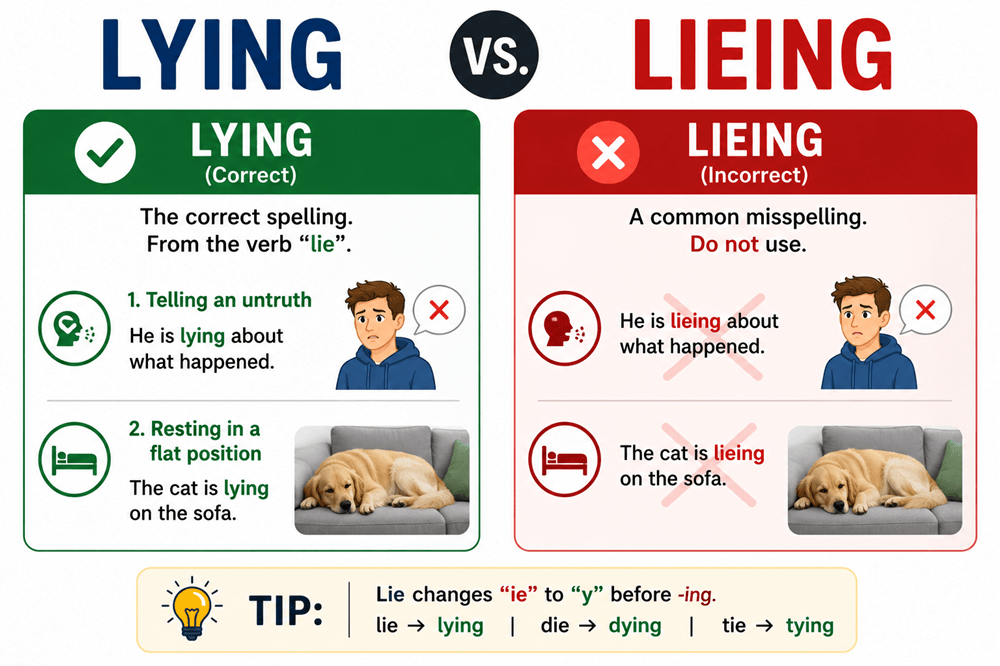
The correct spelling is lying. Lieing is a common misspelling and should not be used in standard English. Use lying when you mean telling an untruth or resting in a flat position. Both meanings come from the verb lie, and both use the same -ing form: lying.
Quick Answer
Use lying, not lieing.
- Correct: He is lying about what happened.
- Correct: The dog is lying on the floor.
- Incorrect: He is lieing about what happened.
- Incorrect: The dog is lieing on the floor.
The simple rule is: lie becomes lying before -ing. The spelling lieing is not correct.
Lieing or Lying: Which One Is Correct?
Lying is correct. Lieing is incorrect.
This mistake happens because many verbs simply keep their spelling and add -ing. For example, jump becomes jumping, read becomes reading, and work becomes working. But verbs ending in ie often change before -ing.
The correct pattern is:
- lie → lying
- die → dying
- tie → tying
The ie changes to y, and then -ing is added. That is why the correct spelling is lying, not lieing.
| Word | Correct? | Meaning |
|---|---|---|
| Lying | Yes | Telling an untruth or resting in a flat position |
| Lieing | No | A common misspelling of lying |
What Does Lying Mean?
Lying has two common meanings. It can mean telling something that is not true, or it can mean resting or being in a flat position.
When lying means telling an untruth, it comes from the verb lie, meaning to say something false on purpose.
- She is lying about her age.
- He was lying when he said he finished the work.
- I do not think they are lying.
When lying means resting in a position, it also comes from the verb lie, but this verb means to recline, rest, or be placed somewhere.
- The cat is lying in the sun.
- She was lying on the couch.
- The book is lying on the table.
The spelling is the same for both meanings. Whether someone is being dishonest or resting on a bed, the correct word is lying.
Why Lieing Is Incorrect
Lieing is incorrect because English does not keep the ie when adding -ing to lie. Instead, the spelling changes.
The correct change is:
- lie + -ing = lying
The incorrect change is:
- lie + -ing = lieing
The spelling lieing may look logical at first, but it is not standard. In polished writing, schoolwork, emails, articles, captions, business messages, and grammar exercises, always use lying.
Lying Meaning “Telling an Untruth”
One common meaning of lying is saying something false. This usually suggests dishonesty, especially when the person knows the truth but chooses not to tell it.
Examples:
- He is lying about where he was last night.
- She accused him of lying.
- The child was lying to avoid getting in trouble.
- I could tell he was lying from his nervous voice.
- They were not lying; they simply misunderstood the question.
In this meaning, lying is connected to truth, honesty, deception, and trust. It is often used in serious situations, but it can also appear in casual conversation.
Lying Meaning “Resting or Reclining”
Lying can also mean resting in a flat or horizontal position. This meaning is not about dishonesty at all.
Examples:
- She is lying in bed with a headache.
- The baby was lying on a soft blanket.
- The papers were lying on the desk.
- He spent the afternoon lying on the beach.
- The dog is lying beside the fireplace.
In these examples, lying describes position or placement. A person, animal, or object is resting somewhere.
Lying vs Laying
Lying is also often confused with laying. These words are related to position, but they are not used the same way.
Lying means resting or reclining by yourself.
- I am lying on the couch.
- The cat is lying by the window.
Laying usually means putting something down.
- She is laying the book on the table.
- He is laying the blanket on the bed.
The simple difference is:
- You lie down yourself.
- You lay something down.
So you would say:
- I am lying down.
- I am laying the baby down.
Lie, Lying, Lay, and Lain
The verb lie meaning to recline has irregular forms, which makes it confusing.
| Verb Form | Correct Word | Example |
|---|---|---|
| Present | lie | I lie down after lunch. |
| -ing form | lying | I am lying down. |
| Past tense | lay | I lay down yesterday. |
| Past participle | lain | I have lain there before. |
This table is only for lie meaning to recline. It is different from lie meaning to tell an untruth.
Lie, Lying, Lied, and Lied
The verb lie meaning to tell an untruth is easier. Its past tense and past participle are both lied.
| Verb Form | Correct Word | Example |
|---|---|---|
| Present | lie | Do not lie. |
| -ing form | lying | He is lying. |
| Past tense | lied | He lied yesterday. |
| Past participle | lied | He has lied before. |
Even though the two meanings of lie have different past tense forms, they share the same -ing form: lying.
Examples of Lying in Sentences
Here are natural examples of lying used correctly:
- He is lying about the broken window.
- She was lying when she said she had no idea.
- I do not believe you are lying.
- The cat is lying on the sofa.
- The wallet was lying on the ground.
- She spent the morning lying in bed.
- The truth was lying somewhere between their stories.
- He was lying low until the argument ended.
Some examples refer to dishonesty. Others refer to position. The spelling stays the same in both meanings.
Common Phrases With Lying
Lying appears in many common phrases. Some are about dishonesty, and others are about position or rest.
- lying about something
- lying to someone
- lying in bed
- lying on the floor
- lying down
- lying low
- lying around
- lying in wait
Examples:
- He was lying about the money.
- She was lying in bed all morning.
- The old boxes were lying around in the garage.
- The cat was lying in wait behind the chair.
Common Mistakes to Avoid
The biggest mistake is spelling lying as lieing.
Incorrect:
- He is lieing to us.
- She is lieing on the couch.
- The papers are lieing on the desk.
Correct:
- He is lying to us.
- She is lying on the couch.
- The papers are lying on the desk.
Another mistake is using laying when the sentence needs lying.
Incorrect:
- I am laying on the couch.
Correct:
- I am lying on the couch.
Use laying only when someone is putting something down.
Correct:
- I am laying the book on the table.
How to Remember Lying
Here is an easy way to remember the correct spelling:
Lie changes ie to y before -ing.
- lie → lying
- die → dying
- tie → tying
You can also remember this sentence:
If someone will lie, they may be lying.
The spelling lieing keeps too many letters. The correct spelling is shorter and cleaner: lying.
Final Answer
Lying is the correct spelling. Lieing is a common misspelling and should be avoided. Use lying when someone is telling an untruth and also when someone or something is resting in a flat position. Remember: lie changes to lying before -ing.