Masters or Master’s: Correct Spelling, Apostrophe Rules, Degree Usage, and Examples Explained
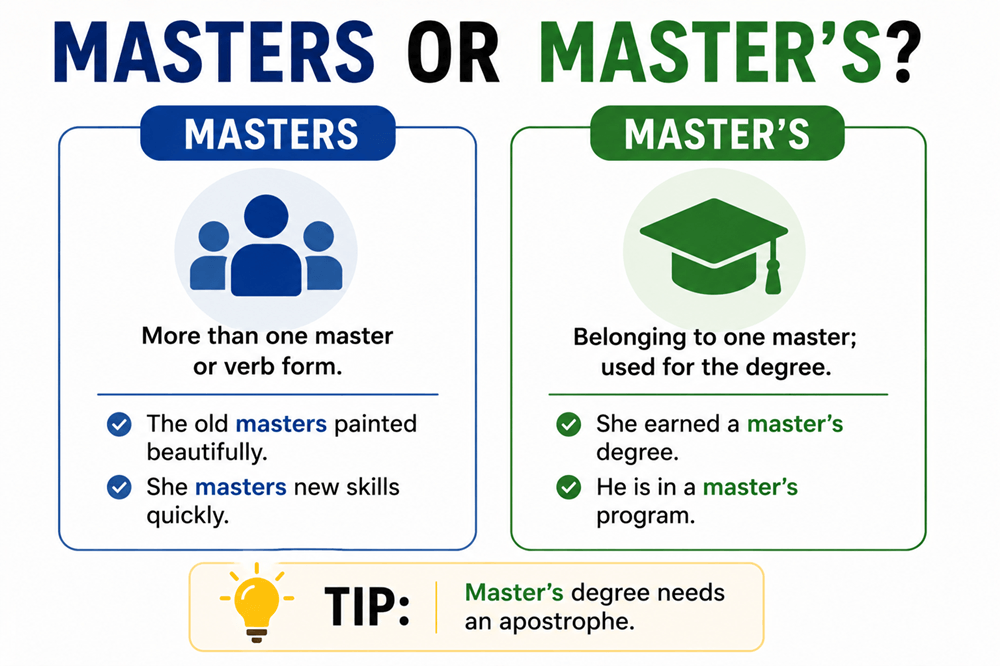
Master’s and masters are both correct words, but they are used differently. Use master’s with an apostrophe when talking about a master’s degree, a master’s program, or something belonging to one master. Use masters without an apostrophe when you mean more than one master, the verb form of master, or a proper name like the Masters golf tournament. The easiest rule is this: master’s degree needs an apostrophe, but masters as a plural does not.
Quick Answer
Use master’s when talking about the academic degree.
- Correct: She earned a master’s degree in education.
- Correct: He is applying to a master’s program.
- Correct: A master’s thesis is usually longer than an undergraduate paper.
Use masters when you mean more than one master or the verb form of master.
- Correct: The old masters influenced many modern painters.
- Correct: She masters new skills quickly.
- Correct: The students became masters of the technique.
The simple rule is this: master’s is possessive. Masters is plural or a verb.
Masters or Master’s: What Is the Difference?
The difference between masters and master’s is the apostrophe. Master’s is possessive. It usually means something belongs to or is connected with one master. In academic writing, it appears in the phrase master’s degree, which is short for a degree at the master’s level.
Masters without an apostrophe is usually plural. It means more than one master. It can also be a verb, as in “she masters a subject.”
| Form | Main Use | Example |
|---|---|---|
| Master’s | Possessive; used for the degree level | He has a master’s degree. |
| Masters | Plural noun or verb | She studies the old masters. |
If the phrase is about graduate education, the safest spelling is usually master’s with an apostrophe.
What Does Master’s Mean?
Master’s is the possessive form of master. It means something belongs to, relates to, or is associated with a master. In everyday writing, the most common use is academic:
- master’s degree
- master’s program
- master’s student
- master’s thesis
- master’s level
Examples:
- She completed her master’s degree in psychology.
- The university offers a master’s program in public health.
- He is a master’s student in computer science.
- The master’s thesis took a full year to finish.
In these phrases, the apostrophe is standard because the phrase refers to the level of degree. You are not talking about several people called masters. You are talking about a degree associated with the rank or level of master.
What Does Masters Mean?
Masters without an apostrophe is usually the plural of master. A master can be an expert, teacher, owner, skilled artist, or person with high control over a subject or craft. When there is more than one, you write masters.
Examples:
- The museum displayed paintings by the old masters.
- The students trained under several martial arts masters.
- Great writers often learn from earlier masters.
- The chefs were considered masters of their craft.
Masters can also be a verb. It means someone learns something completely, gains control over it, or becomes highly skilled at it.
- She masters every new program quickly.
- He masters difficult songs by practicing daily.
- The team wins when it masters the basics.
In these sentences, masters is not possessive. It does not need an apostrophe.
Master’s Degree or Masters Degree?
The correct phrase is master’s degree.
Correct:
- She has a master’s degree in English.
- He earned his master’s degree last spring.
- A master’s degree can help with some career paths.
Incorrect in standard writing:
- She has a masters degree in English.
- He earned his masters degree last spring.
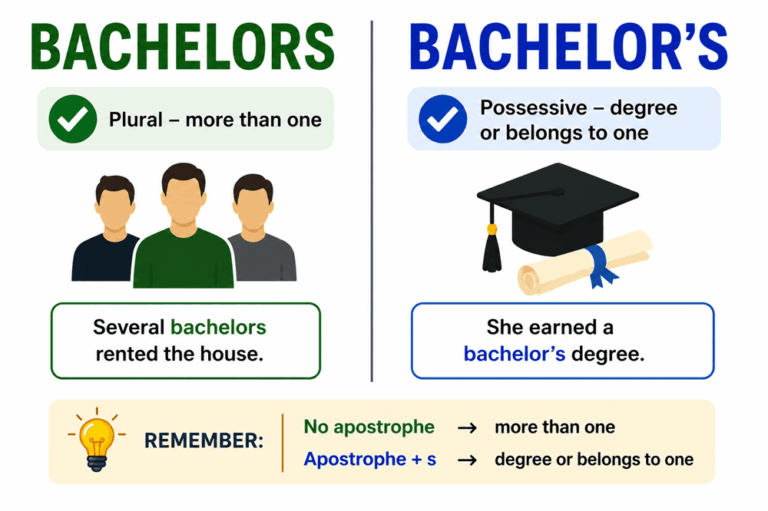
The apostrophe matters because master’s degree is the standard form. It follows the same pattern as bachelor’s degree.
- bachelor’s degree
- master’s degree
Both use an apostrophe because they refer to the degree level.
Master’s Program or Masters Program?
The standard phrase is master’s program.
Correct:
- She applied to a master’s program in social work.
- The master’s program takes two years to complete.
- He was accepted into a master’s program abroad.
Less standard:
- She applied to a masters program in social work.
- The masters program takes two years to complete.
You may see masters program used informally, especially online, but master’s program is the cleaner and more polished choice. For school, resumes, university pages, and professional writing, use the apostrophe.
Master’s Student or Masters Student?
The better phrase is usually master’s student.
Correct:
- He is a master’s student in biology.
- The lab hired two master’s students.
- As a master’s student, she focused on urban planning.
Less formal:
- He is a masters student in biology.
Masters student is sometimes used informally, but master’s student looks more standard because it means a student at the master’s level.
Master of Arts or Master’s of Arts?
The correct degree name is usually Master of Arts, not Master’s of Arts.
Correct:
- She earned a Master of Arts in History.
- He has a Master of Science in Engineering.
- The program awards a Master of Business Administration.
Incorrect:
- She earned a Master’s of Arts in History.
- He has a Master’s of Science in Engineering.
This is a common mistake. Use master’s degree when speaking generally. Use Master of Arts, Master of Science, or another official degree title when naming the degree.
| General Phrase | Official Degree Name |
|---|---|
| master’s degree | Master of Arts |
| master’s degree | Master of Science |
| master’s degree | Master of Business Administration |
Capitalization: Master’s or master’s?
In general writing, master’s degree is usually lowercase.
- Correct: She earned a master’s degree in chemistry.
- Correct: He is finishing his master’s thesis.
- Correct: The school offers several master’s programs.
Capitalize official degree names.
- Correct: She earned a Master of Arts in English.
- Correct: He completed a Master of Science in Nursing.
- Correct: The university offers a Master of Public Health.
Do not capitalize master’s unless it starts a sentence, appears in a title, or is part of a formal style choice.
Masters as a Proper Name
Masters can be correct without an apostrophe when it is part of a proper name. One common example is the Masters, the golf tournament.
- He watched the Masters on television.
- The Masters is played in Augusta, Georgia.
- She hopes to attend the Masters one day.
In this case, Masters is a name. You should not change it to Master’s unless the official name uses an apostrophe, which this one does not.
Common Mistakes With Masters and Master’s
The most common mistake is leaving out the apostrophe in master’s degree.
Incorrect:
- She earned a masters degree.
- He is in a masters program.
- The job requires a masters degree.
Correct:
- She earned a master’s degree.
- He is in a master’s program.
- The job requires a master’s degree.
Another common mistake is adding an apostrophe to a simple plural.
Incorrect:
- The artist studied the old master’s.
- The students became master’s of the skill.
Correct:
- The artist studied the old masters.
- The students became masters of the skill.
If the word simply means more than one master, do not use an apostrophe.
Master’s, Masters, and Masters’
Master’s, masters, and masters’ are all possible forms, but they mean different things.
| Form | Meaning | Example |
|---|---|---|
| Master’s | Belonging to one master; used for the degree | She earned a master’s degree. |
| Masters | More than one master; or verb form | The masters taught their students. |
| Masters’ | Belonging to more than one master | The masters’ techniques were different. |
Use masters’ only when something belongs to multiple masters. This form is much less common than master’s degree or masters as a plural.
Examples of Master’s in Sentences
Here are examples of master’s used correctly:
- She earned a master’s degree in counseling.
- The master’s program includes research and fieldwork.
- He wrote his master’s thesis on climate policy.
- The job prefers applicants with a master’s degree.
- She is working at the master’s level.
- The university expanded its master’s programs.
- A master’s student presented the research.
- He completed his master’s in two years.
In each sentence, master’s refers to the academic level or degree.
Examples of Masters in Sentences
Here are examples of masters used correctly without an apostrophe:
- The museum displayed works by the old masters.
- She masters difficult concepts quickly.
- The young chefs learned from experienced masters.
- He studies the masters of classical music.
- The students became masters of the method.
- She masters every challenge with patience.
- The Masters is one of the most famous golf tournaments.
In these examples, masters is either a plural noun, a verb, or part of a proper name.
How to Remember Masters or Master’s
A simple way to remember the difference is this:
- Master’s = degree or possession
- Masters = plural or verb
You can also remember the phrase:
A master’s degree needs an apostrophe.
If the sentence is about graduate school, use master’s.
- master’s degree
- master’s program
- master’s student
- master’s thesis
If the sentence is about more than one expert, no apostrophe is needed.
- old masters
- martial arts masters
- masters of the craft
Final Answer
Master’s and masters are both correct, but they are used in different ways. Use master’s with an apostrophe when talking about a master’s degree, master’s program, master’s student, or master’s thesis. Use masters without an apostrophe when you mean more than one master, the verb form of master, or a proper name like the Masters.
The easiest rule is simple: master’s degree needs an apostrophe. Masters as a plural or verb does not.