Til or Till: Correct Spelling, Meaning, Usage, and Everyday Examples Clearly Explained
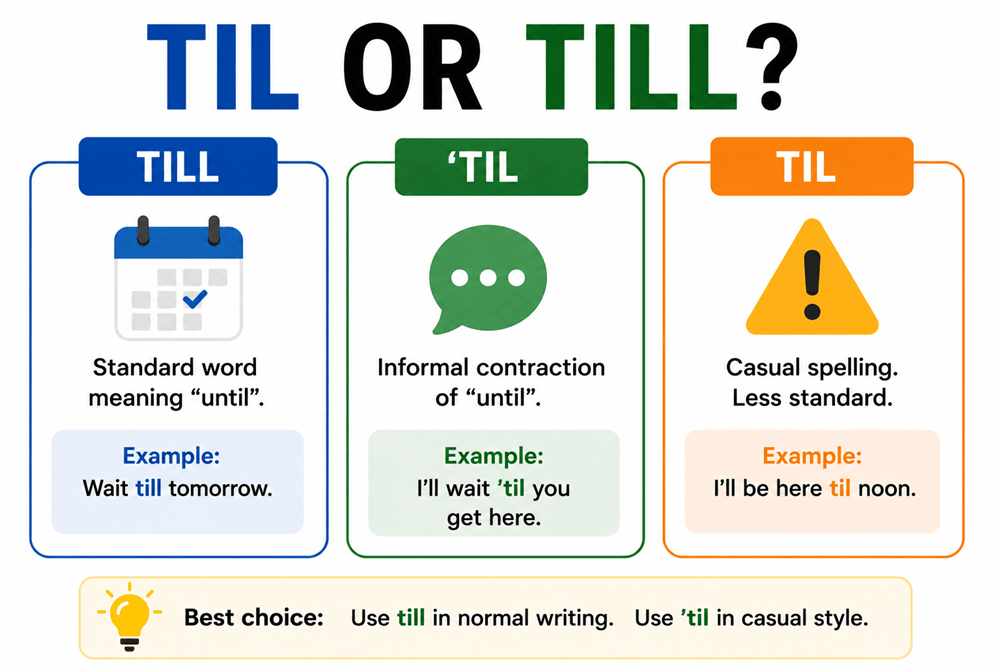
Till is the safest standard spelling when you mean “until.” ’Til with an apostrophe is also used as a shortened form of until, especially in casual writing, song titles, dialogue, and informal phrases. Til without an apostrophe is common online and in casual text, but it is less standard. The easiest rule is this: use till in regular writing, use ’til for a casual shortened form, and avoid til in polished writing.
Quick Answer
Use till when you mean “until.” It is a real word and has been used in English for a long time.
- Correct: Wait till morning.
- Correct: The store is open till nine.
- Correct: We stayed outside till the sun went down.
Use ’til when you want a casual shortened form of until.
- Correct in casual writing: I’ll wait ’til you get here.
- Correct in informal style: Dance ’til midnight.
- Correct in dialogue: “Stay ’til the end,” she said.
Til without an apostrophe is common, but it is less standard.
- Casual: I’ll be here til noon.
- More standard: I’ll be here till noon.
- Also casual: I’ll be here ’til noon.
The simple rule is this: till is the best everyday spelling. ’Til is informal. Til is best avoided in careful writing.
Til or Till: What Is the Difference?
The difference between til and till is spelling and standard usage. Till is a standard English word that means the same thing as until. You can use it before a time, date, event, or condition.
Til is often used as a shortened spelling of until, but many editors prefer ’til with an apostrophe if the word is being shortened. The apostrophe shows that letters have been left out. Without the apostrophe, til can look too casual or unfinished.
| Form | Status | Example |
|---|---|---|
| Till | Standard word meaning until | Wait till I call you. |
| ’Til | Informal shortened form of until | Wait ’til I call you. |
| Til | Casual variant, less standard | Wait til I call you. |
If you are writing a school paper, article, business email, website post, or professional message, till is usually the cleanest choice when you want a shorter alternative to until.
What Does Till Mean?
Till means up to a certain time, up to a certain point, or before something happens. It works much like until.
Examples:
- We waited till the rain stopped.
- The office is open till five.
- She studied till midnight.
- Do not leave till I return.
In each sentence, till points to an ending point. The waiting continued until the rain stopped. The office remains open until five. The studying continued until midnight.
Till can be used as a preposition or conjunction. That sounds technical, but the idea is simple. It can come before a noun phrase or before a full clause.
- Before a noun phrase: Stay till Monday.
- Before a full clause: Stay till I finish work.
Both uses are correct. In everyday writing, till is easy, natural, and widely understood.
What Does ’Til Mean?
’Til is an informal shortened form of until. The apostrophe at the beginning shows that part of the word has been dropped. It is similar to shortened forms like don’t, can’t, and ’cause.
Examples:
- I’ll wait ’til you get back.
- They danced ’til sunrise.
- Save the message ’til later.
- We stayed up ’til the movie ended.
’Til often feels more casual than till. You may see it in music, poetry, advertising, informal captions, dialogue, and personal messages. It can make writing sound relaxed or conversational.
However, ’til is not always necessary. Since till already means until, many sentences look cleaner with till.
- Casual: Wait ’til tomorrow.
- Cleaner: Wait till tomorrow.
Both are understandable, but till is often simpler and less distracting.
What Does Til Mean?
Til without an apostrophe is often used informally to mean until. You may see it in text messages, social media posts, song lyrics, casual notes, and short captions.
Examples:
- See you til Friday.
- I’ll wait til you call.
- Open til late.
These examples are easy to understand, but til is not the best choice for polished writing. Many readers will still understand the meaning, but some may see it as a mistake or overly casual spelling.
If you want a standard word, use till. If you want an informal contraction of until, use ’til. If you are writing carefully, til is usually the weakest option.
Is Till a Real Word?
Yes, till is a real word. Many people assume till is just a lazy or shortened form of until, but that is not true. Till is a standard English word with its own long history.
That means this sentence is correct:
- Wait till tomorrow.
You do not need to change it to:
- Wait until tomorrow.
Until can sound a little more formal or complete, but till is not wrong. In fact, till often sounds natural in everyday sentences.
- Stay till the end.
- Keep stirring till the sauce thickens.
- We talked till late at night.
For clear, natural writing, till is usually a strong choice.
Is Til Wrong?
Til is common, but it is less standard. In very casual writing, readers will usually understand it. However, in edited writing, til may look incomplete because it seems to be missing the apostrophe from ’til.
Compare these examples:
- Casual: I’ll be there til noon.
- Better: I’ll be there till noon.
- Also informal: I’ll be there ’til noon.
The first sentence is not hard to understand, but the second sentence is cleaner. The third sentence works if you want the shortened casual feel of until.
For WordBriefs-style grammar guidance, the best advice is simple: avoid til in formal or polished writing. Use till instead.
Till or Until?
Till and until mean the same thing in most sentences. The difference is tone. Until can sound slightly more formal, while till sounds a little more casual or conversational.
Examples:
- Formal: The office will remain closed until Monday.
- Natural: The office will stay closed till Monday.
- Formal: Please wait until the process is complete.
- Natural: Please wait till the process is complete.
Both words are correct. Choose until when you want a slightly more formal tone. Choose till when you want a shorter, natural word that still looks standard.
Til, Till, and ’Til in Everyday Writing
Here is the simplest way to choose among the three forms:
| Use | Best Choice | Example |
|---|---|---|
| Polished writing | Till or until | Wait till noon. |
| Casual shortened style | ’Til | Dance ’til midnight. |
| Very informal texting | Til | See you til later. |
If you are unsure, choose till. It is short, correct, and standard.
Common Phrases With Till
Till appears in many common everyday phrases. These phrases are natural and correct.
- till tomorrow
- till morning
- till noon
- till later
- till the end
- till further notice
- till death do us part
Examples:
- The sale lasts till tomorrow.
- We stayed awake till morning.
- The road is closed till further notice.
- They promised to stay together till death do them part.
These phrases do not need an apostrophe. Till is already a complete word.
Common Phrases With ’Til
’Til appears often in casual, expressive, or artistic language. It can sound more playful, dramatic, or conversational than till.
- ’til tomorrow
- ’til we meet again
- ’til the end of time
- ’til midnight
- ’til next time
Examples:
- Goodbye ’til we meet again.
- The party goes on ’til midnight.
- Keep going ’til the end.
These examples work because the tone is informal. For more neutral writing, till often looks better.
Till as a Verb and Noun
Till has other meanings besides until. It can also be a verb meaning to prepare soil for planting.
- The farmer will till the field before spring.
- They tilled the soil before planting vegetables.
Till can also be a noun meaning a cash drawer or money tray in a store.
- The cashier opened the till.
- There was not enough change in the till.
These meanings are separate from till meaning until. Context usually makes the meaning clear.
Common Mistakes With Til and Till
The most common mistake is thinking till is wrong and ’til is always better. In fact, till is a perfectly correct standard word.
Less polished:
- Wait til I get home.
- The store is open til eight.
- Stay here til the rain stops.
Better:
- Wait till I get home.
- The store is open till eight.
- Stay here till the rain stops.
Another mistake is using till when the sentence needs the verb tilt. These words look similar, but they are different.
- Incorrect: Please till the picture slightly to the left.
- Correct: Please tilt the picture slightly to the left.
Use till for time, farming soil, or a cash drawer. Use tilt when something leans or angles.
Examples of Till in Sentences
Here are examples of till used correctly:
- The library is open till six.
- Wait till the water boils.
- She stayed at work till late evening.
- Do not start till everyone is ready.
- The children played outside till sunset.
- We talked till the restaurant closed.
- The package will not arrive till Friday.
- He kept practicing till he got the song right.
In each sentence, till means until. It points to the time or event when something stops, starts, or changes.
Examples of ’Til in Sentences
Here are examples of ’til used in casual writing:
- I’ll wait ’til you call.
- They danced ’til the lights came on.
- Save some cake ’til later.
- We laughed ’til we cried.
- Stay ’til the final song.
These sentences have a relaxed tone. In more polished writing, you could replace ’til with till or until.
Examples of Til in Sentences
Here are examples of til as a very casual spelling:
- See you til Monday.
- I’ll be here til five.
- Wait til I text you.
These examples are understandable, but they are not ideal for careful writing. Better options are:
- See you till Monday.
- I’ll be here till five.
- Wait till I text you.
You can also use until if you want a slightly more formal tone.
How to Remember Til or Till
A simple way to remember the difference is this:
- Till = standard word meaning until
- ’Til = casual shortened form of until
- Til = informal spelling, best avoided in polished writing
You can also remember this sentence:
Use till until you have a reason to use ’til.
That means till should be your default. It is short, correct, and easy to read. Use ’til when you intentionally want a casual contraction. Avoid til when your writing needs to look edited or professional.
Final Answer
Till is the best standard spelling when you mean until. It is a real word, not a mistake, and it works well in everyday writing. ’Til is an informal shortened form of until, often used in casual writing, dialogue, music, and expressive phrases. Til without an apostrophe is common but less standard.
The easiest rule is simple: use till for normal writing, use ’til for casual style, and avoid til in polished articles, emails, and professional content.