Mam or Ma’am: Correct Spelling, Meaning, Polite Usage, and Examples Explained Clearly
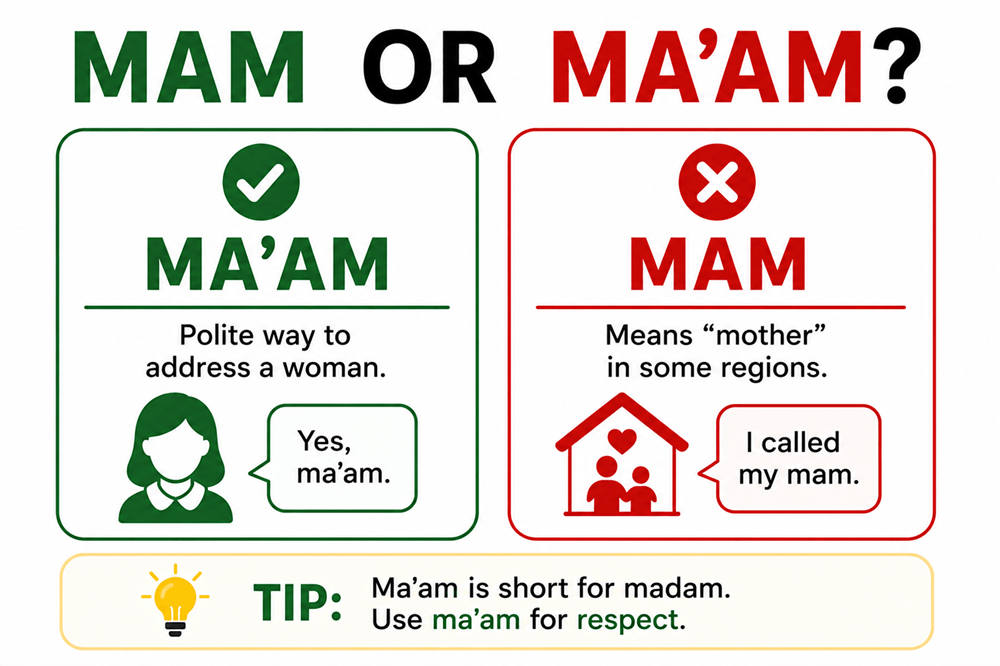
Ma’am is the correct spelling when you are politely addressing a woman. It is a shortened form of madam, and the apostrophe shows that letters have been left out. Mam can be a real word in some regions where it means mother, but it is not the standard spelling for polite address. The easiest rule is simple: use ma’am when speaking respectfully to a woman, and use mam only if you mean mother in a regional style.
Quick Answer
Use ma’am when you are addressing a woman politely.
- Correct: Yes, ma’am.
- Correct: Excuse me, ma’am, you dropped your keys.
- Correct: Thank you, ma’am.
- Correct: May I help you, ma’am?
Mam is not the standard spelling when you mean ma’am.
- Incorrect: Yes, mam.
- Incorrect: Excuse me, mam, you dropped your keys.
- Incorrect: Thank you, mam.
The simple rule is this: ma’am means madam. Mam may mean mother in some places, but it is not the usual polite form.
Mam or Ma’am: What Is the Difference?
The difference between mam and ma’am depends on meaning. Ma’am is a polite form of address for a woman. It comes from madam, and the apostrophe replaces the missing letters. You might use it with a customer, teacher, officer, stranger, elder, or someone you want to address respectfully.
Mam, on the other hand, can mean mother in some varieties of English, especially in parts of the United Kingdom, Ireland, and other regional speech communities. In those contexts, mam is similar to mom, mum, or mama. But if you are writing the polite word used in phrases like yes, ma’am, the correct spelling is ma’am.
| Word | Main Meaning | Example |
|---|---|---|
| Ma’am | Polite address for a woman | Yes, ma’am, I understand. |
| Mam | Regional word for mother | I called my mam after dinner. |
If the sentence is about respect or polite speech, choose ma’am. If the sentence is about someone’s mother in a regional voice, mam may be correct.
What Does Ma’am Mean?
Ma’am is a polite way to address a woman. It is a contraction of madam. The apostrophe shows that letters from the middle of the word have been removed.
Examples:
- Good morning, ma’am.
- Can I help you, ma’am?
- Yes, ma’am, I will send the report today.
- Ma’am, your appointment is ready.
In these examples, ma’am is used directly when speaking to a woman. It can sound polite, formal, respectful, traditional, or service-oriented depending on the situation.
Ma’am is especially common in customer service, military speech, schools, formal settings, and parts of the United States where polite titles are used often. However, tone matters. Some people appreciate being called ma’am, while others may feel it sounds too formal or makes them feel older. In writing, though, the spelling remains the same.
What Does Mam Mean?
Mam is a word used in some regions to mean mother. It is similar to mom in American English or mum in British English. You may see it in dialogue, personal writing, regional stories, songs, family speech, and informal messages.
Examples:
- I called my mam before leaving.
- Her mam made soup for everyone.
- He still visits his mam every Sunday.
- Mam said dinner would be ready soon.
In these examples, mam means a mother, not a polite title for a woman. It is a family word. Because it is regional, it may sound natural in some places and unfamiliar in others.
If you are writing for a broad American audience and mean mother, mom is usually more familiar. If you are writing in a British, Irish, Welsh, Northern English, or regional voice, mam may fit better. But if you mean madam, use ma’am.
Why Ma’am Has an Apostrophe
Ma’am has an apostrophe because it is a shortened form of madam. In contractions, apostrophes often show where letters have been removed. Since ma’am comes from madam, the apostrophe marks the missing letters.
Think of it this way:
- madam
- ma’am
The apostrophe is part of the standard spelling. Without it, the word becomes mam, which has a different meaning in many contexts.
Compare:
- Correct: Yes, ma’am.
- Incorrect: Yes, mam.
In polite address, the apostrophe is not optional in standard writing. It helps distinguish ma’am from mam.
When to Use Ma’am
Use ma’am when you are speaking directly to a woman in a polite or respectful way. It usually appears in dialogue or direct address.
Examples:
- Excuse me, ma’am, is this seat taken?
- No, ma’am, I have not seen your bag.
- Thank you for waiting, ma’am.
- Ma’am, please step this way.
Ma’am is often used after words like yes, no, thank you, excuse me, and please.
- Yes, ma’am.
- No, ma’am.
- Thank you, ma’am.
- Excuse me, ma’am.
In American English, ma’am can sound especially natural in the South, in formal service settings, or in situations where respect and manners are emphasized. In fiction, it can also help show a character’s background, personality, upbringing, or social setting.
When to Use Mam
Use mam only when you mean mother in a regional or personal style. It is not the standard word for polite address.
Examples:
- My mam taught me how to bake.
- He bought flowers for his mam.
- Mam always knew when something was wrong.
- She wrote a letter to her mam.
In these sentences, mam works like mom or mum. It is a family term, not a formal title.
If you are writing dialogue, mam can help create a regional voice. For example, a character from a place where mam is common might naturally say:
- I need to call my mam.
- Mam will be waiting at home.
But if that same character is speaking politely to a woman they do not know, the word would usually be ma’am:
- Excuse me, ma’am, do you know the way?
Yes Ma’am or Yes Mam?
The correct phrase is yes, ma’am.
Correct:
- Yes, ma’am.
- Yes, ma’am, I understand.
- Yes, ma’am, I will be there on time.
Incorrect:
- Yes, mam.
- Yes, mam, I understand.
- Yes, mam, I will be there on time.
Because ma’am is direct address, it is usually set off with a comma. In a short reply, write Yes, ma’am, with a comma after yes.
No Ma’am or No Mam?
The correct phrase is no, ma’am.
Correct:
- No, ma’am.
- No, ma’am, I did not take it.
- No, ma’am, that seat is not reserved.
Incorrect:
- No, mam.
- No, mam, I did not take it.
- No, mam, that seat is not reserved.
Like yes, ma’am, this phrase uses a comma because the speaker is directly addressing someone.
Thank You Ma’am or Thank You Mam?
The correct phrase is thank you, ma’am.
Correct:
- Thank you, ma’am.
- Thank you, ma’am, for your patience.
- Thank you, ma’am, I appreciate your help.
Incorrect:
- Thank you, mam.
- Thank you, mam, for your patience.
- Thank you, mam, I appreciate your help.
Use ma’am for politeness. Use mam only if you are using the regional word for mother.
Madam vs Ma’am
Madam and ma’am are related. Ma’am is the shortened form of madam. Both can be used as polite forms of address, but they do not always sound the same in modern English.
| Word | Use | Example |
|---|---|---|
| Madam | More formal or official | Madam Chair, the meeting may begin. |
| Ma’am | Polite shortened form | May I help you, ma’am? |
Madam may sound very formal, old-fashioned, official, or ceremonial. Ma’am is more common in everyday polite speech. For example, a store employee might say ma’am, while a formal meeting might use Madam Chair.
Is Ma’am Formal or Informal?
Ma’am is polite and respectful, but it can feel formal or informal depending on context. In a store, restaurant, school, office, or public setting, it often sounds like ordinary politeness. In casual conversation between close friends, it might sound playful, teasing, or overly formal.
Examples:
- Formal: Ma’am, your appointment begins at noon.
- Polite: Excuse me, ma’am, you left your receipt.
- Playful: Yes, ma’am, I’ll clean the kitchen.
The word is correct in all three examples, but the tone changes. In grammar terms, the spelling stays ma’am.
Common Mistakes With Mam and Ma’am
The most common mistake is writing mam when the sentence needs ma’am.
Incorrect:
- Excuse me, mam.
- Yes, mam, I can help.
- Thank you, mam.
- No, mam, I have not seen it.
Correct:
- Excuse me, ma’am.
- Yes, ma’am, I can help.
- Thank you, ma’am.
- No, ma’am, I have not seen it.
Another mistake is forgetting the comma when the word is used in direct address.
Less polished:
- Yes ma’am.
Better:
- Yes, ma’am.
The comma separates the reply from the person being addressed.
Examples of Ma’am in Sentences
Here are examples of ma’am used correctly:
- Good afternoon, ma’am.
- Can I help you find anything, ma’am?
- Yes, ma’am, the office is open.
- No, ma’am, the bus has not arrived yet.
- Thank you, ma’am, for your time.
- Ma’am, please sign your name here.
- Excuse me, ma’am, is this your phone?
- I understand, ma’am, and I will fix it.
In each sentence, ma’am is used as a polite form of address for a woman.
Examples of Mam in Sentences
Here are examples of mam used correctly when it means mother:
- My mam called me this morning.
- She learned that recipe from her mam.
- Mam always kept the house warm in winter.
- He sent his mam a birthday card.
- I promised my mam I would visit soon.
In these sentences, mam is not a polite title for a stranger. It means mother in a regional or family style.
How to Remember Mam or Ma’am
A simple way to remember the difference is this:
- Ma’am = polite address for a woman
- Mam = regional word for mother
You can also remember that ma’am comes from madam. Since it is shortened, it needs an apostrophe.
Another helpful phrase is:
Ma’am has an apostrophe because madam lost letters.
If you are saying yes, ma’am, no, ma’am, thank you, ma’am, or excuse me, ma’am, use ma’am. If you are talking about someone’s mother in a regional voice, mam may be correct.
Final Answer
Ma’am is the correct spelling when you are politely addressing a woman. It is a shortened form of madam, and the apostrophe shows that letters have been removed. Use it in phrases like yes, ma’am, no, ma’am, thank you, ma’am, and excuse me, ma’am.
Mam can be correct when it means mother in some regional varieties of English, but it is not the standard spelling for polite address. The easiest rule is simple: ma’am is for respectful address, and mam is for mother in regional speech.