Puting or Putting: Correct Spelling, Meaning, Grammar, Examples, and Memory Tips Explained Clearly
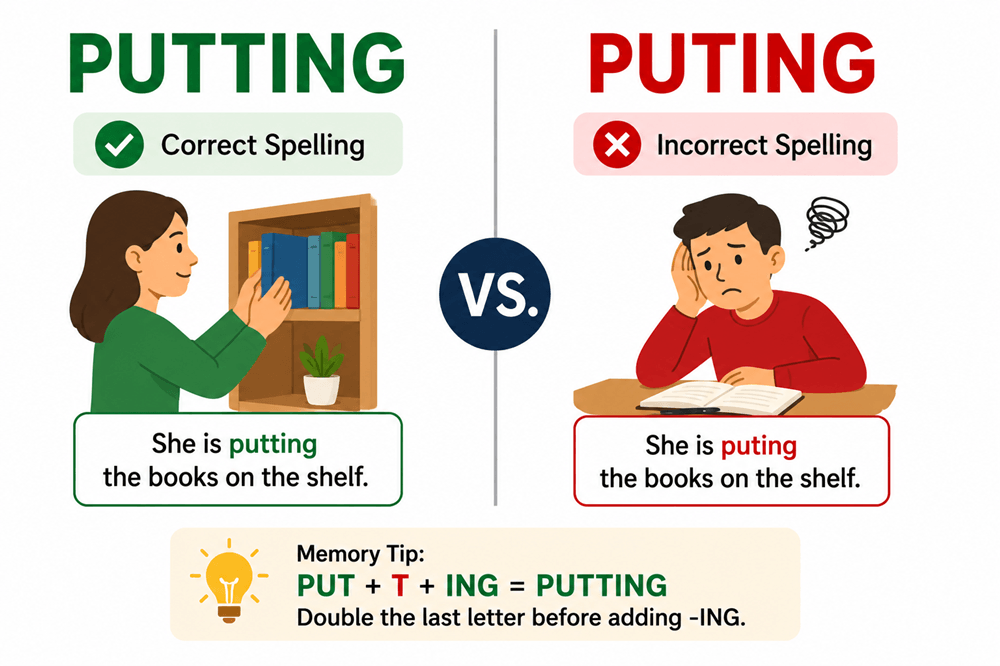
Putting is the correct spelling. Puting is a misspelling. Use putting when you mean placing something somewhere, moving something into a position, adding something, or doing the present action of put. The key spelling rule is simple: put doubles the final t before adding -ing.
Quick Answer
Use putting, not puting.
- Correct: She is putting the books on the shelf.
- Correct: I am putting my phone away.
- Correct: They are putting the plan into action.
Puting is not the standard spelling.
- Incorrect: She is puting the books on the shelf.
- Incorrect: I am puting my phone away.
The simple rule is: put + t + ing = putting.
Puting or Putting: What Is the Difference?
The difference between puting and putting is spelling. Putting is the correct present participle and gerund form of put. Puting is a common spelling error because many people assume they only need to add -ing to put.
| Word | Status | Example |
|---|---|---|
| Putting | Correct spelling | She is putting dinner on the table. |
| Puting | Incorrect spelling | She is puting dinner on the table. |
If you are writing for school, work, messages, articles, captions, or professional content, always use putting.
What Does Putting Mean?
Putting means placing, setting, moving, or positioning something somewhere. It can describe a physical action, but it can also describe adding effort, creating a situation, or moving an idea into use.
Examples:
- She is putting the plate on the table.
- He is putting his jacket in the closet.
- They are putting money into savings.
- The company is putting a new policy in place.
- You are putting too much pressure on yourself.
In each sentence, putting shows an action that is happening now or continuing over time.
What Does Puting Mean?
Puting is not a correct standard spelling. It is usually a typing mistake or a spelling mistake. The intended word is almost always putting.
Examples:
- Incorrect: I am puting my keys on the counter.
- Correct: I am putting my keys on the counter.
- Incorrect: They are puting up decorations.
- Correct: They are putting up decorations.
Even though readers may understand what puting means, it looks unfinished because the correct form needs two t letters.
Why Does Putting Have Two T’s?
Putting has two t letters because of a common English spelling pattern. When a short one-syllable verb ends in one vowel plus one consonant, the final consonant is often doubled before adding -ing.
The structure of put is:
- p = consonant
- u = vowel
- t = consonant
That gives the word a simple consonant-vowel-consonant pattern. When you add -ing, the final t doubles:
- put + t + ing = putting
This same pattern appears in many other words:
- run → running
- sit → sitting
- cut → cutting
- hop → hopping
- stop → stopping
The doubled consonant helps preserve the short vowel sound. Without the second t, puting looks like it should follow a different spelling pattern.
Spelling Structure: Put + Ing Is Not Enough
A common mistake is thinking the spelling should be:
- put + ing = puting
That looks logical, but it skips the doubling rule. The correct structure is:
- put + ting = putting
Another way to see it is this:
- Keep put.
- Add one more t.
- Then add ing.
This gives you putting, with double t in the middle.
When to Use Putting
Use putting when the action of put is happening now, continuing, or being used as a noun-like action.
Examples:
- She is putting the baby to bed.
- I am putting my shoes by the door.
- They are putting fresh paint on the walls.
- Putting your phone away can help you focus.
- He keeps putting off his homework.
Putting can appear after helping verbs like am, is, are, was, and were. It can also begin a sentence when the action itself is the subject.
Putting in Common Phrases
Putting appears in many everyday phrases. Learning these phrases can help you remember the spelling.
- putting away: She is putting away the dishes.
- putting on: He is putting on his coat.
- putting off: Stop putting off the appointment.
- putting together: They are putting together a new desk.
- putting up with: I am not putting up with rude behavior.
- putting into practice: She is putting the advice into practice.
In all of these phrases, the spelling stays the same: putting with two t letters.
Putting and Golf
Putting can also refer to a golf stroke made on the green. This meaning comes from the verb putt, but the spelling is still putting.
- He is practicing his putting.
- Good putting can improve your golf score.
- She spent an hour on the putting green.
This is another reason the double t matters. In both ordinary writing and golf writing, the correct spelling is putting.
Common Mistakes
The most common mistake is leaving out the second t.
Incorrect:
- I am puting the laundry away.
- She is puting her bag on the chair.
- They are puting the final touches on the project.
Correct:
- I am putting the laundry away.
- She is putting her bag on the chair.
- They are putting the final touches on the project.
If the word looks too thin in the middle, check the double t. The correct word should have tt: putting.
How to Remember Putting
Use these memory tips:
- Putting has two t letters because put is a short word.
- Think: put + t + ing.
- The double tt sits in the middle: putting.
- Compare it with cutting and sitting, which also double the final consonant.
A simple memory sentence is: When you are putting something down, put an extra “t” in the word.
Final Answer
Putting is the correct spelling. Puting is a misspelling. The word comes from put, but you must double the final t before adding -ing.
To remember it, use the structure put + t + ing = putting. If you are unsure, look for the double tt in the middle. The correct spelling is always putting.