Disc or Disk: Difference, Correct Usage, Spelling Structure, and Memory Tips Explained
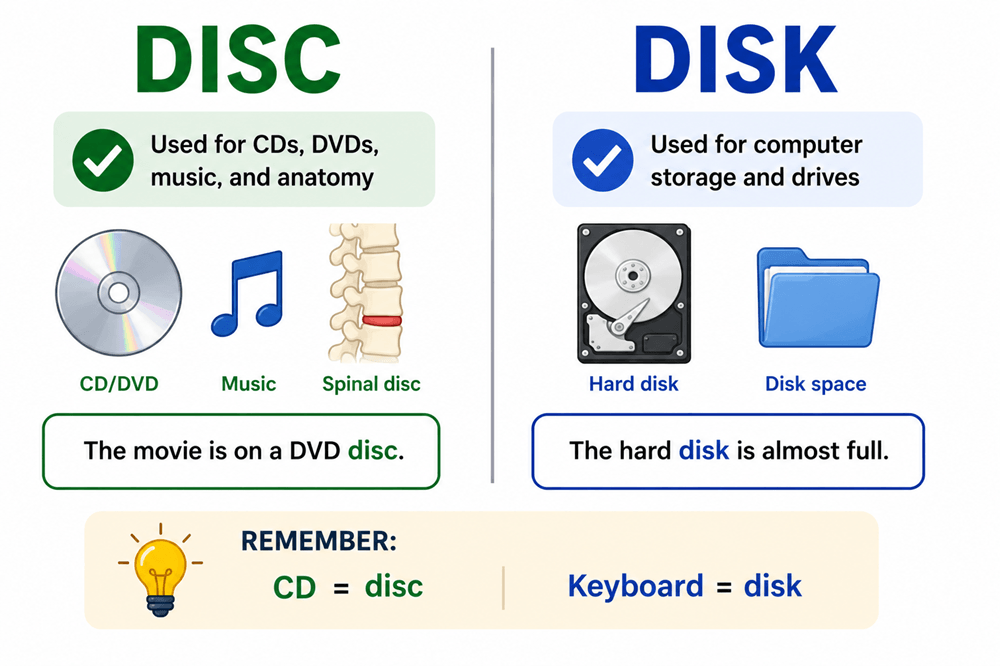
Disc and disk are both correct, but they are used in different contexts. Disc is more common for optical media, music, anatomy, and round flat objects in British English. Disk is more common for computer storage, hard drives, and many American English uses. The safest rule is this: use disc for CDs and music, and disk for computers and storage.
Quick Answer
Use disc for CDs, DVDs, records, and some body-related terms.
- The album is available on compact disc.
- She inserted the DVD disc into the player.
- He has a slipped disc in his back.
Use disk for computer storage and drives.
- The file is saved on the hard disk.
- The computer has low disk space.
- Back up the data to an external disk.
The simple rule is: disc is often physical and round; disk is often digital or computer-related.
Disc or Disk: What Is the Difference?
The difference between disc and disk is mostly spelling tradition and context. Both words can describe something thin, flat, and round. However, modern usage has separated them in several common areas.
| Word | Common Use | Example |
|---|---|---|
| Disc | CDs, DVDs, records, anatomy | The music disc was scratched. |
| Disk | Computer storage | The disk is almost full. |
If you are writing about technology, disk is usually the better spelling. If you are writing about music, movies, optical media, or spinal anatomy, disc is usually the better spelling.
What Does Disc Mean?
Disc is a noun that usually means a thin, flat, round object. It is commonly used for optical media and certain physical or biological objects.
Examples:
- The CD disc had several scratches.
- The movie came on a Blu-ray disc.
- The DJ played an old vinyl disc.
- The doctor said he had a damaged spinal disc.
- The athlete threw the disc across the field.
Disc often feels connected to visible, round objects. A CD, DVD, record, or spinal disc has a shape you can imagine clearly. That physical roundness helps explain why disc is common in these uses.
What Does Disk Mean?
Disk is also a noun meaning a flat, round object, but it is especially common in computer and storage terms.
Examples:
- The hard disk stores your files.
- The system needs more disk space.
- The technician checked the disk for errors.
- Save the backup to another disk.
- The laptop uses a solid-state disk.
In computer writing, disk is the standard spelling. This includes phrases such as hard disk, disk drive, disk space, disk image, and disk utility.
Spelling Structure: Why Disc Uses C
The spelling disc ends in c. A useful way to remember it is to connect the c with CD.
- disc ends in c
- CD begins with c
- A CD is a compact disc
This memory trick works well because compact disc is one of the most familiar uses of disc. If you are talking about CDs, DVDs, Blu-rays, music discs, or movie discs, the spelling with c is usually natural.
You can also remember that disc often appears in body-related terms:
- spinal disc
- slipped disc
- herniated disc
In these uses, disc refers to a physical structure, not digital storage.
Spelling Structure: Why Disk Uses K
The spelling disk ends in k. A helpful memory trick is to connect the k with keyboard, because disk is the spelling often used with computers.
- disk ends in k
- keyboard begins with k
- Computers use disk storage
This is not a formal grammar rule, but it is a practical memory aid. If your sentence is about files, storage, drives, computers, backups, or system space, choose disk.
Common computer phrases include:
- hard disk
- disk drive
- disk space
- disk error
- disk image
- disk cleanup
When to Use Disc
Use disc when talking about optical media, music, movies, anatomy, or a flat round object in many non-computer contexts.
- The compact disc was popular before streaming.
- The DVD disc would not play.
- The band released a special-edition disc.
- He injured a disc in his lower back.
- The object looked like a small silver disc.
Disc is also the preferred spelling in many British English contexts for round flat objects. However, even in British English, computer storage commonly uses disk.
When to Use Disk
Use disk when talking about computer storage, data, drives, software, or memory space.
- The disk has no room left.
- Delete old files to free disk space.
- The hard disk failed unexpectedly.
- The backup disk is stored safely.
- The program created a disk image.
If the word appears near terms like computer, file, drive, storage, backup, or data, disk is almost always the better choice.
Common Mistakes
A common mistake is using disc for computer storage.
Less standard:
- The computer has low disc space.
Better:
- The computer has low disk space.
Another mistake is using disk for CDs or DVDs.
Less common:
- The movie is on a DVD disk.
Better:
- The movie is on a DVD disc.
Readers may still understand both forms, but using the expected spelling makes your writing look more careful.
Disc vs Disk in American and British English
In American English, disk is common for many general uses, especially technology. In British English, disc is more common for many physical round objects. Still, the computer distinction is strong: disk is widely used for computer storage in both styles.
| Context | Preferred Spelling |
|---|---|
| CD, DVD, Blu-ray | Disc |
| Hard drive or computer storage | Disk |
| Spinal injury | Disc |
| Disk space or disk drive | Disk |
How to Remember the Difference
Use these memory tips:
- Disc has c, like CD.
- Disk has k, like keyboard.
- Use disc for music, movies, and body parts.
- Use disk for computers, files, and storage.
A simple memory sentence is: A CD is a disc, but a computer uses a disk.
This one sentence covers the most common difference. If you remember CD = disc and keyboard = disk, you will choose the right spelling most of the time.
Final Answer
Disc and disk are both correct, but they are used in different contexts. Use disc for CDs, DVDs, records, spinal discs, and many physical round objects. Use disk for computer storage, hard disks, disk drives, and disk space.
To remember the spelling, connect disc with CD and disk with keyboard. The easiest rule is: a CD is a disc, but a computer uses a disk.