Compliment or Complement: Difference, Correct Usage, Meanings, Examples, and Memory Tips Explained
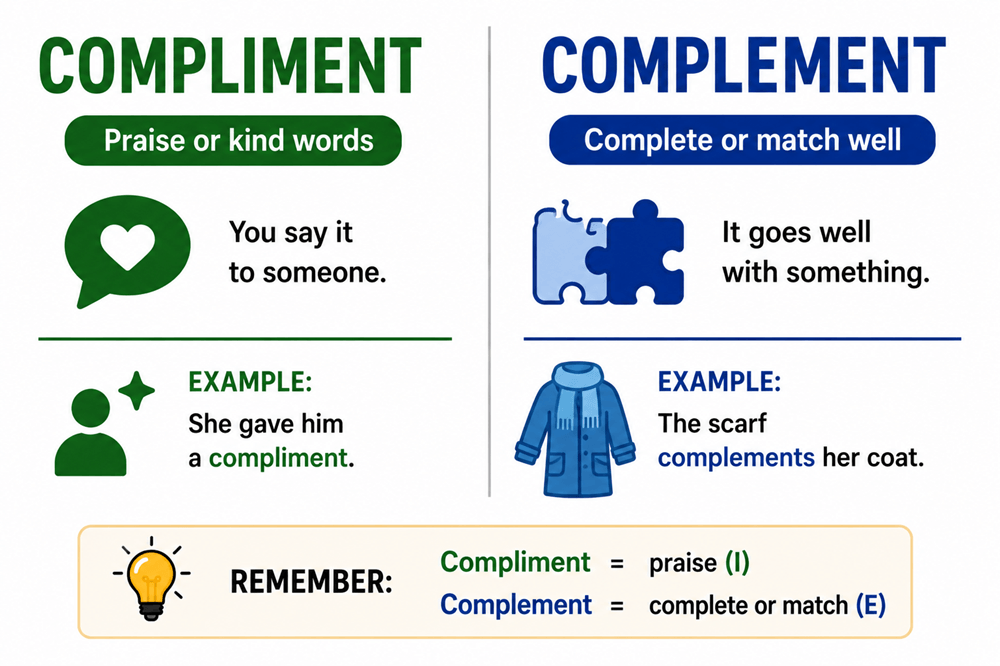
Compliment and complement are both correct words, but they mean different things. Compliment means praise or a polite expression of admiration. Complement means something that completes, improves, matches, or goes well with something else. The easiest rule is: a compliment is praise; a complement completes.
Quick Answer
Use compliment when talking about praise, kind words, or admiration.
- She gave him a compliment on his presentation.
- That was a lovely compliment.
- He complimented her cooking.
Use complement when talking about something that completes or goes well with something else.
- The red scarf complements her coat.
- The sauce is a perfect complement to the fish.
- The two skills complement each other.
The simple rule is: compliment means praise; complement means complete or match well.
Compliment or Complement: What Is the Difference?
The difference between compliment and complement is meaning. They sound alike, but they are not interchangeable. Compliment is about saying something nice. Complement is about adding something that fits, completes, balances, or improves another thing.
| Word | Main Meaning | Example |
|---|---|---|
| Compliment | Praise or kind words | She received a compliment. |
| Complement | Something that completes or matches | The shoes complement the dress. |
If the sentence is about admiration, praise, flattery, politeness, or saying something nice, use compliment with an i. If the sentence is about fitting together, completing, improving, pairing, or matching, use complement with an e.
What Does Compliment Mean?
Compliment can be a noun or a verb. As a noun, it means a kind or admiring remark. As a verb, it means to praise someone or say something nice about them.
Examples:
- She smiled after receiving a compliment.
- He gave me a compliment on my writing.
- The teacher complimented the student’s effort.
- They complimented the chef after dinner.
- Her boss complimented her attention to detail.
A compliment usually makes someone feel appreciated. You can compliment a person’s appearance, work, kindness, talent, outfit, cooking, idea, or achievement.
- Compliment on appearance: Your jacket looks great.
- Compliment on work: Your report was clear and thoughtful.
- Compliment on character: You handled that situation with patience.
The word compliment is connected to social kindness. It is something you give with words.
What Does Complement Mean?
Complement can also be a noun or a verb. It means something that completes another thing, makes it better, or works well with it.
Examples:
- The wine complements the meal.
- The rug complements the colors in the room.
- Her calm personality complements his energetic style.
- The new software complements the existing system.
- The lemon flavor is a nice complement to the tea.
A complement does not praise something. It improves or completes it by fitting well with it. Clothes can complement each other. Flavors can complement each other. Skills, colors, personalities, designs, and ideas can complement each other.
For example, if blue curtains look good with a white wall, the curtains complement the wall. They do not compliment the wall, because curtains cannot say kind words.
Spelling Structure: Why Compliment Has I
Compliment has an i in the middle:
- compliment
A helpful memory trick is to connect the i with I, as in a person speaking.
- I give a compliment.
- I say something nice.
- I praise someone.
If the word is about kind words from a person, choose compliment with i.
You can also remember that compliment and kind both contain i. A compliment is a kind remark.
Spelling Structure: Why Complement Has E
Complement has an e in the middle:
- complement
A helpful memory trick is to connect the e with complete.
- complement
- complete
Complement means something that completes, fills out, balances, or improves something else. The e is your clue. If the sentence means “goes well with” or “makes complete,” use complement.
When to Use Compliment
Use compliment when the sentence is about praise or kind words.
- She gave me a compliment after the speech.
- He complimented my new haircut.
- The customer complimented the server’s kindness.
- I took her words as a compliment.
- That comment was meant as a compliment.
Common phrases include:
- give a compliment
- receive a compliment
- pay someone a compliment
- take it as a compliment
- compliment someone on something
If someone is saying something nice, compliment is the word you want.
When to Use Complement
Use complement when one thing completes, matches, balances, or improves another thing.
- The necklace complements the dress.
- The side dish complements the main course.
- The warm lighting complements the cozy furniture.
- His technical skills complement her creative skills.
- The two colors complement each other beautifully.
Common phrases include:
- perfect complement
- nice complement
- complement each other
- complement the design
- complement the flavor
If the sentence means something fits well with something else, use complement.
Complimentary vs Complementary
The confusion continues with complimentary and complementary.
Complimentary means praising or free.
- She made a complimentary comment about the speech.
- The hotel offers complimentary breakfast.
Complementary means matching, completing, or working well together.
- The room uses complementary colors.
- The two programs have complementary goals.
The same spelling clue works here. Complimentary with i is connected to praise or courtesy. Complementary with e is connected to completion or matching.
Common Mistakes
A common mistake is using compliment when the sentence needs complement.
Incorrect:
- The shoes compliment the dress.
- The sauce compliments the chicken.
Correct:
- The shoes complement the dress.
- The sauce complements the chicken.
Another mistake is using complement when the sentence is about praise.
Incorrect:
- She gave me a nice complement.
- He complemented my work.
Correct:
- She gave me a nice compliment.
- He complimented my work.
How to Remember Compliment and Complement
Use these memory tips:
- Compliment has i, and I give praise.
- Complement has e, like complete.
- A compliment is something nice you say.
- A complement is something that completes or matches.
A simple memory sentence is: I give a compliment; a complement completes.
You can also remember it this way: compliment is praise with “i,” while complement completes with “e.”
Final Answer
Compliment means praise, admiration, or a kind remark. Example: She gave him a compliment on his work.
Complement means something that completes, improves, balances, or matches something else. Example: The scarf complements her coat.
To remember the difference, use this rule: compliment has “i” because I give praise; complement has “e” because it completes.