Less or Fewer: Correct Usage, Grammar Difference, and Simple Ways to Remember
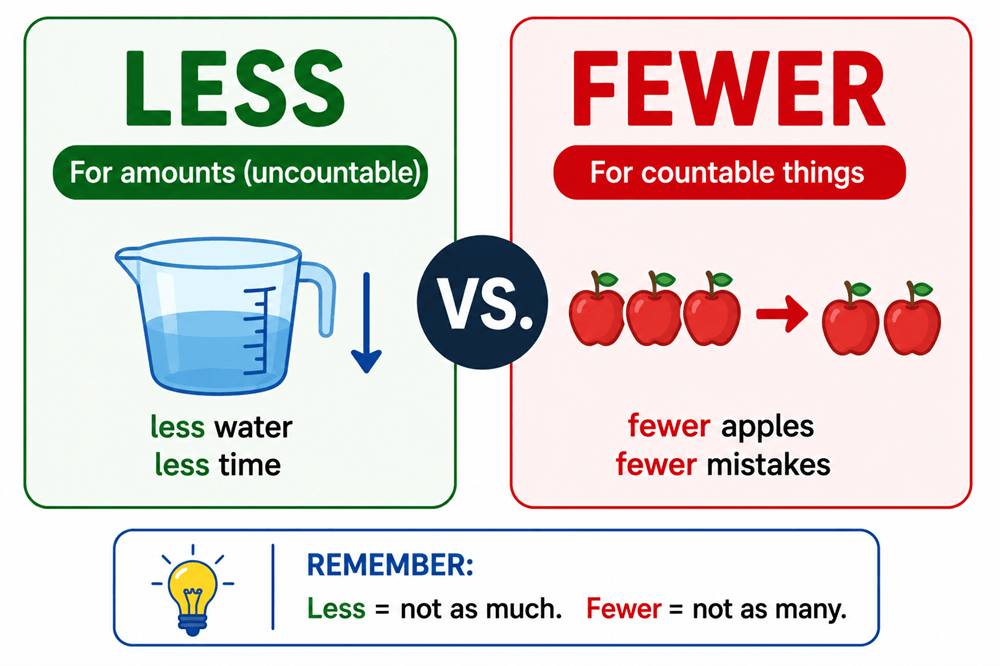
If you are choosing between less or fewer, the basic rule is simple: use fewer for things you can count, and use less for things you cannot count. You would say fewer mistakes because mistakes can be counted. You would say less time because time is treated as an amount. The rule is easy once you know what kind of noun follows the word.
Less or Fewer: What Is the Difference?
Less and fewer both mean a smaller amount, but they are used with different kinds of nouns.
Use fewer with countable nouns. These are things you can count one by one.
For example:
fewer books
fewer cars
fewer people
fewer mistakes
fewer chances
Use less with uncountable nouns. These are things you usually measure as a mass, amount, idea, or general quantity rather than count one by one.
For example:
less water
less money
less time
less stress
less traffic
You should write:
Correct: You made fewer errors this time.
Incorrect: You made less errors this time.
And:
Correct: You have less patience today.
Incorrect: You have fewer patience today.
The shortcut is this: if you can count the noun with numbers, use fewer. If you measure it as an amount, use less.
What Does Less Mean?
Less means a smaller amount of something. It is used when the noun is uncountable, abstract, or treated as a general quantity.
For example:
You need less sugar in the recipe.
This means the recipe needs a smaller amount of sugar. You are not counting individual sugars. You are measuring sugar as a substance, so less is correct.
You might also write:
You felt less anxiety after the meeting ended.
Here, anxiety is not counted one by one. It is an emotional state or amount, so less is the right word.
Less is common with words like noise, energy, space, work, information, attention, effort, pain, and confidence. These words are usually treated as amounts rather than individual items.
What Does Fewer Mean?
Fewer means a smaller number of things. It is used with plural countable nouns, which are things you can count individually.
For example:
You received fewer emails today.
This means the number of emails was smaller. You can count emails one by one, so fewer is correct.
You might also write:
There were fewer chairs in the room than expected.
Chairs can be counted: one chair, two chairs, three chairs. That makes fewer the right choice.
Fewer is common with words like students, tickets, questions, days, problems, steps, ideas, comments, and appointments. If the noun is plural and countable, fewer usually fits.
Why Less and Fewer Are Easy to Confuse
Less and fewer are confusing because everyday speech often uses less where formal grammar would prefer fewer. You may hear people say less problems, less cars, or less people. These phrases are common in casual speech, but in polished writing, fewer is usually better with plural countable nouns.
Another reason for the confusion is that both words point in the same direction. They both mean “not as much” or “not as many.” The meaning is close, but the grammar is different.
The noun after the word gives you the answer:
Less answers “how much?”
Fewer answers “how many?”
If you would ask how much water?, use less water. If you would ask how many bottles?, use fewer bottles.
A Simple Way to Remember Less
The easiest memory trick is:
Less is for lumps, amounts, and ideas.
This works because less usually goes with things you do not count individually. You use it for substances, feelings, time, money, space, effort, and general amounts.
For example:
less milk
less anger
less sleep
less work
less pressure
You can also remember:
Less means not as much.
If the sentence sounds like it is about an amount instead of a number, choose less.
A Simple Way to Remember Fewer
The easiest memory trick for fewer is:
Fewer is for figures you can count.
Both fewer and figures begin with f, which makes the phrase easy to remember. If you can place a number before the noun, fewer is probably correct.
For example:
fewer apples because you can count apples
fewer pages because you can count pages
fewer guests because you can count guests
fewer mistakes because you can count mistakes
You can also remember:
Fewer means not as many.
If the sentence is about a number of separate things, choose fewer.
Common Examples With Less
Here are common sentences where less is correct:
You need less salt in the soup.
There is less traffic on Sunday morning.
You have less free time this week.
The room has less light after sunset.
She showed less interest after hearing the price.
You felt less stress after finishing the project.
In these examples, the nouns are treated as amounts, not individual countable items. That is why less works.
Common Examples With Fewer
Here are common sentences where fewer is correct:
You made fewer spelling mistakes.
There were fewer people at the second event.
The class has fewer students this year.
You answered fewer questions than last time.
The new process has fewer steps.
Fewer cars were parked outside the building.
In these examples, the nouns are plural and countable. You can count mistakes, people, students, questions, steps, and cars. That is why fewer is correct.
Less vs Fewer in Side-by-Side Examples
Side-by-side examples make the rule easier to see:
Correct: You drank less water today.
Incorrect: You drank fewer water today.
Correct: You drank fewer bottles of water today.
Incorrect: You drank less bottles of water today.
Correct: The project needs less time.
Incorrect: The project needs fewer time.
Correct: The project needs fewer revisions.
Incorrect: The project needs less revisions.
Correct: You had less trouble with the new system.
Correct: You had fewer problems with the new system.
Notice how the meaning can be similar, but the noun controls the choice. Trouble is usually uncountable, so it takes less. Problems are countable, so they take fewer.
What About Money, Time, Distance, and Weight?
Money, time, distance, and weight can be tricky because they involve numbers. Even so, they are often treated as amounts, so less is common and natural.
For example:
You spent less than twenty dollars.
The trip took less than two hours.
The town is less than five miles away.
The bag weighs less than ten pounds.
Even though dollars, hours, miles, and pounds can be counted, the phrase is usually expressing a total amount, measurement, or value. That is why less often sounds natural in these cases.
However, if you are talking about individual units as separate items, fewer may fit better.
You used fewer dollar bills this time.
You worked fewer hours this month.
The route has fewer miles of rough road.
The difference depends on whether you mean an amount or separate countable units.
What About “10 Items or Less”?
You have probably seen signs that say 10 items or less. Strictly speaking, many grammar guides would prefer 10 items or fewer, because items are countable.
So the more formal version is:
10 items or fewer
However, 10 items or less is common in stores and everyday speech. It is widely understood, even if it is not the strictest grammatical choice.
If you are writing carefully, especially for school, editing, grammar content, or formal communication, choose fewer with countable plural nouns.
How to Check Which Word You Need
Before choosing between less and fewer, look at the noun after it.
Ask:
Can you count it one by one?
If yes, use fewer.
fewer cookies
fewer books
fewer messages
Then ask:
Is it an amount, mass, idea, feeling, or measurement?
If yes, use less.
less flour
less patience
less noise
This quick check works in most everyday sentences. Countable plural nouns usually take fewer. Uncountable nouns usually take less.
The Final Answer on Less or Fewer
Less is used for amounts, masses, measurements, feelings, and uncountable nouns. Use it in phrases like less time, less money, less water, less stress, and less noise.
Fewer is used for countable plural nouns. Use it in phrases like fewer people, fewer mistakes, fewer books, fewer questions, and fewer steps.
To remember the difference, use this simple rule: less means not as much, fewer means not as many. If you can count the noun one by one, choose fewer. If you are talking about an amount, choose less.