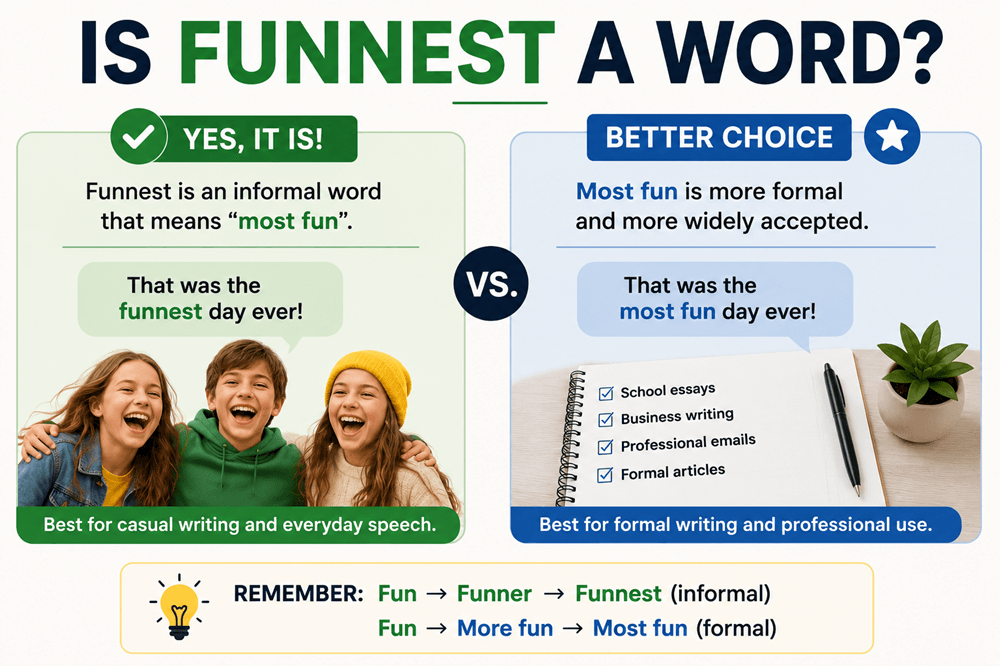
Is Funnest a Word? Correct Usage and Better Alternatives
Yes, funnest is a word, but it is informal.
Funnest is used as the superlative form of fun. It means the most fun.
Examples:
- That was the funnest party of the year.
- This is the funnest game we have played.
- She said summer camp was the funnest part of vacation.
However, in formal writing, most fun is usually the safer and more polished choice.
Formal:
- That was the most fun event of the year.
Informal:
- That was the funnest event of the year.
The simple answer is:
Funnest is used in modern English, especially in casual speech, but most fun is better for formal writing.
Quick Answer
Yes, funnest is a real word.
It means most fun.
Correct in casual English:
- This was the funnest trip ever.
More formal:
- This was the most fun trip ever.
If you are writing casually, funnest is acceptable.
If you are writing for school, work, a formal article, or a professional message, use most fun.
What Does Funnest Mean?
Funnest means something is more fun than all the others.
It is the superlative form of fun.
Examples:
- Of all the rides, the roller coaster was the funnest.
- That was the funnest class activity.
- The beach day was the funnest part of the trip.
- This is the funnest puzzle on the website.
In these sentences, funnest means most enjoyable, most entertaining, or most exciting.
Is Funnest Grammatically Correct?
Funnest is widely used, but it can still sound informal to some readers.
The reason is that fun was traditionally used mainly as a noun.
Examples:
- We had fun.
- The party was a lot of fun.
- Reading can be fun.
Over time, people also began using fun as an adjective.
Examples:
- It was a fun game.
- She is a fun teacher.
- We had a fun weekend.
Once fun became common as an adjective, people naturally started forming comparisons:
- fun
- funner
- funnest
That pattern makes sense, but more fun and most fun are still often preferred in careful writing.
Funnest vs Most Fun
Funnest and most fun mean the same basic thing.
The difference is tone.
Funnest sounds casual, playful, and conversational.
Example:
- That was the funnest birthday party ever.
Most fun sounds more standard, smooth, and formal.
Example:
- That was the most fun birthday party we have ever had.
Both are understandable. The best choice depends on your audience.
Use funnest when the tone is relaxed.
Use most fun when the tone is polished.
Is Funner a Word?
Yes, funner is also used, but it is informal.
Funner means more fun.
Examples:
- This game is funner than the last one.
- The second movie was funner than the first.
- Playing outside is funner with friends.
However, in formal writing, more fun is usually better.
Formal:
- This game is more fun than the last one.
Informal:
- This game is funner than the last one.
So the pattern is:
Casual:
fun → funner → funnest
More formal:
fun → more fun → most fun
Why Does Funnest Sound Wrong to Some People?
Funnest sounds wrong to some people because they were taught to use more fun and most fun instead.
They may feel that fun should not take -er or -est.
But English changes over time. Since fun is now commonly used as an adjective, forms like funner and funnest appear naturally in casual speech.
Still, not every context accepts them equally.
In a text to a friend, funnest sounds normal.
In a formal essay, most fun is safer.
When Should You Use Funnest?
Use funnest in casual writing or speech.
It works well in:
- texts
- captions
- social posts
- casual reviews
- friendly emails
- children’s writing
- relaxed blog posts
Examples:
- Best day ever. The funnest trip!
- This is the funnest board game for family night.
- We had the funnest time at the fair.
The word has a cheerful, informal feeling.
When Should You Avoid Funnest?
Avoid funnest in formal writing.
Use most fun instead in:
- school essays
- academic writing
- business writing
- professional emails
- formal articles
- reports
- polished reviews
Less formal:
- The museum was the funnest stop on the tour.
More polished:
- The museum was the most fun stop on the tour.
If you want your writing to sound mature, neutral, or professional, choose most fun.
Better Alternatives to Funnest
Sometimes most fun is not the only option. You can use more specific words depending on the meaning.
Good alternatives include:
- most enjoyable
- most entertaining
- most exciting
- most memorable
- most amusing
- most engaging
- most lively
- most interesting
Examples:
- That was the most enjoyable part of the trip.
- The game was the most entertaining activity.
- The concert was the most exciting event of the weekend.
- The class was the most engaging part of the program.
These choices can sound more polished than funnest.
How to Remember the Difference
A simple memory trick:
Funnest is fun, but most fun is formal.
Think:
funnest = casual
most fun = formal
Another easy rule:
If you are talking to a friend, funnest is usually fine.
If you are writing for a teacher, boss, client, or public article, use most fun.
Common Mistakes
Mistake 1: Thinking funnest is never a word
Incorrect idea:
- Funnest is not a real word.
Better idea:
- Funnest is used in English, but it is informal.
Mistake 2: Using funnest in formal writing
Too casual:
- The science fair was the funnest event of the semester.
More formal:
- The science fair was the most fun event of the semester.
Mistake 3: Using most funnest
Incorrect:
- That was the most funnest day ever.
Correct:
- That was the funnest day ever.
Also correct:
- That was the most fun day ever.
Do not use most and -est together.
Mistake 4: Using funner where more fun sounds better
Casual:
- This activity is funner than the old one.
More polished:
- This activity is more fun than the old one.
Both are understandable, but more fun is safer in formal writing.
Example Sentences
Casual:
- This is the funnest game I own.
- That was the funnest night of summer.
- The water slide was the funnest ride.
- We had the funnest time together.
More formal:
- This is the most fun game I own.
- That was the most fun night of summer.
- The water slide was the most enjoyable ride.
- We had a wonderful time together.
Final Answer: Is Funnest a Word?
Yes, funnest is a word, but it is informal.
It means most fun.
Use funnest in casual speech, texts, captions, and relaxed writing.
Use most fun in formal writing, school assignments, professional writing, and polished articles.
The easiest rule is:
Funnest = casual
Most fun = formal
So you can say:
- That was the funnest party ever.
But in careful writing, it is usually better to write:
- That was the most fun party ever.