Another Word for According To: Better Alternatives With Examples
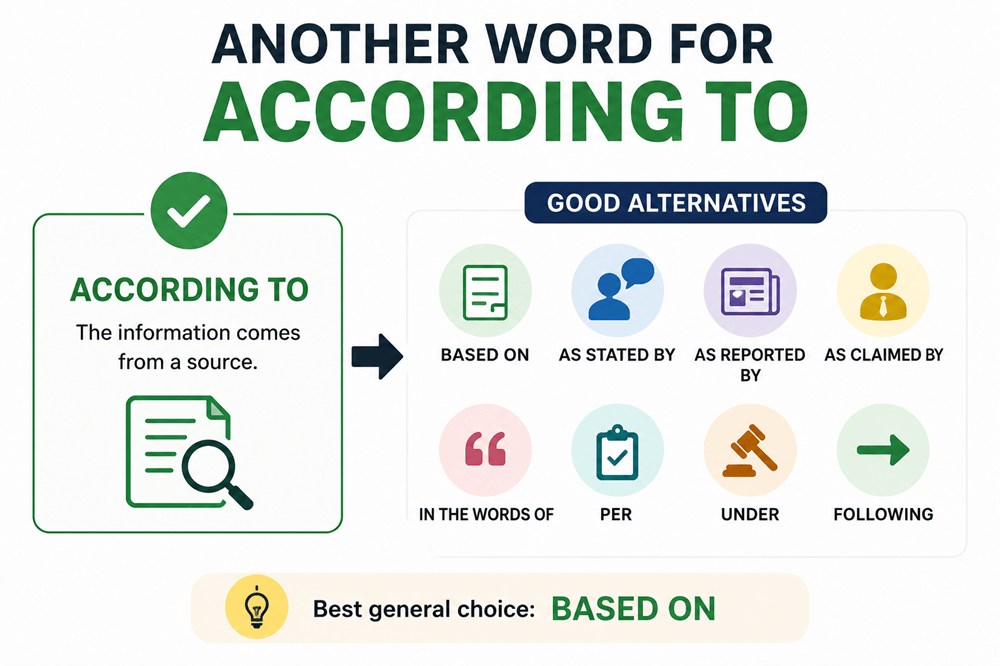
If you need another word for according to, the best choice is usually based on.
According to is used when you want to show where information comes from. It can refer to a person, source, report, rule, study, statement, or piece of evidence.
Examples:
- According to the report, sales increased last year.
- According to the teacher, the test will be on Friday.
- According to the weather forecast, it may rain tomorrow.
- According to the rules, phones must be turned off.
Good alternatives include based on, as stated by, as reported by, as claimed by, in the words of, per, following, and under.
The best replacement depends on whether you are citing a source, reporting a claim, following a rule, or explaining evidence.
Quick Answer
Good alternatives for according to include:
- based on
- as stated by
- as reported by
- as claimed by
- as noted by
- as explained by
- in the words of
- per
- under
- following
- in line with
- from the perspective of
Best general replacement:
based on
Example:
- According to the survey, most readers prefer short articles.
- Based on the survey, most readers prefer short articles.
Best formal replacement:
as stated by
Example:
- As stated by the company, the policy begins next month.
Best concise replacement:
per
Example:
- Per the instructions, submit the form by Friday.
What Does According To Mean?
According to means that information comes from a specific source.
That source may be a person, article, report, law, rule, study, expert, or organization.
Examples:
- According to the doctor, rest is important.
- According to the study, sleep affects memory.
- According to the instructions, you should restart the device.
- According to Maria, the meeting was canceled.
The phrase helps readers understand that the information is not just your personal opinion. It is connected to another source.
Based On
Based on is one of the most useful replacements for according to.
It means the statement comes from evidence, facts, information, or reasoning.
Examples:
- Based on the results, the plan worked.
- Based on the data, the company changed its strategy.
- Based on her experience, the job is harder than it looks.
- Based on the forecast, we should bring umbrellas.
Use based on when you are explaining evidence or support.
It is often smoother than according to when the source is not a person, but a fact, result, study, or observation.
As Stated By
As stated by is a formal alternative.
It means someone or something clearly said the information.
Examples:
- As stated by the manager, the office will close early.
- As stated by the report, the number increased in 2025.
- As stated by the school, registration opens Monday.
Use as stated by when you want to sound precise and formal.
It works well in reports, essays, business writing, and official summaries.
As Reported By
As reported by is useful when information comes from news, media, research, or a published source.
Examples:
- As reported by local news, the road reopened this morning.
- As reported by the magazine, the actor will return for the sequel.
- As reported by the study, the treatment showed promising results.
Use as reported by when you are summarizing information from a report, article, news outlet, or research source.
This phrase is especially helpful when the information is not something you personally verified.
As Claimed By
As claimed by is more cautious than according to.
It means someone said something, but you are not saying whether it is definitely true.
Examples:
- As claimed by the company, the product lasts for 24 hours.
- As claimed by the witness, the car stopped suddenly.
- As claimed by the seller, the item is handmade.
Use as claimed by when the information may be disputed, uncertain, promotional, or one-sided.
This phrase is useful because it protects your writing from sounding too certain.
As Noted By
As noted by means someone mentioned, observed, or pointed out something.
Examples:
- As noted by the author, the word has several meanings.
- As noted by researchers, the results may vary.
- As noted by the teacher, spelling improves with practice.
This phrase sounds polished and academic.
Use it when the source makes an observation rather than a dramatic claim.
As Explained By
As explained by is useful when the source gives a reason, definition, or explanation.
Examples:
- As explained by the guide, the rule applies only in formal writing.
- As explained by the doctor, symptoms can appear slowly.
- As explained by the article, the two words are not interchangeable.
Use as explained by when you are referring to a source that helps clarify something.
It works well in educational writing.
In the Words Of
In the words of is used before a direct quote or close paraphrase.
Examples:
- In the words of the author, “Clarity comes first.”
- In the words of the coach, the team “needed discipline.”
- In the words of one reviewer, the film was “quiet but powerful.”
Use this phrase when the exact wording matters.
It is more personal and quote-focused than according to.
Per
Per is a short and formal alternative to according to.
Examples:
- Per the instructions, sign your name at the bottom.
- Per company policy, refunds must be requested within 30 days.
- Per your request, I attached the document.
Per is common in business, legal, office, and administrative writing.
However, it can sound stiff in casual writing.
Casual:
- According to the instructions, click “Save.”
More formal:
- Per the instructions, click “Save.”
Use per when you want a concise professional tone.
Under
Under can replace according to when talking about rules, laws, policies, systems, or agreements.
Examples:
- Under the new policy, employees may work from home twice a week.
- Under state law, drivers must carry insurance.
- Under the agreement, both sides must share costs.
Use under when the meaning is “following the authority of a rule or system.”
It does not work for every source.
Less natural:
- Under the teacher, the test is Friday.
Better:
- According to the teacher, the test is Friday.
Following
Following can mean “in agreement with” or “after obeying a rule, guide, or instruction.”
Examples:
- Following the instructions, restart the computer.
- Following the new guidelines, the team changed its process.
- Following the doctor’s advice, he rested for two days.
Use following when someone acts based on instructions, advice, or guidance.
It often focuses on action, not just information.
In Line With
In line with means consistent with or matching something.
Examples:
- The decision is in line with company policy.
- The results are in line with earlier studies.
- The new design is in line with current trends.
Use in line with when you want to show that something agrees with a rule, trend, expectation, or standard.
It is common in business and formal writing.
From the Perspective Of
From the perspective of is useful when you are discussing someone’s viewpoint.
Examples:
- From the perspective of a beginner, the rule may seem confusing.
- From the perspective of parents, safety is the main concern.
- From the perspective of the writer, the ending feels hopeful.
Use this phrase when the information is not a fact from a source, but a point of view.
It is especially useful in essays, analysis, and opinion writing.
According To vs Based On
According to points to a source.
Based on points to evidence or reasoning.
Compare:
- According to the report, sales increased.
- Based on the report, the company changed its plan.
The first sentence tells us what the report says.
The second sentence tells us that the report influenced a conclusion or action.
Both are correct, but they are not always interchangeable.
According To vs As Claimed By
According to is neutral.
As claimed by is more cautious.
Compare:
- According to the company, the product lasts 24 hours.
- As claimed by the company, the product lasts 24 hours.
The second sentence suggests that the writer is not fully confirming the claim.
Use as claimed by when you want to avoid sounding too trusting.
Formal Alternatives to According To
For formal writing, use:
- based on
- as stated by
- as reported by
- as noted by
- as explained by
- in accordance with
- in line with
- under
Examples:
- Based on the evidence, the claim is reasonable.
- As stated by the report, the trend continued.
- In accordance with the rules, the form must be signed.
These alternatives work well in essays, reports, business writing, and academic-style explanations.
Casual Alternatives to According To
For casual writing, use:
- based on
- from
- as said by
- as explained by
- as someone said
Examples:
- Based on what she said, the meeting is canceled.
- From what I heard, they are moving soon.
- As she said, the plan is not final yet.
These sound more natural in everyday conversation.
Common Mistakes
Mistake 1: Using according to yourself
Awkward:
- According to me, this is the best option.
Better:
- In my opinion, this is the best option.
- I think this is the best option.
Use according to for outside sources, not usually for your own opinion.
Mistake 2: Using per in casual writing
Stiff:
- Per my mom, dinner is ready.
Better:
- According to my mom, dinner is ready.
- My mom said dinner is ready.
Per works better in professional or formal contexts.
Mistake 3: Using as claimed by for trusted facts
Too doubtful:
- As claimed by the dictionary, this word has two meanings.
Better:
- According to the dictionary, this word has two meanings.
- As stated by the dictionary, this word has two meanings.
Use as claimed by only when you want a cautious or skeptical tone.
Final Answer: Another Word for According To
Good alternatives for according to include based on, as stated by, as reported by, as claimed by, as noted by, as explained by, per, under, and in line with.
The best replacement depends on meaning:
Based on = best general choice
As stated by = formal and clear
As reported by = from news or reports
As claimed by = cautious or uncertain
Per = short and professional
Under = rules, laws, or policies
In line with = consistent with something
For most writing, the safest alternative is:
based on