Another Word for In Conclusion: Better Ways to End an Essay or Article
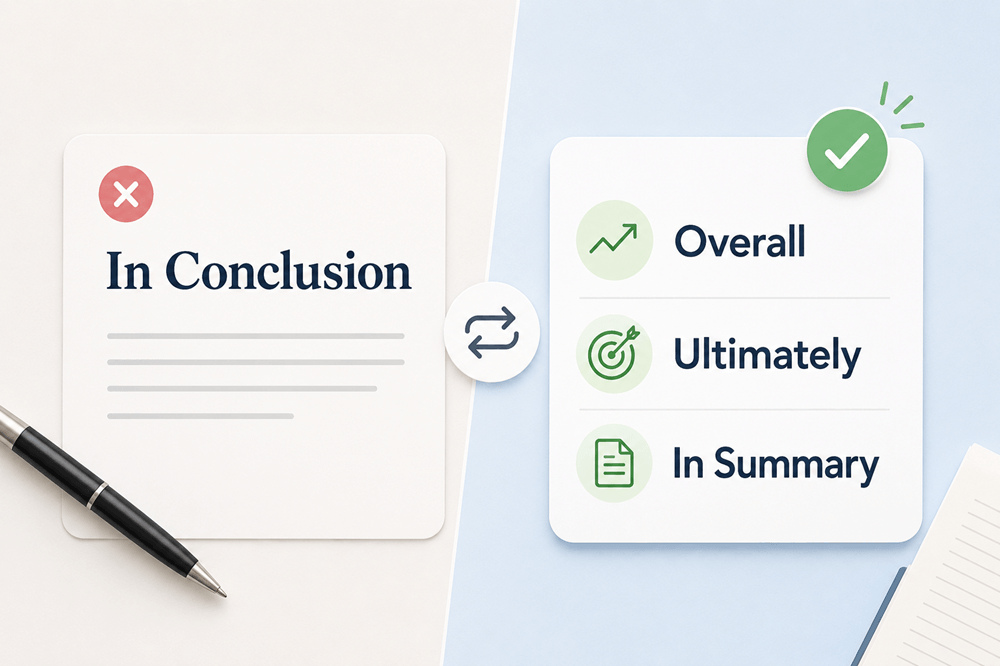
If you need another word for in conclusion, the best choice depends on your tone.
Use to conclude for formal essays.
Use in summary when you are briefly reviewing the main points.
Use to sum up for a simple and natural ending.
Use ultimately when you want to emphasize the final meaning or lesson.
Use overall when you want a smooth, general closing sentence.
Examples:
- In conclusion, the evidence supports the argument.
- To conclude, the evidence supports the argument.
- In summary, the plan has three main benefits.
- Ultimately, the decision depends on cost, timing, and long-term value.
- Overall, the results show clear improvement.
The phrase in conclusion is not wrong. It is common in essays, speeches, and formal writing. But it can sound predictable if you use it too often. A stronger alternative can make your ending feel smoother and more natural.
Quick Answer
Good alternatives for in conclusion include:
- to conclude
- in summary
- to sum up
- overall
- ultimately
- finally
- in closing
- all things considered
- taking everything into account
- as a final point
- to bring this to a close
- the main takeaway is
The best general replacement is to conclude.
For essays, use:
- to conclude
- in summary
- ultimately
For casual writing, use:
- to sum up
- overall
- the main takeaway is
Is “In Conclusion” Wrong?
No, in conclusion is correct.
It means you are ending your discussion, summarizing your main idea, or giving your final judgment.
Examples:
- In conclusion, exercise improves both physical and mental health.
- In conclusion, the novel shows how fear can change people’s choices.
- In conclusion, the company should invest in better customer service.
The problem is not grammar. The problem is style.
In school writing, many students use in conclusion because it is clear and easy. But because it is so common, it can sometimes sound basic or formulaic.
A more polished ending might begin with:
- Ultimately, regular exercise supports long-term health.
- Overall, the novel shows how fear shapes human behavior.
- Taking everything into account, the company should improve customer service.
These alternatives often sound more natural than repeating in conclusion.
To Conclude
To conclude is one of the best formal alternatives to in conclusion.
It is direct, clear, and appropriate for essays, reports, presentations, and academic writing.
Examples:
- To conclude, the study shows a strong connection between sleep and memory.
- To conclude, renewable energy offers both environmental and economic benefits.
- To conclude, the character’s final choice reveals his true values.
Use to conclude when you want a clean academic tone without sounding too casual.
In Summary
In summary is useful when you are briefly reviewing the main points.
It means “to summarize what has been said.”
Examples:
- In summary, the policy is expensive, difficult to enforce, and unpopular.
- In summary, the article explains three causes of childhood anxiety.
- In summary, the plan would save time and reduce waste.
Use in summary when your final paragraph restates the main ideas before closing.
It works well in:
- essays
- reports
- business writing
- presentations
- study notes
To Sum Up
To sum up is a simple and natural alternative.
It is less formal than in conclusion, but it is still clear.
Examples:
- To sum up, the trip was affordable, relaxing, and easy to plan.
- To sum up, the app is useful but still needs improvement.
- To sum up, better communication can prevent many misunderstandings.
Use to sum up in blog posts, casual essays, speeches, and friendly explanations.
For very formal academic writing, in summary or to conclude may sound better.
Ultimately
Ultimately is a strong alternative when you want to focus on the final meaning, result, or lesson.
Examples:
- Ultimately, the success of the project depends on teamwork.
- Ultimately, the story is about forgiveness.
- Ultimately, the best choice is the one that solves the real problem.
Ultimately does not simply announce the ending. It helps show the deeper conclusion.
It is especially useful when your final sentence gives a judgment, lesson, or final interpretation.
Overall
Overall is a smooth and flexible way to end a paragraph or article.
It means “when everything is considered.”
Examples:
- Overall, the product is reliable and easy to use.
- Overall, the essay makes a convincing argument.
- Overall, the benefits outweigh the risks.
Use overall when you want your ending to feel natural, simple, and balanced.
It works well in reviews, comparisons, opinion articles, and general explanations.
Finally
Finally can work when you are introducing the last point in a sequence.
Examples:
- Finally, schools should give students more time to read independently.
- Finally, the author reminds readers that courage often begins with small choices.
- Finally, the data suggests that the new method is more efficient.
Be careful: finally does not always mean the same thing as in conclusion.
It often means “last in order,” not necessarily “to conclude the whole discussion.”
Use it when you are making a final point, not when you are summarizing everything.
In Closing
In closing is often used in speeches, letters, presentations, and formal remarks.
Examples:
- In closing, I want to thank everyone who contributed to this project.
- In closing, let us remember why this issue matters.
- In closing, the speaker encouraged the audience to take action.
It sounds slightly more spoken or ceremonial than in conclusion.
Use in closing when ending a speech, public statement, email, or formal message.
All Things Considered
All things considered means that you have looked at the issue from several sides.
Examples:
- All things considered, the plan is worth trying.
- All things considered, the book gives a fair view of the problem.
- All things considered, moving to a new city may be the better choice.
This phrase is useful when your conclusion weighs both pros and cons.
It works well for opinion writing, reviews, comparisons, and decision-based topics.
Taking Everything Into Account
Taking everything into account is similar to all things considered, but it sounds a little more formal.
Examples:
- Taking everything into account, the proposal is practical and affordable.
- Taking everything into account, the school should update its policy.
- Taking everything into account, the evidence supports the final claim.
Use this phrase when your conclusion is based on several factors.
It is useful for essays, reports, and analysis.
The Main Takeaway Is
The main takeaway is is a modern and reader-friendly alternative.
It is especially good for blog posts, guides, business writing, and educational content.
Examples:
- The main takeaway is that small habits can create major change.
- The main takeaway is that clear writing depends on clear thinking.
- The main takeaway is that preparation matters more than perfection.
This phrase tells readers exactly what they should remember.
It is less formal than to conclude, but often more useful in online writing.
Formal Alternatives to In Conclusion
For formal essays or academic writing, use:
- to conclude
- in summary
- ultimately
- in closing
- taking everything into account
- all things considered
- as the evidence shows
- based on the evidence
- therefore
- thus
Examples:
- Based on the evidence, the argument is convincing.
- Thus, the results support the original hypothesis.
- Therefore, the policy should be reconsidered.
Words like therefore and thus are more logical than conversational. They work best when your conclusion follows directly from evidence or reasoning.
Casual Alternatives to In Conclusion
For blog posts, everyday writing, or friendly explanations, use:
- overall
- to sum up
- in the end
- the main takeaway is
- the bottom line is
- simply put
- when all is said and done
Examples:
- The bottom line is that sleep matters.
- Simply put, the rule is easy to remember.
- In the end, kindness often matters more than being right.
These alternatives sound more natural than in conclusion in casual writing.
What to Avoid
Avoid using conclusion phrases too mechanically.
Weak:
- In conclusion, this essay was about pollution.
Better:
- Ultimately, reducing pollution requires action from individuals, businesses, and governments.
Also avoid using too many closing phrases in one paragraph.
Too much:
- In conclusion, to sum up, overall, this issue is important.
Better:
- Overall, this issue deserves more attention.
Choose one transition and then make your final point clearly.
Example Endings
Basic:
- In conclusion, social media has both benefits and risks.
Better:
- Overall, social media can connect people, but it also requires thoughtful use.
Formal:
- To conclude, the evidence suggests that early reading habits improve long-term academic performance.
Analytical:
- Ultimately, the novel shows that identity is shaped by both personal choice and social pressure.
Casual:
- The main takeaway is simple: better habits start with small, repeatable actions.
Final Answer: Another Word for In Conclusion
Good alternatives to in conclusion include to conclude, in summary, to sum up, overall, ultimately, finally, in closing, and all things considered.
The best choice depends on tone:
To conclude = formal and clear
In summary = good for reviewing main points
To sum up = simple and natural
Ultimately = good for final meaning or lesson
Overall = smooth and flexible
The main takeaway is = modern and reader-friendly
For most essays, to conclude or ultimately will sound stronger than in conclusion. For blog posts and everyday writing, overall or the main takeaway is often feels more natural.