Another Word for Overall: Best Synonyms and Examples
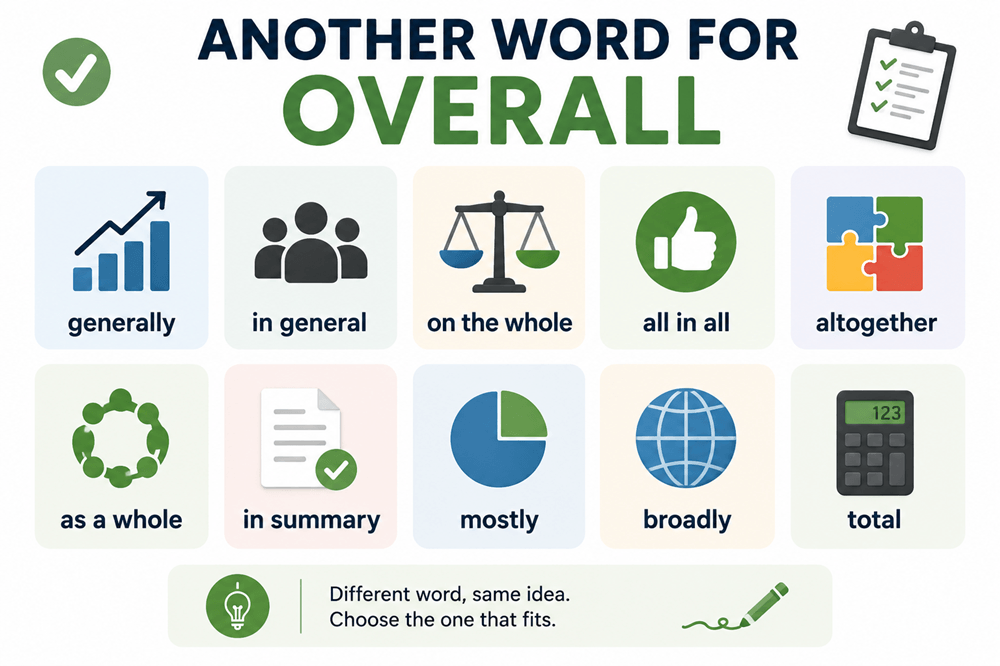
Another word for overall is generally. You can also use in general, on the whole, all in all, altogether, as a whole, in summary, mostly, or total, depending on the sentence.
Overall usually means “considering everything” or “in general.” It is often used when you are giving a broad opinion, summary, or final judgment.
Examples:
Overall, the movie was good.
In general, the movie was good.
Overall, the team did well.
On the whole, the team did well.
The best replacement depends on whether you mean generally, in total, or as a whole.
Best Synonyms for Overall
Here are some common synonyms for overall:
| Synonym | Best For |
|---|---|
| generally | A broad statement |
| in general | Everyday writing |
| on the whole | A balanced summary |
| all in all | Final opinion or conclusion |
| altogether | Total effect or complete amount |
| as a whole | Looking at everything together |
| in summary | Ending or summarizing |
| mostly | Something true most of the time |
| broadly | General view, not details |
| total | Complete amount or number |
Each word has a slightly different meaning, so choose the one that fits your sentence.
Generally
Generally is one of the most useful replacements for overall. It means something is true in most cases or when looking at the big picture.
Examples:
Overall, the students performed well.
Generally, the students performed well.
Overall, I liked the book.
Generally, I liked the book.
Use generally when you want to make a broad statement without focusing on every small detail.
In General
In general is a simple and natural synonym for overall. It works well in everyday writing and speech.
Examples:
Overall, the plan makes sense.
In general, the plan makes sense.
Overall, people enjoyed the event.
In general, people enjoyed the event.
Use in general when you mean “most of the time” or “when considering the situation broadly.”
On the Whole
On the whole means “considering everything.” It is useful when something has both good and bad parts, but your final opinion is mostly one way.
Examples:
Overall, the trip was enjoyable.
On the whole, the trip was enjoyable.
Overall, the report was clear.
On the whole, the report was clear.
Use on the whole when you want a balanced, thoughtful tone.
All in All
All in all is often used before a final opinion or conclusion. It sounds natural and conversational.
Examples:
Overall, it was a successful day.
All in all, it was a successful day.
Overall, the restaurant was worth visiting.
All in all, the restaurant was worth visiting.
Use all in all when you are wrapping up your thoughts.
Altogether
Altogether can mean “overall,” especially when describing the total effect of something.
Examples:
Overall, the experience was positive.
Altogether, the experience was positive.
The project cost $500 altogether.
In the second example, altogether means “in total.” That is slightly different from overall, so make sure the meaning fits.
As a Whole
As a whole means looking at all parts together, not separately.
Examples:
Overall, the company is growing.
The company as a whole is growing.
Overall, the class improved.
The class as a whole improved.
Use as a whole when you want to talk about a group, system, project, book, company, team, or situation in its complete form.
In Summary
In summary is a good replacement when overall introduces a final point or short conclusion.
Examples:
Overall, the results were encouraging.
In summary, the results were encouraging.
Overall, the article explains the topic clearly.
In summary, the article explains the topic clearly.
Use in summary in essays, reports, articles, and presentations when you are closing a section or ending an explanation.
Mostly
Mostly can sometimes replace overall, but it means “mainly” or “for the most part.”
Examples:
Overall, the feedback was positive.
The feedback was mostly positive.
Overall, the weather was nice.
The weather was mostly nice.
Use mostly when something is true in the majority of cases, but not completely.
Broadly
Broadly means generally or without focusing on small details.
Examples:
Overall, the two plans are similar.
Broadly, the two plans are similar.
Overall, the idea is correct.
Broadly, the idea is correct.
Use broadly when you are giving a general view instead of a detailed one.
Total
Total can replace overall when overall is used as an adjective meaning complete or combined.
Examples:
The overall cost was too high.
The total cost was too high.
The overall score was 85.
The total score was 85.
Use total when talking about numbers, cost, score, amount, size, or combined results.
Overall as an Adverb
Overall is often used as an adverb at the beginning of a sentence. In this position, it means “considering everything.”
Examples:
Overall, I enjoyed the class.
Overall, the design looks clean.
Overall, the results were better than expected.
Good replacements include:
- generally
- in general
- on the whole
- all in all
- in summary
Examples:
Generally, I enjoyed the class.
On the whole, the design looks clean.
All in all, the results were better than expected.
Overall as an Adjective
Overall can also be used as an adjective before a noun. In this case, it means total, complete, or general.
Examples:
The overall score improved.
The overall result was positive.
The overall goal is simple.
Good replacements include:
- total
- complete
- general
- combined
- final
Examples:
The total score improved.
The final result was positive.
The general goal is simple.
Formal Synonyms for Overall
For essays, reports, business writing, and professional emails, these are good formal alternatives:
- generally
- in general
- as a whole
- broadly
- in summary
- collectively
- in total
- taken together
Examples:
In general, the findings support the main argument.
The results, taken together, suggest improvement.
The organization as a whole performed well.
In summary, the proposal is practical.
These choices sound polished and clear in formal writing.
Casual Synonyms for Overall
For everyday speech, simple writing, and blog-style content, these alternatives sound natural:
- all in all
- mostly
- basically
- in general
- on the whole
- for the most part
Examples:
All in all, it was a good day.
The movie was mostly funny.
Basically, the plan worked.
For the most part, everyone agreed.
Use these when you want a relaxed and easy-to-read tone.
Common Mistakes
One common mistake is using total when you mean generally.
Awkward: Total, the movie was good.
Correct: Overall, the movie was good.
Correct: In general, the movie was good.
Use total for amounts, scores, numbers, and complete sums.
Another mistake is using mostly when the meaning is not about “most of the time” or “most of the parts.”
Awkward: The mostly cost was $200.
Correct: The overall cost was $200.
Correct: The total cost was $200.
Choose the synonym based on the exact meaning.
Final Answer
Another word for overall is generally.
Other good synonyms include in general, on the whole, all in all, altogether, as a whole, in summary, mostly, broadly, and total.
Use generally or in general for broad statements.
Use on the whole or all in all for final opinions.
Use as a whole when looking at everything together.
Use total when talking about complete amounts, scores, or costs.
The best synonym for overall depends on whether you mean generally, finally, completely, or in total.