Another Word for This: Best Alternatives and Examples
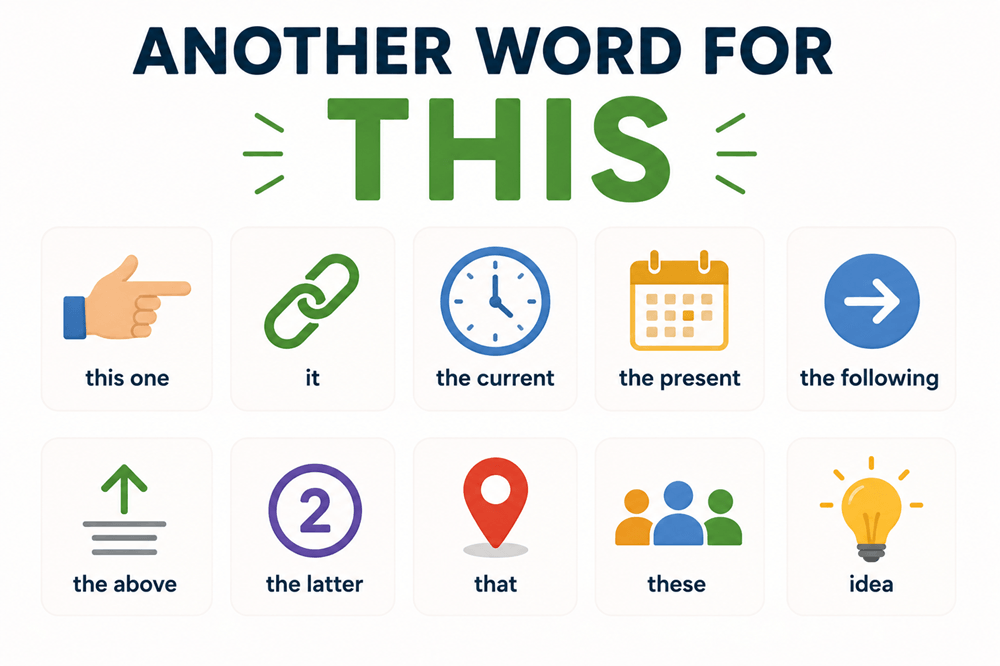
Another word for this is the current when you mean something happening now. You can also use the present, the following, this one, it, that, these, the above, the latter, or a specific noun, depending on the sentence.
This is a very common word, but it does not have one perfect synonym in every sentence. The best replacement depends on what this refers to.
Examples:
This problem is difficult.
The current problem is difficult.
I like this.
I like this one.
This shows that the rule works.
The example shows that the rule works.
The most important rule is simple: when this sounds unclear, replace it with the exact noun you mean.
Best Alternatives for This
Here are some useful words and phrases you can use instead of this:
| Alternative | Best For |
|---|---|
| this one | Choosing a specific thing |
| it | Referring to something already mentioned |
| the current | Something happening now |
| the present | Formal writing about now |
| the following | Introducing something next |
| the above | Referring to something already written |
| the latter | Referring to the second of two things |
| that | Referring to something farther away or already mentioned |
| these | Referring to more than one nearby thing |
| a specific noun | Making the sentence clearer |
The best choice depends on whether this points to a thing, idea, time, example, situation, or sentence.
This One
This one is a simple replacement when you are choosing or pointing to one specific thing.
Examples:
I want this.
I want this one.
Which shirt do you like? I like this one.
That phone is old, but this one is new.
Use this one when the object is clear from context. It works well in everyday speech and casual writing.
It
It can replace this when you are referring to one thing that was already mentioned.
Examples:
I bought a new laptop. This works well.
I bought a new laptop. It works well.
She gave me a book. This was very helpful.
She gave me a book. It was very helpful.
Use it when the noun is already clear and you do not need to point to it strongly.
The Current
The current is a good replacement for this when you mean something happening now.
Examples:
This situation is confusing.
The current situation is confusing.
This problem needs attention.
The current problem needs attention.
This plan may change later.
The current plan may change later.
Use the current in formal writing, business writing, reports, and explanations.
The Present
The present can also mean “this current time,” but it sounds more formal than the current.
Examples:
This moment is important.
The present moment is important.
This situation requires patience.
The present situation requires patience.
This period of history was difficult.
The present period of history is difficult.
Use the present when talking about time, periods, moments, conditions, or situations.
The Following
The following can replace this when introducing something that comes next.
Examples:
Remember this rule.
Remember the following rule.
Study this example.
Study the following example.
Please read this list.
Please read the following list.
Use the following in instructions, articles, reports, essays, and formal explanations.
The Above
The above refers to something already written or mentioned earlier.
Examples:
This shows why the rule matters.
The above shows why the rule matters.
This explains the problem.
The above explains the problem.
Based on this, we can make a decision.
Based on the above, we can make a decision.
Use the above in formal or written contexts. In casual speech, it may sound stiff.
The Latter
The latter refers to the second of two things already mentioned.
Example:
The article discusses spelling and pronunciation. This is often confusing.
The article discusses spelling and pronunciation. The latter is often confusing.
In this sentence, the latter means pronunciation because pronunciation is the second thing mentioned.
Use the latter carefully. It only works when you are choosing between two previously mentioned things.
That
That can sometimes replace this, but the meaning may change.
This usually points to something near, current, or just mentioned.
That often points to something farther away, earlier, or less immediate.
Examples:
I like this idea.
I like that idea.
This is my favorite.
That is my favorite.
Use that when the thing is farther away in distance, time, or conversation.
These
Use these instead of this when referring to more than one thing.
Examples:
Incorrect: This are useful tips.
Correct: These are useful tips.
Incorrect: I like this shoes.
Correct: I like these shoes.
This is singular.
These is plural.
Examples:
This book is helpful.
These books are helpful.
This idea is interesting.
These ideas are interesting.
Use a Specific Noun Instead of This
Sometimes the best replacement for this is not another small word. It is a specific noun.
This is especially important in essays, articles, and professional writing.
Vague:
This is important.
Clear:
This rule is important.
This problem is important.
This result is important.
This decision is important.
Vague:
This caused confusion.
Clear:
The unclear instruction caused confusion.
The sudden change caused confusion.
The missing detail caused confusion.
Using a specific noun makes writing clearer and stronger.
Formal Alternatives for This
For essays, reports, business writing, and professional documents, these alternatives can work well:
- the current
- the present
- the following
- the above
- the latter
- the former
- the issue
- the example
- the situation
- the result
Examples:
This shows a clear pattern.
The result shows a clear pattern.
This is a major concern.
The issue is a major concern.
This explains the increase.
The data explains the increase.
Formal writing often becomes clearer when you replace vague this with a precise noun.
Casual Alternatives for This
For everyday speech, messages, and simple writing, these alternatives sound natural:
- this one
- it
- that
- the thing
- this idea
- this part
- this place
- this situation
Examples:
I like this one.
Can you fix it?
That sounds better than this.
This part is confusing.
The best casual replacement depends on what you are pointing to.
Common Mistakes
One common mistake is using this without making the meaning clear.
Vague:
The price increased, the delivery was delayed, and the product arrived damaged. This upset customers.
Clear:
The damaged product and delayed delivery upset customers.
Clear:
These problems upset customers.
Another common mistake is using this with a plural noun.
Incorrect: This examples are helpful.
Correct: These examples are helpful.
Correct: This example is helpful.
Remember:
This = one thing
These = more than one thing
Final Answer
Another word for this depends on the sentence.
Use this one when choosing a specific thing.
Use it when referring to something already mentioned.
Use the current when talking about something happening now.
Use the following when introducing something next.
Use the above when referring to something already written.
Use that when pointing to something farther away or previously mentioned.
Use these when talking about more than one thing.
In formal writing, the best replacement is often a specific noun, such as this idea, this issue, this result, this example, or this situation. This makes the sentence clearer and easier to understand.