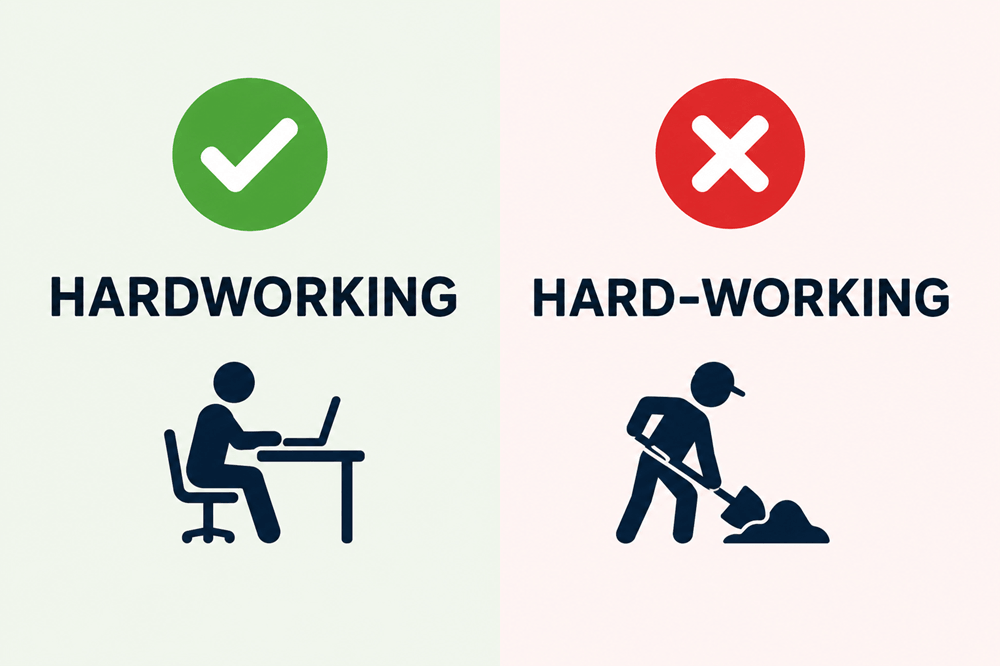
Is Hardworking One Word? Hardworking vs. Hard-Working Explained
Hardworking can be written as one word. It is an adjective describing someone who regularly puts substantial time, energy, and care into their work.
Examples:
- She is a hardworking student.
- He comes from a hardworking family.
- The company values hardworking employees.
The hyphenated spelling hard-working is also correct and remains common, particularly in British English and publications that follow a hyphenated style. Merriam-Webster lists hardworking, while Cambridge and Collins include hard-working as an accepted form.
Quick Answer
Use either:
- hardworking
- hard-working
Both mean diligent, industrious, and willing to put considerable effort into a task.
For most American writing, hardworking as one word is a safe choice:
- a hardworking employee
- a hardworking mother
- a hardworking team
The unhyphenated two-word form hard working is usually less suitable when directly describing a person.
A simple memory rule is:
A hardworking person keeps working, and the word stays together.
What Does Hardworking Mean?
Hardworking describes someone who approaches work seriously and consistently.
A hardworking person may be:
- diligent
- reliable
- productive
- persistent
- conscientious
- willing to make an effort
Examples:
- Mia is a hardworking and dependable employee.
- His hardworking parents encouraged him to value education.
- The coach praised the team’s hardworking players.
- She built the business with a small but hardworking staff.
The word does not necessarily mean that someone performs physical labor. A student, artist, parent, athlete, office worker, or business owner can all be described as hardworking.
Is Hardworking One Word or Two?
Hardworking is accepted as one word, especially in American English.
Correct:
- She is hardworking.
- He is a hardworking teacher.
- They hired several hardworking employees.
The spelling appears as a standard adjective in Merriam-Webster and Cambridge’s American dictionary materials.
However, hard-working with a hyphen is also accepted:
- She is hard-working.
- He is a hard-working teacher.
- They hired several hard-working employees.
The choice often depends on regional preference or house style rather than meaning.
Hardworking vs. Hard-Working
The two spellings have the same meaning.
| Spelling | Status | Common Use |
|---|---|---|
| Hardworking | Correct | Especially common in American English |
| Hard-working | Correct | Common in British English and some edited styles |
| Hard working | Usually less suitable as the adjective | May create ambiguity |
Compare:
- She is a hardworking nurse.
- She is a hard-working nurse.
Both sentences describe a nurse who works diligently.
Collins recognizes both hard-working and hardworking, while Cambridge dictionary entries commonly display the hyphenated form in British-oriented materials.
Is Hard Working Without a Hyphen Correct?
The open form hard working can occasionally occur when hard and working perform separate jobs in a sentence. However, it is normally better to use hardworking or hard-working when describing a diligent person.
Less clear:
- She is a hard working student.
Better:
- She is a hardworking student.
- She is a hard-working student.
Without a hyphen, the phrase may briefly appear as though hard describes the type of working rather than combining with working to form one adjective.
You can also rewrite the sentence:
- She is a student who works hard.
Notice that works hard remains two words because it is a verb followed by an adverb.
Hardworking or Works Hard?
These forms are related, but they follow different grammatical structures.
Hardworking
Hardworking is an adjective.
- She is hardworking.
- He is a hardworking mechanic.
- They are hardworking people.
Works hard
In works hard, works is a verb and hard is an adverb describing how the person works.
- She works hard.
- He works hard every day.
- They work hard to meet deadlines.
Do not combine the words in this structure.
Incorrect:
- She workshard.
- He works-hard.
Correct:
- She works hard.
- He works hard.
Hardworking Before a Noun
Use hardworking directly before a noun to describe a person or group.
Examples:
- a hardworking student
- a hardworking employee
- a hardworking family
- a hardworking mother
- a hardworking team
- a hardworking community
Examples in sentences:
- The award recognized a hardworking student.
- Every hardworking employee deserves fair treatment.
- She was raised in a hardworking family.
- The restaurant has a small but hardworking team.
The one-word form makes it immediately clear that the two elements form one descriptive idea.
Hardworking After a Verb
The adjective may also appear after linking verbs such as be, seem, remain, or become.
Examples:
- She is hardworking.
- The new assistant seems hardworking.
- He remained hardworking throughout his career.
- The students became more hardworking as the exam approached.
The spelling does not need to change because of its position in the sentence.
Hardworking in a Sentence
Examples:
- Ava is one of the most hardworking people I know.
- The manager wants to hire someone honest and hardworking.
- His hardworking attitude helped him progress.
- The farm depends on a group of hardworking employees.
- She is talented, patient, and hardworking.
- Their hardworking volunteers organized the entire event.
- A hardworking student still needs adequate rest.
- He earned a reputation as a hardworking and reliable colleague.
Is Hardworking a Compound Word?
Yes. Hardworking can be considered a compound adjective formed from:
hard + working
The two parts combine to express one quality: working with substantial effort and persistence.
Other similar compounds include:
- easygoing
- good-looking
- long-lasting
- well-known
- time-consuming
Compound adjectives do not all follow the same spelling pattern. Some are closed, some are hyphenated, and others remain open.
That is why checking a dictionary can be helpful when you are uncertain.
Is Hardworking Hyphenated Before a Noun?
It can be, but it does not have to be when you use the accepted one-word spelling.
Correct:
- a hardworking employee
- a hard-working employee
Both are accepted.
Do not write:
- a hardworking-employee
The hyphen, when used, belongs between hard and working, not between the adjective and the noun.
Choose one spelling and use it consistently throughout the document.
American and British Usage
In American English, hardworking as one word is common and widely accepted.
In British English, hard-working remains a familiar spelling. Cambridge prominently lists the hyphenated form, while American dictionary entries commonly include the closed form.
This does not create a strict regional rule. Writers in either region may encounter both forms.
The safest approach is to:
- follow your publication’s style guide
- use the form preferred by your audience
- remain consistent within the same document
Is Hardworking Positive?
Hardworking is usually a positive description.
It suggests that a person:
- makes a serious effort
- remains committed
- completes responsibilities
- does not give up easily
- takes pride in their work
Example:
- She is a hardworking and valued member of the team.
However, being hardworking does not automatically mean someone is effective. A person may put in considerable effort while still needing better organization, training, or direction.
The word praises effort and diligence rather than guaranteeing a particular result.
Synonyms for Hardworking
Alternatives include:
- diligent
- industrious
- dedicated
- conscientious
- committed
- productive
- tireless
- persistent
- energetic
- reliable
Merriam-Webster lists related terms such as diligent, industrious, and energetic.
Examples:
- She is a diligent student.
- He is an industrious employee.
- They have a dedicated team.
- Maria is a conscientious worker.
Choose the word that best matches the quality you want to emphasize.
Hardworking vs. Diligent
Hardworking emphasizes the amount of effort someone makes.
Diligent emphasizes careful and persistent attention.
Compare:
- He is hardworking, often staying late to finish tasks.
- He is diligent, carefully checking every detail.
A person can be both hardworking and diligent.
Hardworking vs. Workaholic
These words do not mean the same thing.
Hardworking is usually positive. It describes someone who puts strong effort into work.
Workaholic describes someone who works excessively or feels unable to stop working. It may suggest an unhealthy lack of balance.
Examples:
- She is hardworking but still makes time for her family.
- He worries that he has become a workaholic.
Do not use workaholic as a direct synonym when you simply mean diligent.
Common Misspellings
Common incorrect or less suitable forms include:
- hardworkin
- hardwork ing
- hardworkking
- hardwork-ing
- hard working, when used as a single adjective
Accepted forms are:
- hardworking
- hard-working
For straightforward American writing, use hardworking.
Common Mistakes
Separating the adjective unnecessarily
Less clear:
- She is a hard working employee.
Better:
- She is a hardworking employee.
- She is a hard-working employee.
Combining the verb phrase
Incorrect:
- She workshard every day.
Correct:
- She works hard every day.
Switching spellings in one document
Inconsistent:
- We need hardworking employees. Our hard-working staff will receive additional training.
Consistent:
- We need hardworking employees. Our hardworking staff will receive additional training.
How to Remember the Spelling
Connect the form to its grammar.
When describing a person, join the idea:
- a hardworking person
When describing an action, separate the words:
- the person works hard
Use this memory sentence:
A hardworking person works hard.
The first form is an adjective. The second is a verb phrase.
You can also remember:
Hard work is two words, but a hardworking person can be one word.
Is Hard Work One Word?
No. Hard work is written as two words when it is a noun phrase.
Examples:
- Success often requires hard work.
- Thank you for your hard work.
- Her hard work produced excellent results.
Compare:
- Her hard work was recognized.
- She is a hardworking employee.
Hard work names the effort. Hardworking describes the person.
Final Answer
Hardworking is correctly written as one word, especially in American English.
Examples:
- a hardworking student
- a hardworking employee
- She is extremely hardworking.
The hyphenated spelling hard-working is also correct and remains common in British English and some publication styles.
Avoid the unhyphenated form hard working when the words act together as one adjective.
Remember:
A hardworking person works hard.