Is Throughout One Word? Meaning, Spelling, and Examples
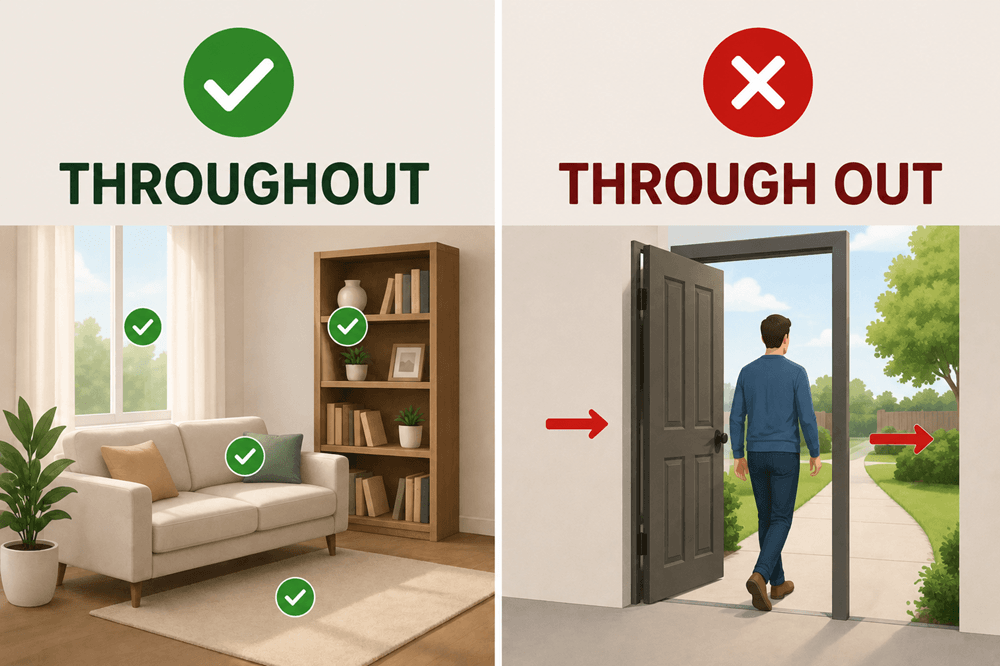
Throughout is normally written as one word.
It means:
- in every part of a place
- during the whole period of time
- from beginning to end
Examples:
- Flowers grew throughout the garden.
- It rained throughout the night.
- She remained calm throughout the meeting.
The spelling through out is usually incorrect when you mean “in every part” or “during the whole time.”
Quick Answer
Use throughout as one word in standard English.
Correct:
- The lights were on throughout the building.
- He worked throughout the summer.
- The theme appears throughout the book.
Incorrect:
- The lights were on through out the building.
- He worked through out the summer.
A simple memory rule is:
If it means everywhere or the whole time, write throughout as one word.
What Does Throughout Mean?
Throughout can refer to place or time.
When it refers to place, it means in every part of something.
Examples:
- There were signs throughout the city.
- Music played throughout the house.
- The company has offices throughout the country.
When it refers to time, it means during the entire period.
Examples:
- She studied throughout the evening.
- Snow fell throughout the day.
- He stayed focused throughout the lesson.
In both uses, throughout suggests that something continues across a complete space or period.
Is Throughout One Word or Two?
Throughout is one word.
It should not normally be written as:
- through out
- through-out
Correct:
- The message remained consistent throughout the article.
- The children laughed throughout the movie.
- Paintings were displayed throughout the museum.
The one-word spelling is the standard form in modern English.
Why Is Throughout One Word?
Throughout developed from the words through and out, but they now function together as one established word.
The meaning is broader than simply moving through something and then going out.
For example:
- We walked through the tunnel and came out on the other side.
- Lights were placed throughout the tunnel.
In the first sentence, through and out are separate because they describe two actions.
In the second sentence, throughout means in every part of the tunnel.
That difference explains why the words are sometimes separate and sometimes combined.
Throughout as a Preposition
Throughout often works as a preposition.
A preposition connects a noun or pronoun to the rest of the sentence.
Examples:
- Trees grew throughout the valley.
- She traveled throughout Europe.
- The alarm sounded throughout the building.
- He took notes throughout the lecture.
The noun or noun phrase after throughout shows the place or period being covered.
Throughout as an Adverb
Throughout can also work as an adverb, especially when the object is understood.
Examples:
- The house was beautifully decorated throughout.
- The book was entertaining throughout.
- The performance remained strong throughout.
Here, throughout means in every part or from beginning to end.
Throughout in a Sentence
Here are common examples:
- The same color appears throughout the room.
- She remained supportive throughout the process.
- The road was crowded throughout the afternoon.
- He lived in several countries throughout his career.
- The audience stayed quiet throughout the speech.
- Small details are repeated throughout the novel.
- The temperature stayed low throughout the week.
- There are walking trails throughout the park.
These examples show how the word can describe both place and time.
Throughout for Place
Use throughout when something exists or happens in every part of an area.
Examples:
- Cameras were installed throughout the building.
- Wildflowers grew throughout the field.
- The smell of bread spread throughout the kitchen.
- The festival attracted visitors from throughout the region.
You can often replace throughout with:
- all over
- across
- in every part of
Example:
- Posters were placed throughout the school.
- Posters were placed all over the school.
Both sentences have a similar meaning.
Throughout for Time
Use throughout when something continues during an entire period.
Examples:
- It snowed throughout the night.
- She worked throughout the weekend.
- He stayed alert throughout the journey.
- The weather remained warm throughout the month.
You can often replace throughout with:
- during the whole of
- all through
- from beginning to end
Example:
- He remained calm throughout the interview.
- He remained calm during the whole interview.
Throughout vs. Through
Throughout and through are related, but they are not always interchangeable.
Through
Through often describes movement from one side to another.
Examples:
- We walked through the forest.
- Light came through the window.
- She drove through the tunnel.
Throughout
Throughout describes something present in every part or continuing for the whole time.
Examples:
- Birds could be heard throughout the forest.
- Windows were placed throughout the building.
- She stayed awake throughout the night.
Compare:
- He walked through the building.
He moved from one part to another. - He checked the alarms throughout the building.
He checked alarms in many or all parts of it.
Throughout vs. All Through
Throughout and all through can have similar meanings.
Examples:
- It rained throughout the night.
- It rained all through the night.
Both are correct.
However, throughout is more compact and often sounds more formal.
Use all through when you want a more conversational tone.
Throughout vs. During
Throughout and during both refer to time, but they do not always mean the same thing.
Throughout suggests that something happened continuously or repeatedly during the whole period.
- She remained quiet throughout the meeting.
This suggests she was quiet from beginning to end.
During means that something happened at some point within the period.
- She spoke once during the meeting.
This does not mean she spoke for the entire meeting.
Compare:
- It rained during the day.
Rain occurred at some point. - It rained throughout the day.
Rain continued for most or all of the day.
Throughout vs. Everywhere
Throughout and everywhere can both refer to place.
Examples:
- Flowers were growing throughout the park.
- Flowers were growing everywhere in the park.
The meanings are similar.
However, throughout is usually followed by a place:
- throughout the park
- throughout the city
- throughout the country
Everywhere can stand alone:
- Flowers were growing everywhere.
Is It “Throughout the Day” or “Through Out the Day”?
The correct phrase is:
throughout the day
Examples:
- Drink water throughout the day.
- The weather changed throughout the day.
- She received several calls throughout the day.
Do not write:
- through out the day
The one-word form is standard.
Is It “Throughout the Year” or “Through Out the Year”?
The correct phrase is:
throughout the year
Examples:
- The museum is open throughout the year.
- Prices change throughout the year.
- The plants need care throughout the year.
Again, throughout is one word.
Is It “Throughout the World” or “Through Out the World”?
The correct phrase is:
throughout the world
Examples:
- The song became popular throughout the world.
- The organization has members throughout the world.
- Similar traditions exist throughout the world.
You may also say:
- around the world
- across the world
- worldwide
Can Through Out Ever Be Correct?
Yes, but only when through and out belong to different parts of the sentence.
Example:
- We walked through the house and out the back door.
Here, through describes movement inside the house, while out describes leaving it.
Another example:
- The path continued through the woods and out into the field.
These are not examples of the word throughout. They are separate words performing separate roles.
Common Mistakes
Writing through out for throughout
Incorrect:
- The rule applies through out the company.
Correct:
- The rule applies throughout the company.
Using throughout when only one moment is meant
Less accurate:
- He coughed throughout the meeting.
This means he coughed repeatedly or continuously for the whole meeting.
If he coughed only once, write:
- He coughed during the meeting.
Confusing through with throughout
- She walked through the hallway.
- Lights were placed throughout the hallway.
The first describes movement. The second describes location in every part.
How to Remember the Spelling
Think of throughout as one complete idea:
through the whole of something
Because the meaning is complete, the spelling is also joined.
You can also remember:
- throughout the day
- throughout the room
- throughout the book
If it means all through or in every part, use one word.
A simple memory sentence is:
Throughout stays together because it covers the whole thing.
Final Answer
Throughout is one word.
Use it when you mean:
- in every part of a place
- during an entire period
- from beginning to end
Examples:
- Music played throughout the house.
- It rained throughout the night.
- The idea appears throughout the book.
Write through out only when through and out are separate parts of the sentence.
Remember:
If it means everywhere or the whole time, write throughout as one word.