Is Into One Word? Into vs. In To Explained
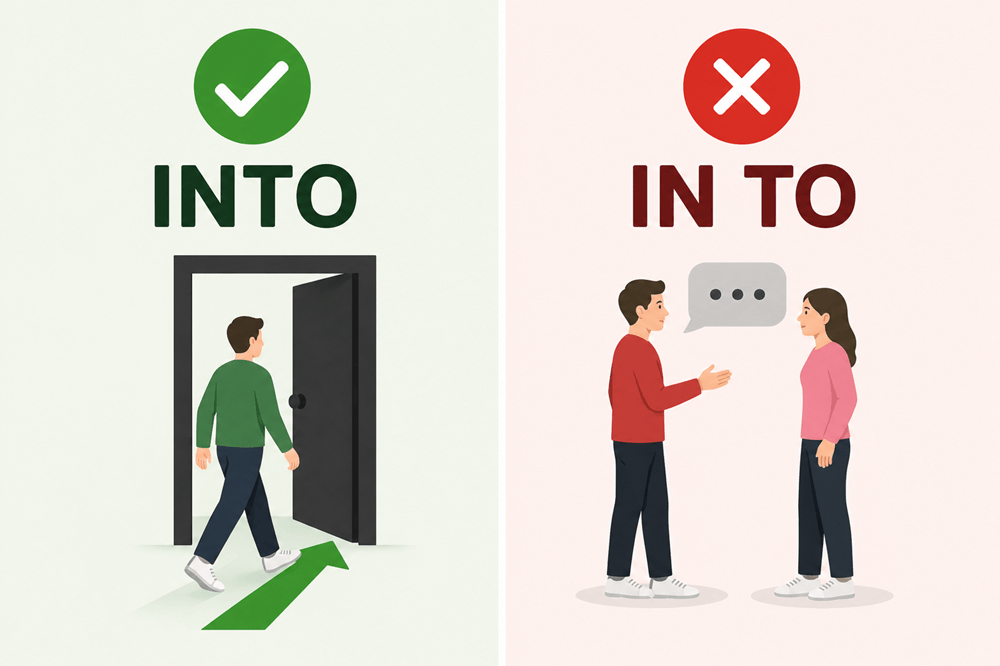
Into is one word when it shows movement toward the inside of something, a change in condition, or strong interest in something.
In to is two words when in belongs to one part of the sentence and to belongs to another.
Examples:
- She walked into the room.
- He turned the form in to his teacher.
- I’m really into photography.
- She came in to speak with the manager.
The difference depends on grammar and meaning, not just pronunciation.
Quick Answer
Use into as one word when it means:
- moving inside
- entering
- changing from one state to another
- becoming involved or interested
Examples:
- The dog ran into the house.
- Water turned into ice.
- She is into jazz.
Use in to as two words when:
- in is part of a phrasal verb
- to begins an infinitive
- the two words happen to appear next to each other
Examples:
- Please turn the paper in to your teacher.
- He came in to ask a question.
- She logged in to check her account.
A useful test is:
If the phrase means “inside” or “toward the inside,” use into.
What Does Into Mean?
Into is usually a preposition. It connects a noun or pronoun to another part of the sentence.
It often shows movement from the outside to the inside.
Examples:
- She stepped into the elevator.
- The cat jumped into the box.
- He poured the milk into a glass.
- They moved into a new apartment.
In each example, something crosses a boundary or enters a space.
Into for Change or Transformation
Into can also show that one thing changes and becomes another.
Examples:
- The caterpillar turned into a butterfly.
- The rain changed into snow.
- She translated the letter into English.
- The old factory was converted into apartments.
Here, into does not describe physical movement. It describes transformation.
A useful pattern is:
change + into + new form
Into for Interest
In informal English, into can mean interested in or enthusiastic about something.
Examples:
- He is really into basketball.
- I’m not into horror movies.
- She has always been into fashion.
- They are into hiking and camping.
In these sentences, into means interested in, involved in, or attracted to.
What Does In To Mean?
In to is not a single expression with one fixed meaning.
It appears when in and to belong to different grammatical parts of the sentence.
For example:
- He came in to talk.
Here:
- in is connected to came
- to talk explains why he came in
The sentence could be understood as:
- He came in.
- He came to talk.
Because the two words serve different roles, they remain separate.
Into vs. In To
The main difference is whether the words function together.
| Form | Use | Example |
|---|---|---|
| Into | One preposition | She walked into the kitchen. |
| In to | Two separate words | She came in to get her keys. |
Compare:
- He ran into the office.
- He ran in to speak to his boss.
The first sentence means he entered the office while running.
The second sentence means he ran in, and his purpose was to speak to his boss.
Movement: Into Is Usually Correct
Use into when something moves from outside to inside.
Examples:
- Put the books into the bag.
- The children rushed into the classroom.
- She looked into the mirror.
- The car drove into the garage.
A simple replacement test is to see whether inside makes sense.
- She walked inside the room.
This is not always the most natural sentence, but it confirms the basic idea of entering.
In To After a Phrasal Verb
Some verbs include the word in as part of their meaning.
Examples include:
- hand in
- turn in
- log in
- check in
- give in
When to follows one of these expressions, the words may appear together but remain separate.
Hand in to
- Please hand the assignment in to your teacher.
The phrasal verb is hand in. The word to introduces the teacher.
Turn in to
- He turned the keys in to the receptionist.
The expression means he submitted or returned the keys.
This differs from:
- The frog turned into a prince.
Here, turned into means transformed.
Turn Into vs. Turn In To
This pair is one of the easiest ways to see the difference.
Turn into
Use turn into when something changes form.
- Water turns into ice.
- The empty lot turned into a park.
- The conversation turned into an argument.
Turn in to
Use turn in to when turn in means submit or surrender.
- Please turn your homework in to the teacher.
- She turned the wallet in to the police.
- He turned himself in to the authorities.
The meaning determines the spelling.
Log Into or Log In To?
Both forms can appear, depending on the sentence.
Many people write:
- Log into your account.
This is common and widely understood.
However, some style guides prefer:
- Log in to your account.
That is because log in is the phrasal verb, and to introduces the account or system.
Compare:
- I need to log in.
- I need to log in to the website.
In everyday writing, log into is very common. In careful technical writing, log in to may be preferred when emphasizing the phrasal verb.
As a noun or adjective, use login as one word:
- Enter your login details.
- The login page is not loading.
Sign Into or Sign In To?
The same distinction applies to sign in.
Examples:
- Please sign in at the front desk.
- You must sign in to access the portal.
The form sign into is also common, especially in casual or technical writing:
- Sign into your account.
Both may be accepted, but sign in to clearly preserves the phrasal verb sign in.
Come Into vs. Come In To
Use come into when someone or something enters a space.
- She came into the room.
- A bird flew into the house.
- Please come into my office.
Use come in to when in completes the verb and to introduces a purpose.
- She came in to ask a question.
- He came in to work early.
- They came in to discuss the plan.
A quick test is to pause after in:
- She came in / to ask a question.
If the sentence still makes sense with that pause, in to is often correct.
Get Into vs. Get In To
Use get into for entering or becoming involved.
Examples:
- Get into the car.
- She got into college.
- He got into trouble.
- They got into an argument.
Use get in to when get in and to belong to separate parts of the sentence.
Example:
- We got in to see the doctor before noon.
Here, got in means succeeded in entering or being admitted, while to see explains the purpose.
Is It “Into It” or “In To It”?
The usual phrase is:
into it
Examples:
- She is really into it.
- I couldn’t get into it.
- He became deeply into it after the first lesson.
Here, into expresses interest, involvement, or movement toward something.
The form in to it would only appear in an unusual sentence where in and to it belong to different structures.
Common Mistakes
Writing in to for movement
Incorrect:
- She walked in to the store.
Correct:
- She walked into the store.
The sentence describes movement inside, so use one word.
Writing into after a phrasal verb
Less precise:
- Turn the assignment into your teacher.
Better:
- Turn the assignment in to your teacher.
The meaning is submit, not transform.
Confusing transformation with submission
- The paper turned into a book.
It changed form. - She turned the paper in to her teacher.
She submitted it.
How to Decide Between Into and In To
Use these three tests.
1. The movement test
Does the phrase mean entering or going inside?
Use into.
- He went into the building.
2. The transformation test
Does one thing become another?
Use into.
- The milk turned into cheese.
3. The pause test
Can you pause naturally after in?
Use in to.
- She came in / to explain.
- He handed the form in / to the clerk.
The pause shows that the words belong to different parts of the sentence.
How to Remember Into or In To
Think:
Into works together. In to works separately.
Use into when the two ideas combine:
- movement into a place
- change into a new form
- interest in something
Use in to when you can separate the sentence:
- come in / to talk
- hand it in / to the teacher
- log in / to the account
A simple memory rule is:
If “in” completes the verb, keep “to” separate.
Final Answer
Into is one word when it shows movement inside, transformation, or interest.
Examples:
- She walked into the room.
- The water turned into ice.
- He is into photography.
In to is two words when in and to serve different grammatical roles.
Examples:
- She came in to ask a question.
- Turn the paper in to your teacher.
- Log in to view your account.
Remember:
Use into for entering or changing. Use in to when the words belong to separate parts of the sentence.